
You too could become a perpetrator
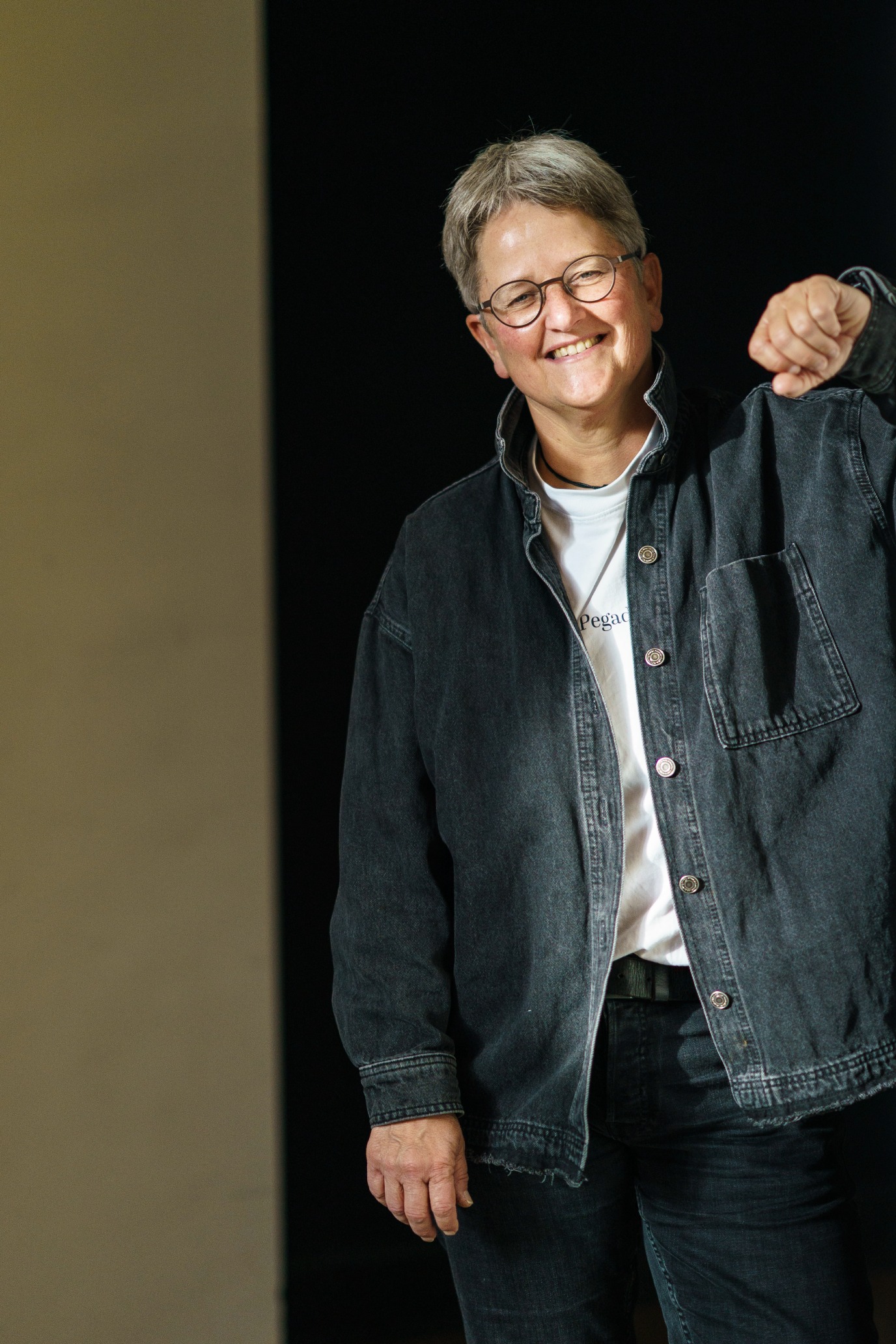
Alette Smeulers’ meticulous research into war criminals and genocidaires has brought her firmly into the spotlight. Her book Angstaanjagend normaal (which translates as ‘Terrifyingly Normal’) features a typology of these offenders. She wrote the book explicitly as a warning to all of us. The thing that worries her most is the commonly held idea that you could not be a perpetrator yourself.
Text: Jurgen Tiekstra / Photos: Reyer Boxem
It is a small act of revenge for Alette Smeulers, Professor in International Crimes: her new book about war criminals and terrorists is entitled Angstaanjagend normaal. This refers to a piece by the German philosopher Hannah Arendt about the Nazi officer Adolf Eichmann, who was sentenced to death in Jerusalem in 1961 for his role in coordinating the transport of Jewish people to extermination camps. In the epilogue of her English book Eichmann in Jerusalem, Arendt described the German criminal as ‘terribly and terrifyingly normal’.
Smeulers used this quote as the title of a podcast series she made about her research, and wanted it as the title of the first draft of her book in 2024. But her academic published Routledge blocked her idea. ‘They would only let me use it as a subtitle, which was incredibly frustrating,’ says Smeulers. Now that a public version of her book is being released, she can reclaim her original title.
The title is a perfect description of how Alette Smeulers sees war criminals and genocidaires after 30 years of research: ordinary people, disturbingly similar to us.
Encyclopaedia of atrocities
In essence, her book gives a detailed typology of various types of perpetrators: the destructive leader, the fanatic, the careerist, the dedicated citizen, the avenger, the opportunist, the criminal, the sadist, the professional. She finds examples of these types in the encyclopaedia of atrocities that have taken place in the 20th century: from the Dirty War in Argentina to the Greek junta, from Nazi Germany to the Vietnam War, and from Saddam Hussein to Pol Pot.
Her basic message is that people have psychological weaknesses, which can result in them becoming perpetrators.
‘I think the difference between Arendt and me is that she says some people lack empathy, whereas my research shows that people can learn to switch off their compassion and ability to reflect on their actions. People can develop tunnel vision and say: I’m closing my mind to empathy. This can be directed at a specific group, which they first demonize, and then dehumanize. This explains why someone is able to be a loving father in the mornings and evenings after work, and shut down all their empathy in the hours in between.’
‘Compare it with a surgeon who has deal with a seriously injured child. The doctor can’t burst into tears because they feel so sorry for the child and parents, even if they know that the child will suffer the consequences of the accident for the rest of their life. No, this surgeon switches to professional mode and concentrates on what needs to be done. This may sound harsh, but it’s very similar to the way perpetrators act: “I need to get this done for the greater good.”’
Perpetrators get caught up in it
Stripped back to the bare bones, Smeulers’ idea is this: never think that only ‘others’ can become perpetrators. ‘I was fairly frustrated by the popularity of Rutger Bregman’s book Humankind: A Hopeful History’, she says. ‘The original Dutch title (De meeste mensen deugen) suggests that most people (automatically: you and me) are good. We are good. To me, this is the most dangerous assumption of all: I can’t become a perpetrator, I would never do something like that. My research has shown that perpetrators don’t set out to carry out atrocities, they get caught up in events, swept along, talked into things. And then all of a sudden: they do it, or they’re somehow involved.’
Strangely enough, both in the public version of her book and in other publications, Smeulers warns us about the current political dynamics in the United States. Is this major leap from her book full of crimes to current affairs in the United States not somewhat awkward?
‘No, I think that's the whole point,’ she says. ‘My aim is to understand why people do certain things. I focus on the psychosocial mechanisms and dynamics behind the crimes. Seen from this perspective, my book is warning about what is currently unfolding in the US. You can’t simply compare Trump with Hitler, because this immediately conjures up images of Hitler’s crimes. But if you compare Trump with a younger Hitler, for example, or with the start of his regime, you see an alarming number of parallels. So my conclusion is: anyone can be a perpetrator. Not because there is evil in you or me, but because in certain situations, we can transform into a perpetrator.’
In academic literature, this is known as the “continuum of destructiveness”: the way in which, step by step, we gradually come to accept and get used to a new, more cruel reality. The first step may be the most important, because when you take this step, you overcome a psychological barrier.
Bottom-up genocide
‘The thing that shocks me about the United States, is the way that certain groups are demonized and dehumanized. It was the Jews in Nazi Germany, here it’s migrants. They are perpetually called criminals, or even animals. Under the normal rule of law, we have checks and balances: we can’t just be arrested and thrown into jail. If this happens, we can apply to the courts. This is a basic right, which is being withdrawn from certain groups in the US, in the same way as it was in Nazi Germany. Suspected illegal migrants are being apprehended there, taken across the border, and detained in detention centres without the possibility of a trial.’
‘The dynamics within a group are also important. In Nazi Germany, Hitler was the charismatic leader. You also had the fanatic Joseph Goebbels and careerists like Hermann Göring. Then you had a whole crowd of people who, as the historian Ian Kershaw so accurately put it, “are working towards the Führer.” As everyone in Nazi Germany was keenly aware: if you want a successful career, you have to go along with it. This meant that Hitler himself no longer had to order certain things to be done, because people were doing them on their own initiative. At one point, historians were even asking themselves the question: was the genocide top-down, or in fact bottom-up?’
‘On to the comparison with the US,’ Smeulers continues: ‘The Republican party has already been cleansed. Any form of criticism aimed at the president, even if it’s supported by sound arguments, earns you the wrath of Trump and you find yourself cancelled. Dissent is no longer endured. All the handbrakes on that moving train have been removed.’
“Divide and conquer” within Europe
So what does she think of Mark Rutte’s role as Secretary-General of NATO in his dealings with Trump? ‘I find Rutte’s actions painful and embarrassing. He says exactly what Trump wants to hear and feeds his narcissism. This may be (or seem) successful in the short term, but Rutte is in danger of accepting Trump’s world vision. And this vision states that law and justice are unimportant. This is disastrous in the long term. He’s basically agreeing with a man who wants to create a world that is totally detached from the European foundations, with their normalizing framework of human rights, cooperation, and international legal order. In other words, Rutte is playing a part in the collapse of the world order.’
‘You’re already witnessing “divide and conquer” within Europe, and seeing various personal motives starting to surface. Some leaders, like the Hungarian Prime Minister Orbán, support Trump for ideological reasons. Others support Trump out of opportunism, like Mark Rutte. And others will support him because they are scared, scared of his import tariffs and other types of blackmail he deploys. I see this as one huge, dangerous trend.’
‘European leaders should have stood up for the international rule of law right from the start, and denounced every single violation. They didn’t and they still don’t, which is why our problems are mounting. If we do it now, we’ll have a high price to pay as we risk the wrath of the most powerful man in the world. But if we don’t stand up to him, the price will be even higher, as it will ultimately mean an end to the international rule of law and to democracy as we know it.’
About Alette Smeulers
Alette Smeulers is Professor of International Crimes, but started her studies as a physical education student in Groningen. She swapped the world of physical education for a degree programme in political studies at the Vrije Universiteit in Brussels, and was later awarded a PhD by Maastricht University. Her book is dedicated to Mohammedou Ould Slahi, who was wrongfully held in Guantánamo Bay for 14 years.
More information
More news
-
21 September 2026
Disinheritance is about much more than money
-
31 August 2026
A digital game of cat and mouse
-
03 August 2026
Opinion: ‘AI must not take the place of the judge’