
Science for Society | New workout method protects cruciate ligaments
Scientists work day by day on solutions to a variety of problems. From new drugs to smart farming techniques, our research helps society move forward. But the progress is not always immediately visible. In this section, we therefore present stories about impactful innovations, products, and ideas to show that science works!
Text: Jaap Ploeger, Corporate Communication UG
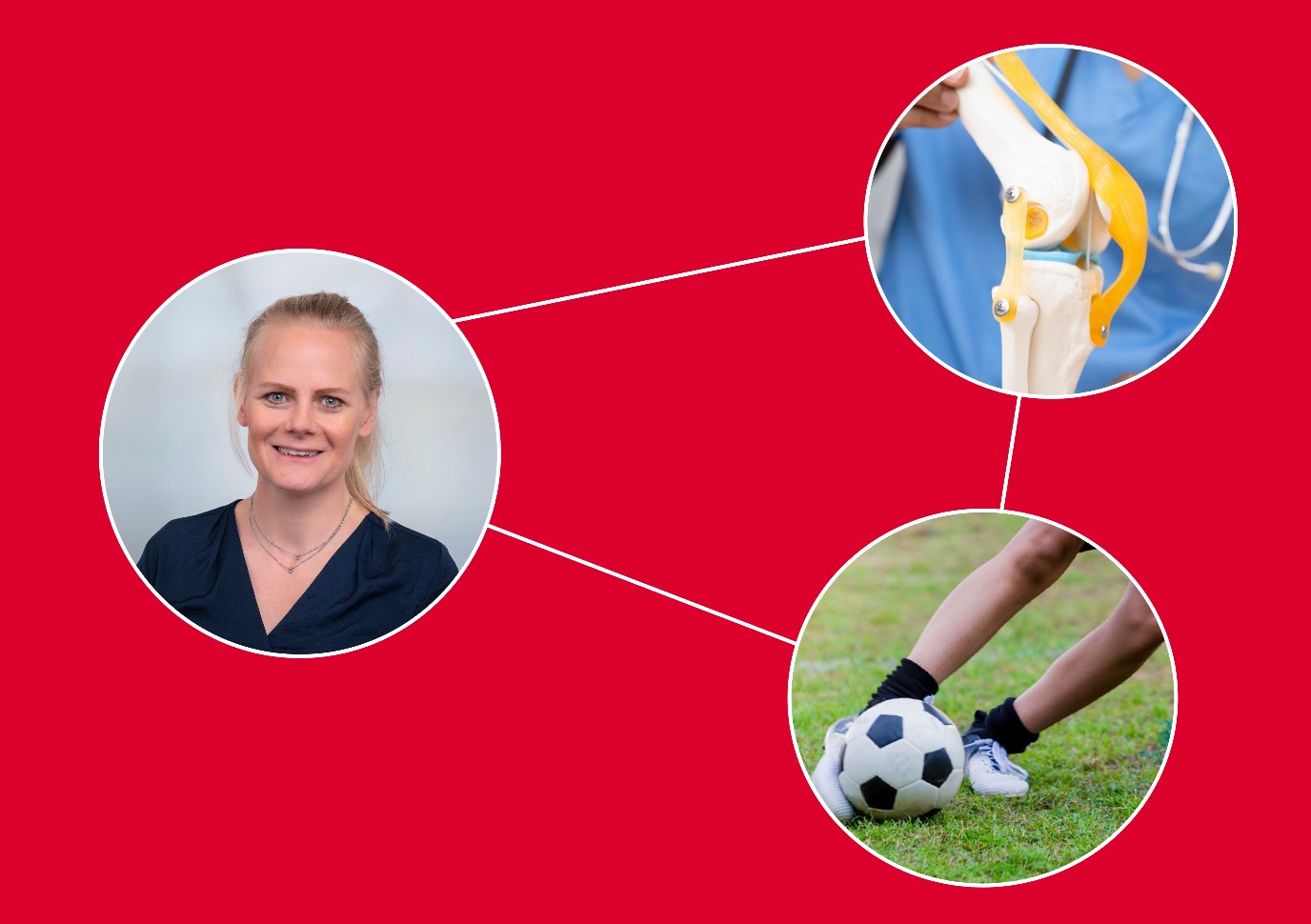
In team sports involving balls, such as football, where players change direction quickly and make unexpected movements, the anterior cruciate ligament (ACL) plays a vital part in stabilizing the knee. ACL tears have a significant impact. Whether people choose to undergo surgery or not, it is not unusual to be out of action for a year. The injury not only affects their ability to engage in high-performance sport, but also basic activities such as walking stairs, lifting their children, and running to catch a bus. Anne Benjaminse, assistant professor at the Faculty of Medical Sciences/UMCG, conducts research on factors that affect ACL tears and is developing a programme designed to prevent ACL-related problems in collaboration with the Royal Dutch Football Association (KNVB) and football club FC Groningen.
Buckling knees
One notable aspect is that women and girls are at greater risk of cruciate ligament injuries. This may seem strange at first: even though there are physical differences between men and women, their knees are built the same way. ‘It’s true that there are no real differences in the ACL itself, but we are noticing differences between boys and girls,’ says Benjaminse. The differences are not related to muscular strength or muscle mass, but rather to motor control. For instance, Benjaminse observes that girls tend to move and land a little more stiffly, with the knee buckling inward. ‘Teenage girls in the middle of a growth spurt often have long limbs, and they move a little clumsily,’ says Benjaminse. ‘They’re still getting used to having a new body.’
Staying focused
However, teenage boys also experience significant growth spurts, so other factors must be at work as well. That is right, says Benjaminse. There are vital cognitive and psychological factors at play too. For instance, boys and girls respond differently to stress. ‘When you're not feeling great, because of bad marks, trouble with friends, or because it’s that time of the month, these things will affect your performance,’ says Benjaminse. ‘In a sport like football, you constantly have to anticipate other players’ moves and respond to them. If you're preoccupied with something else, the way you control your body is significantly affected, which may result in injuries.’
Dynamic exercises
The insights Benjaminse has gathered help her develop an exercise programme for footballers that may prevent this type of injury. ‘There was a programme before, but the exercises need a lot of improvement.’ Benjaminse involves trainers and coaches in her programme and ensures that the content is specific, challenging, and fun, so that athletes will actually use the programme. ‘Instead of basic exercises featuring squats and lunges, which mostly train strength and endurance, we are using more dynamic exercises for two or three people that better reflect the unpredictability of football games,’ Benjamins explains. ‘The latter aspect in particular is more effective at incorporating the cognitive element, because in team sports you always have to stay focused on what’s happening around you. And besides, it makes the whole thing a lot more fun.’
Visual instructions are helpful
Benjaminse also looks at the way in which coaches provide instructions. ‘Coaches traditionally give their athletes very explicit instructions on how to move. For instance, a coach will tell you to bend your knees properly when landing.’ But it’s not just about the type of actions athletes are supposed to perform. It’s also about how they learn a particular movement.’ Says Benjaminse: ‘We have learned that implicit learning, for instance through visual instructions – do it as if you’re sitting down on a chair – sticks in the athletes’ minds much better.’
Helpful for everyone
The programme has not yet been completed, but Benjaminse is already disseminating the knowledge though publications and conferences. And the response has been positive. Some physiotherapists have already begun using her implicit learning approach, and she has been told that some trainers have begun working with her exercises. Furthermore, Benjaminse is collaborating with the KNVB and FC Groningen to test the programme in practice and further develop it. ‘The idea is that it will be incorporated into “Rinus”, an online tool for trainers affiliated with the KNVB, so that all trainers can start using it.’ The programme can be used outside football as well: ‘I’m currently working with the KNVB, but this would be very useful to athletes in other sports too.’ In fact, the method is also highly relevant outside sport. For instance, the insights gained can be applied to rehabilitation therapy and fall prevention for the elderly. After all, prevention is better than cure.
To find out more about Science for Society, take a look at the overview page for all editions.
More news
-
-
03 September 2026
Ming Cao reappointed as scientific director of the Jantina Tammes School
-
01 September 2026
Evrim Ursavas appointed scientific director Wubbo Ockels School