
Insight into the inner workings of lightning

A bright flash, a loud bang, and a deep rumble: lightning is a fascinating meteorological phenomenon, and perhaps a little scary. Though it has been around forever, research on the inner workings of lightning has been limited thus far. However, Brian Hare and his colleagues from the Kapteyn Astronomical Institute (part of the Faculty of Science and Engineering at the University of Groningen) are shaking up the lightning research landscape. How? By using ASTRON’s large radio telescope LOFAR.
Text: Thomas Vos, Corporate Communication UG / Photos: Henk Veenstra
Launching a rocket into the air to trigger lightning strikes: it sounds like the work of a mad scientist, but it is serious business at the University of Florida. That is where Hare conducted his PhD research, which started his career as a researcher. Hare: ‘As part of the lightning research group, we would launch rockets that were connected to the ground with Kevlar-coated copper wire. This would trigger a lightning strike. It does not behave the same as purely natural lightning, but it was still very interesting to study.’
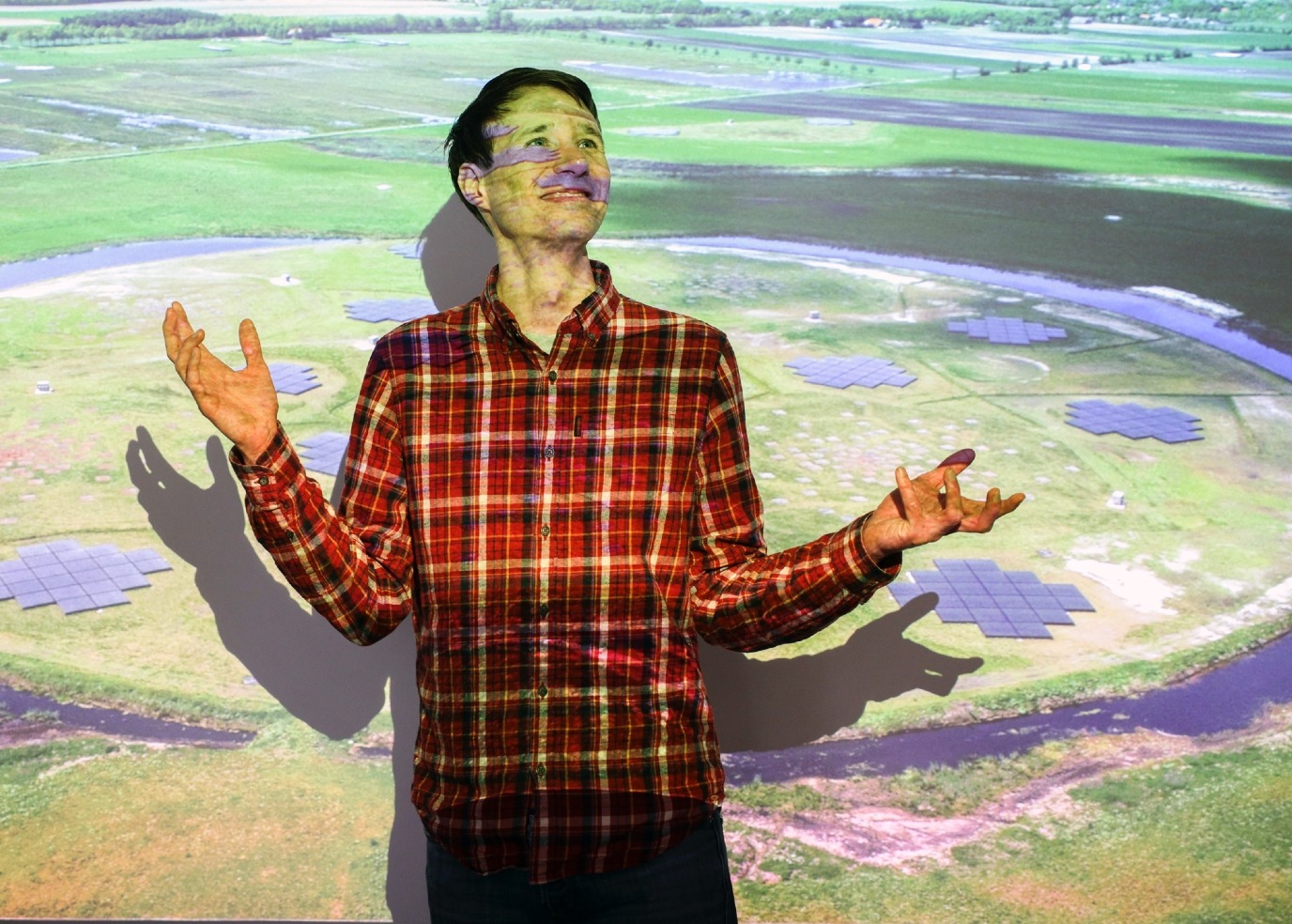
LOFAR
After his PhD, Hare came to Groningen in 2017, where he was hired by physics professor Olaf Scholten. Hare: ‘Professor Scholten had an unusual idea back then. He wanted to use LOFAR a large radio telescope with thousands of antennas, mainly located in the Netherlands and designed for astronomers, to study lightning. He even claimed that we could achieve meter-level precision in our observations with LOFAR. Many people thought this was impossible, because most lightning systems can only measure with a minimum precision of one hundred metres. I personally knew LOFAR was good, but I didn’t realize it could be metre-level good. I can now say, however, that we can currently measure lightning processes with sub-metre precision.
Sharp pulses of radio-frequency radiation
How does it work? LOFAR is a very large array of simple antennas that pick up radio signals, comparable to whip antennas on cars. Each antenna provides little information, but they are clustered in stations, of which there are many. Altogether, they make for a sophisticated and powerful telescope. Hare: ‘As lightning grows through the sky, it emits millions of very sharp pulses of radio-frequency radiation. The closer the antenna is to the lightning, the sooner it will pick up this radiation. By measuring the arrival times and using the right algorithms, we can see exactly where this signal is coming from. We try to measure arrival times for as many pulses as we can. By doing this, we can create a 3D model of all kinds of lightning types.’
Peer inside the clouds
This has allowed Hare and his colleagues to peer inside the plasma of lightning, something that had not been possible before, due to technological constraints. Hare: ‘In the past, lightning research relied heavily on high-speed cameras. Very cool, but it doesn’t allow you to peer inside the clouds. Radio waves, however, go straight through clouds. After all, you can still listen to your radio on a cloudy day. LOFAR has allowed us to see lightning in a way that has never been seen before. Most of the stuff we are doing within our research group is entirely new.’
Like lights on a Christmas tree
One of the big discoveries Hare and his colleagues made is a lightning process they call needles. Hare explains: ‘Lightning has negatively and positively charged ends. These are plasma channels that we call leaders, and they grow through the sky. The negative ends are very easy to see with the help of radio antennas. The positive ones are not. They would be picked up, but it was not clear what we were seeing. Were we actually seeing the growth of the positive leader channel, or some other process? LOFAR allowed us to dig deeper and see structures along the positive leader channel, things that stick out laterally just like needles on a tree branch. The unique thing is that these things we now call needles would occur after you expect lightning to branch out. They would occur multiple times and twinkle at regular 5-millisecond intervals. Almost like lights on a Christmas tree.’
Negative charge moving away from positive charge
According to Hare, this is quite a unique find: ‘Lightning tends to go through the same path, but only sometimes it goes back through. And this is not very often. So, why is air then turning into plasma multiple times, as we can see with the needles? We reconstructed the plasma channel based on our measurements of the needles. The needles are coming from a positively charged channel, the propagation of which we normally can’t see. The fact that we can see the needles, means that these are negatively charged. But that means negative charge going away from positive charge. This doesn’t make sense: negative should go towards positive, as most of us know. This really blew our minds.’
Channel flipped charge
Eventually, after testing several hypotheses, Hare and his colleagues found out what was happening: the channel flipped charge. Hare: ‘The positive leader, still positive at the tip, loses conductivity back along the body. It will stop carrying electrical current. This will cause it to build up negative charge. And then it needs to expel it somehow, and it does so through these needles. Other research groups were able to show not only the existence of these needles, but also that our hypothesis is correct. This was the first discovery, and it really put us on the map.’
Dart leaders
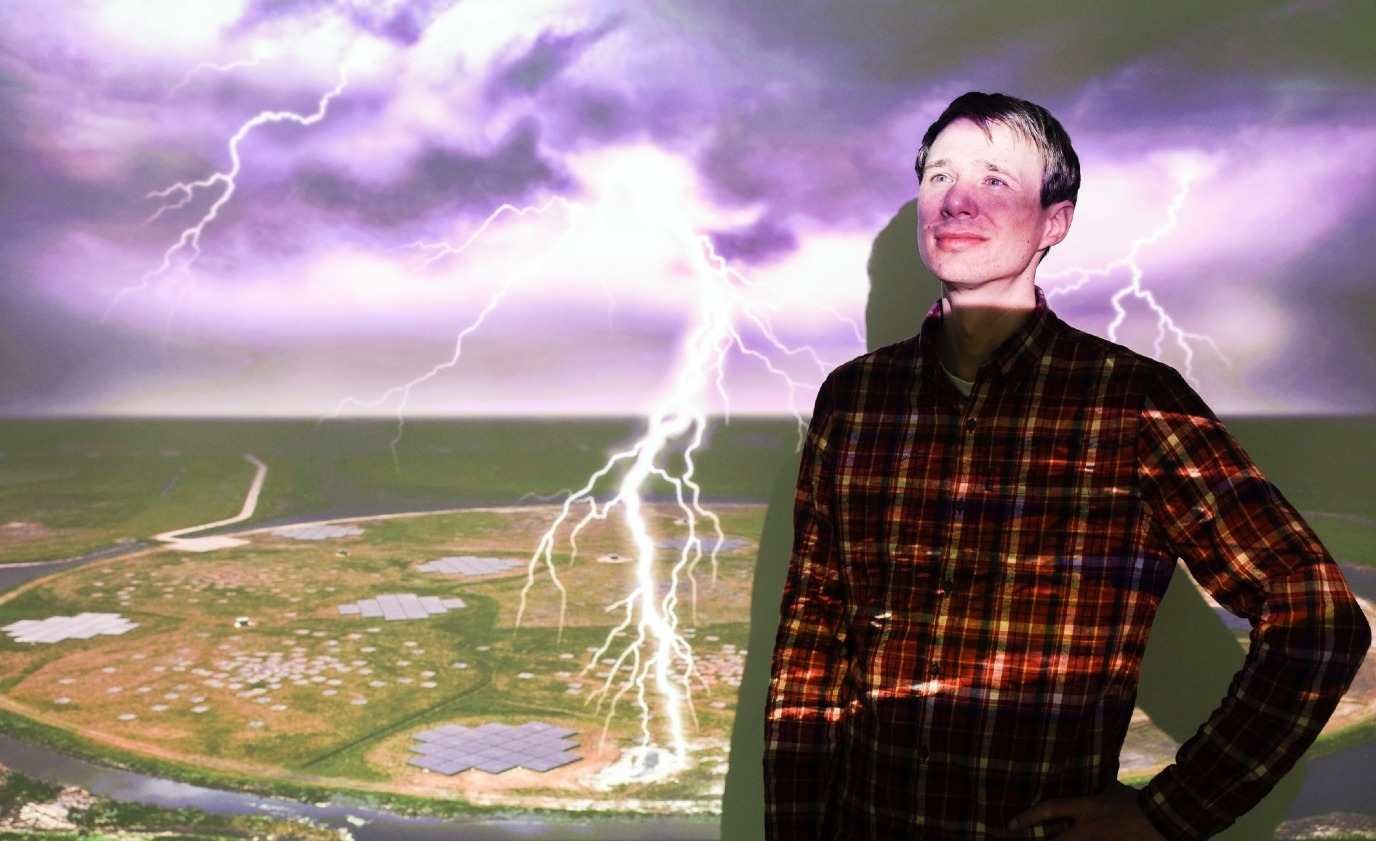
In the meantime, Hare is building on this research. For example, he collected a lot of data on dart leaders, strong lightning pulses that happen along an already established lightning path. This has led to new hypotheses, Hare says: ‘There is something there that heats up the plasma and allows it to grow along the channel. The researcher that came up with this calls it a heating wave. It has not been fully proven yet, but it is a direction we are going in. It is pretty cool to find new possibilities like this, to really understand how and why lightning works the way it does.’
Diving into lightning even further
With the development of new, larger arrays of antennas in South Africa and Australia, SKA-low, Hare hopes to discover even more: ‘SKA-low’s benefit compared to LOFAR is a huge increase in frequency range. The higher the frequency, the higher the resolution. This would, in theory, allow us to study the physics of lightning at an even smaller scale. It will allow us to dive even further into the fundamental processes that drive lightning.’ Though it might not be as spectacular as rocket-triggered lightning, it will definitely take lightning research to new heights.
More information
More news
-
-
03 September 2026
Ming Cao reappointed as scientific director of the Jantina Tammes School
-
01 September 2026
Evrim Ursavas appointed scientific director Wubbo Ockels School