
Alcohol, texting, and e-bikes
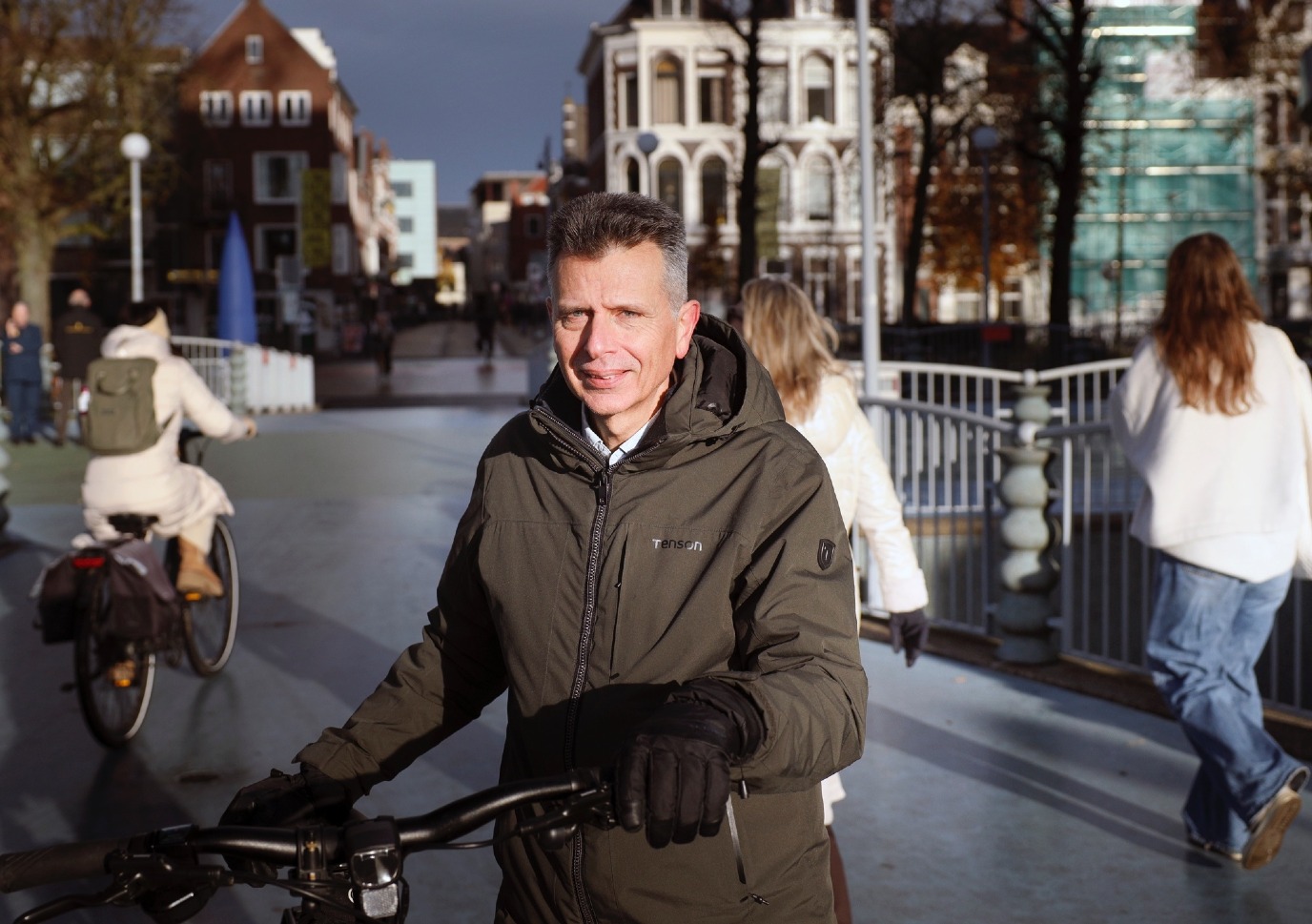
For decades, traffic psychologist Dick de Waard has been studying how people act in traffic. He studies everything thoroughly: from texting cyclists and drunk students to speed differences and e-bikes. Moreover, his advanced bicycle simulator allows him to safely replicate even the most high-risk situations.
Text: Beau Oldenburg, communication advisor at the Faculty of BSS / Photos: Henk Veenstra
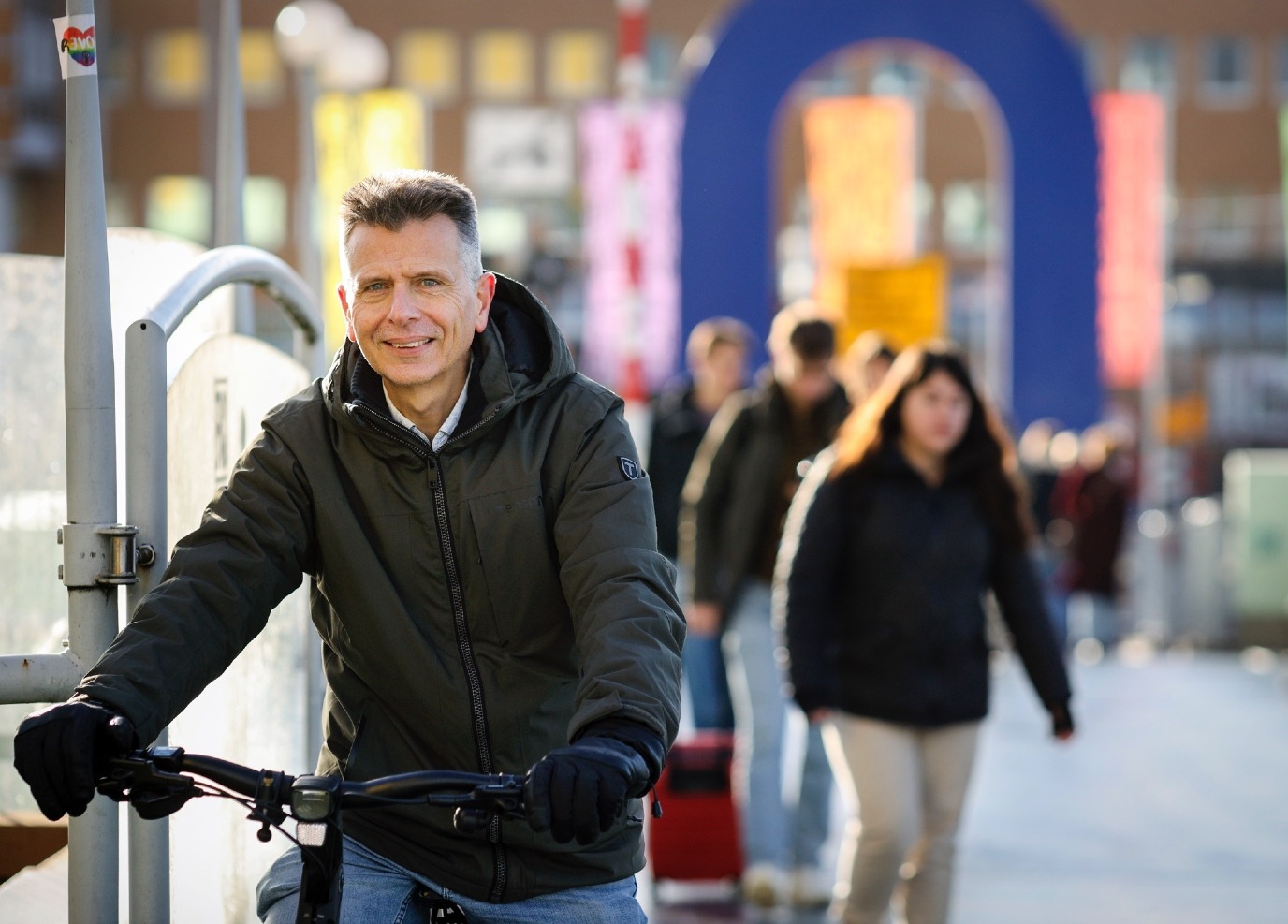
On his twelve-kilometre bike ride to the University, Dick de Waard powers through, regardless of the weather. No e-bike, no racing bike. Just a reliable two-wheeler. ‘A lightweight model, though,’ he says. ‘On the Werkman Bridge, nicknamed the Museum Bridge, I zigzag between the crowds.’ Laughing, he adds: ‘My wife thinks I cycle recklessly.’
The early years
For over 35 years, De Waard has been studying how people behave in traffic, whether on foot, by bike, or by car. His career started in the late 1980s, when, as a student of experimental psychology, he ended up at the former Traffic Research Centre, where he investigated the effect of medication on driving behaviour. ‘We had a car with a camera on the roof, and a driving instructor sat next to the test subject. Some sleep medications still had an effect the next day: people would swerve without realizing it.’ During those years, De Waard discovered what made traffic psychology so appealing to him: its practical nature. ‘Hit the road and start measuring,’ he says. ‘It’s actually useful research.’
Mobile phone booth
Another early study looked at the effects of the car phone — back then it was mostly a handset without a screen. ‘We called it a mobile phone booth. On quiet motorways, it turned out that calling had hardly any negative effects, unlike on busier roads.’ That changed with the arrival of the smartphone. ‘We did research on cyclists who were texting, when it was still allowed,’ he shares. ‘They swerved more and, due to their divided attention, were less alert. When I see someone cycling with a phone in their hand, I instantly recognize it from their wobbling path and road position — sometimes right in the middle of the lane or on the bike path.’
Ethical awareness
Over time, De Waard has witnessed a change in how research is carried out. ‘In the 1980s, it was relatively easy to do research in traffic,’ he explains. ‘Nowadays, ethical awareness has grown, and for good reason.’ Thanks to a grant from the province of Fryslân, the Faculty of Behavioural and Social Sciences now has access to an advanced bicycle simulator. ‘It’s not just a spin bike, but a bike that can actually tilt and lean. In essence, a highly realistic lab.’
Simulator
With the simulator, De Waard can research behaviour that would be too risky to examine in real traffic. ‘For example, I wanted to find out whether international students cycle differently from Dutch students. The ethics committee only allowed them to participate if they had at least six months of cycling experience in the Netherlands. That’s only logical if you’re conducting research on public roads, but it’s exactly the phase where they’re still adjusting that gets left out. And that’s exactly the interesting part.’
Blood alcohol content
Not all his research studies are high-tech. 'One of the most enjoyable projects involved taking students to the Grote Markt to measure cyclists’ alcohol levels,’ he says. ‘We were there from 5 p.m. to 8 a.m. the next day. People thought it was great fun to take the breath test. On average, their blood alcohol content was around 1 promille, sometimes even 2, while the legal limit is just 0.5. Some people were too drunk to take the breath test, but oddly enough, they could still ride their bikes,’ he laughs. ‘Of course, it’s not allowed and it’s dangerous, but it’s better to cycle than to drive after drinking.’
Interplay
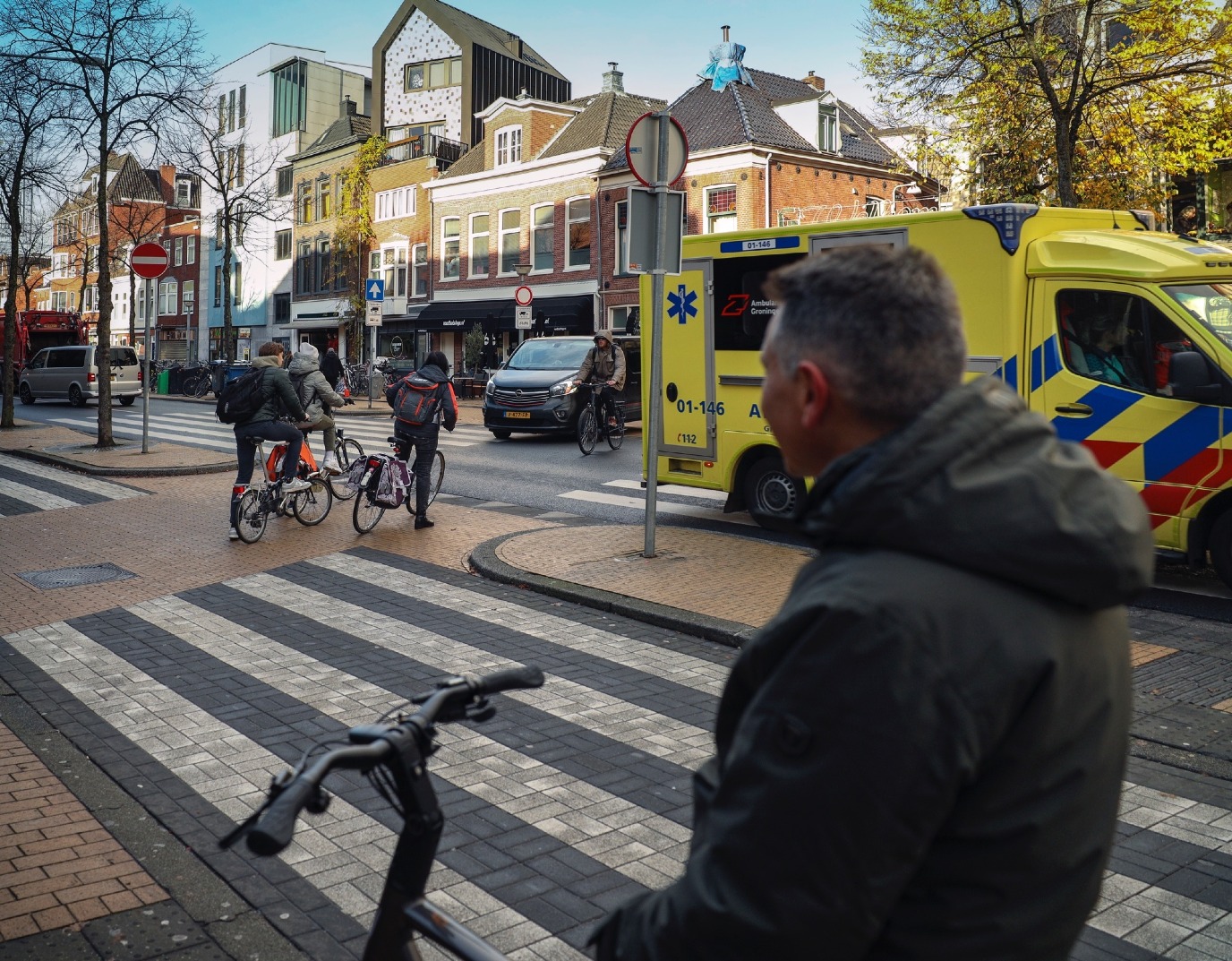
Those who speak with De Waard quickly notice that he does not view traffic as a matter of ‘people’ or ‘roads’, but rather their interplay. That is the view he takes on traffic designs in Groningen, such as traffic lights that turn green for all cyclists at once. ‘It’s a smart idea and I’m a fan of it,’ he says. ‘Because the light is only for cyclists, the worst that can happen is that they bump into each other. But it has to be feasible. You need enough space to build up speed. It works well near the station, but not at the UMCG.’
Shared space
De Waard has a nuanced view of shared spaces, such as the one on the Grote Markt. ‘The idea is appealing: everyone can move freely, both pedestrians and cyclists. But it only works if people are mindful of each other. Once speed differences become too great, it goes wrong.’ Speed differences are, in any case, a thorn in his side. ‘Just look at the German motorways,’ he says. ‘Some cars go 120, while others 220. That’s absurd, unnecessary, and very unsafe.’
Low-traffic areas
De Waard is mostly satisfied with the situation in the Netherlands. ‘We’re a wealthy country, which is also reflected in our roads. Although there are more cycling casualties, we’re still doing well when it comes to cycling. Our cities are designed with cyclists in mind, and that’s exactly what makes them comfortable to live in.’ He believes cities with low-traffic areas are not just a fad, but a logical development. ‘There should be no reason to want to go by car to the city centre. In the 1970s, Groningen was a pioneer with its traffic circulation plan: cars couldn’t go straight through the city but had to go around via the Diepenring. That made the city a more pleasant place to live, shop, and work. In the US, the opposite is true: everything revolves around the car.’
E-bike
And the e-bike, is it a blessing or a curse? ‘For many elderly people, it’s a necessity’, according to De Waard. ‘They can stay mobile, visit family and friends, and remain socially active. But there’s a flip side: if they fall, they’re more likely to get injured and end up in the hospital. This makes e-bikes seem more dangerous than they really are. It’s not about the bike itself, but rather about the combination of speed, infrastructure, and, above all, the vulnerability of the rider.’
Watching out
De Waard laughs: ‘Talking of the vulnerability of older people, I’m 61 myself now. Perhaps it wouldn’t hurt to listen to my wife a bit more’
More information
More news
-
-
-
12 May 2026
Mind and money matters