
Citizen participation essential for a sustainable energy future
At the Wubbo Ockels School for Energy and Climate, researchers are working on innovative solutions to the major sustainability issues of our time, from technological innovation to circular systems and climate adaptation. Much of this research focuses on developing new methods, models and applications that contribute to a more sustainable world. In addition to the technological and policy aspects of sustainability, there is another, equally important question: how do we ensure that people are truly involved in this transition? Who decides on the design of our future energy supply? How are citizens involved? And what is needed to make that involvement truly meaningful?
Text: Kirsten Otten / Photos: Reyer Boxem
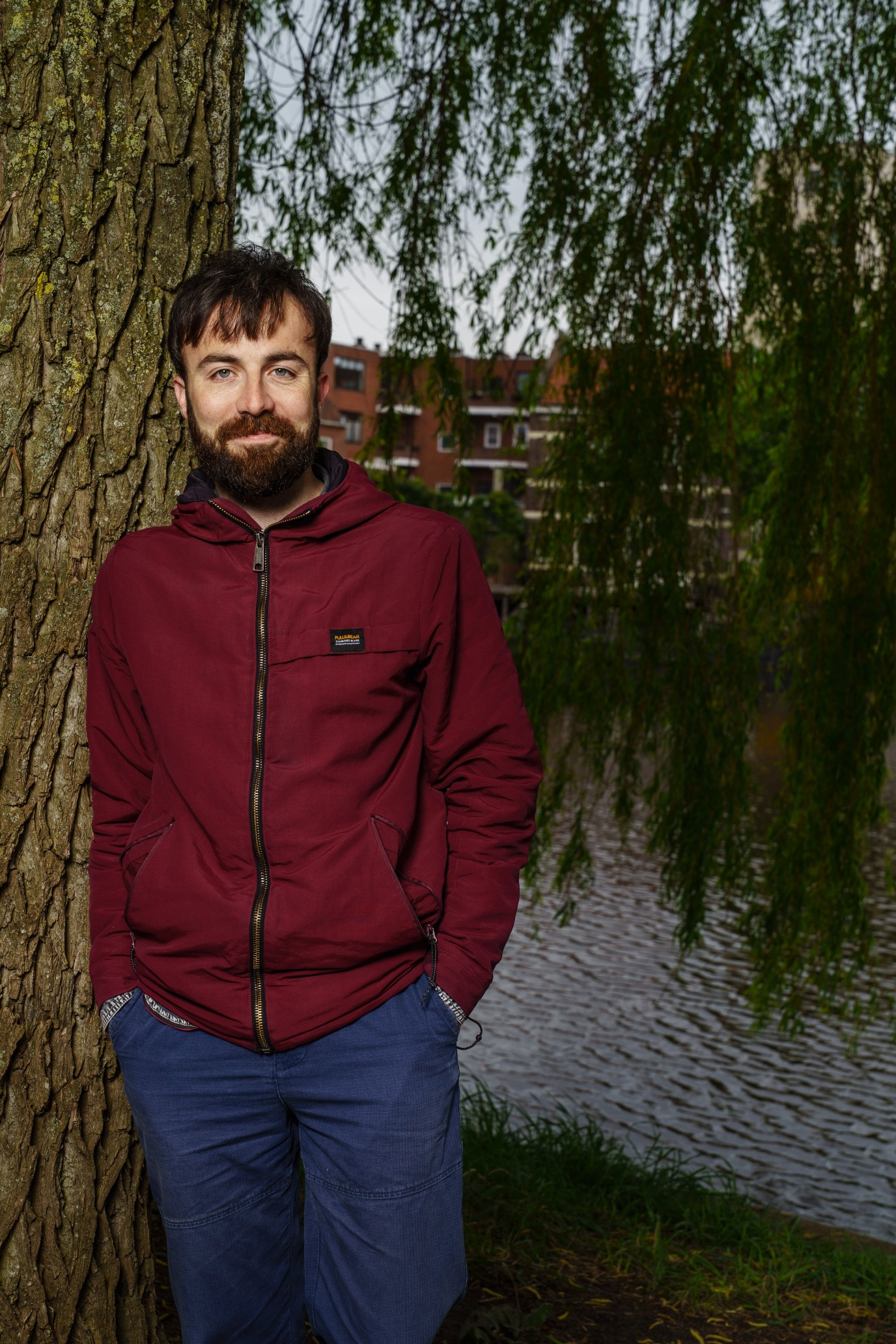
‘For this research I have drawn on all the tools available to me, from a wide range of disciplines, from psychology to geography, from political science to cultural studies, which makes the research particularly multidisciplinary.’ Adrien Chanteloup speaks passionately about the subject he has been working on intensively for more than two years: citizen participation in the energy transition and the decision making that surrounds it. ‘I strongly believe in the importance of democratising the energy transition. Only in this way can we ensure that no one is left behind in the greatest challenge of our time, climate change.’
A new approach
‘The original research proposal focused primarily on stimulating the development of so called energy communities, sustainable energy collectives set up by citizens. It was therefore very practical in nature. The energy debate is still mainly conducted from an economic and technological perspective. Citizen involvement and the behavioural changes required for this play only a minor role. Together with my supervisors Goda Perlaviciute (Psychology) and Lea Distelmeijer (Energy Law), I decided to take a step back for this research and look at how we can make the energy transition democratic by asking citizens what role they want to play in decision making about energy.’
From door to door in Normandy and Groningen
‘In my first article within the project I focus on the question of why someone would want to participate in a sustainable energy initiative and actively contribute ideas about the overall energy supply of a country or even Europe.’ To find answers to these questions, Chanteloup conducted door to door interviews in both his native province of Normandy, where many large energy parks are being built, and in the suburbs of Groningen. ‘In rural Normandy in particular, there was a lot of dissatisfaction with current energy policy and sustainable energy projects. Their surroundings are filled with wind turbines, and some people felt that this electricity only benefits the cities and that they themselves do not benefit from it.’
Trust in neighbours
The bond that people have with their environment plays a major but complex role in a person's willingness to participate in a local energy project, Chanteloup discovered. ‘People who trust their neighbours are more willing to participate. They think: great, we can all benefit from this. But among them there are also those who do not participate because they think their neighbours are much better at it than they are. At the other end of the spectrum are people who do not trust their neighbours, but do want to participate to prevent their neighbours from gaining too much power. The most important conclusion I can draw from these interviews is that, under certain conditions, people definitely want to participate in something as complex as energy governance.’
Making use of citizens’ creative ideas
The ideas that the interviewees themselves contributed regarding the energy transition are the focus of the second phase of Chanteloup’s research. ‘I wanted to know what they thought should be done differently and better. This produced many creative suggestions and a striking number of comments about reducing energy consumption as a counterbalance to the continuous production of energy.’
The policymakers’ perspective and a look to the future
For the final phase of his research, Chanteloup has two more topics in mind. ‘After the citizens I am now talking to the policymakers, people from the ministries, researchers, think tanks, lobbyists, but also people from a cooperative. Through these conversations I want to map out how much room there actually is for citizens to participate in energy governance.’
Finally, Chanteloup wants to consider a new social contract. ‘How do we want to organize society, and how do we adapt the technical organization of the energy system to that? Citizen involvement and participation are indispensable in making the distribution of energy fairer and preventing energy poverty. But also in ensuring a fair distribution of the burdens of this energy transition, so that the rich cannot maintain their costly lifestyles at the expense of the poor.’
This project is funded by the Ubbo Emmius Fund and is part of the Wubbo Ockels School.
More information
More news
-
-
24 August 2026
Social media: swimming or drowning?
-