

Recap New Energy Forum 2026: from Tile Tipping to Disinformation Bingo

The sixth edition of the New Energy Forum took place last week at the sun-drenched Entrance site in Groningen. As a co-organiser, the Wubbo Ockels School contributed to the programme with a Climate Disinformation Bingo and a session on climate adaptation. New this year was the well-attended scientific conference at Energy Academy Europe, organised one day prior to the festival.
Participants in the scientific conference attended a total of 19 presentations across six sessions. The conference was opened by Entrance Director Jan-Jaap Aué, who emphasised the importance of interdisciplinarity and knowledge sharing. 'We want to reach not only the scientific community, but also the general public, governments, and businesses.'
All speakers submitted a paper, which have been published in the conference proceedings: Breaking Barriers: Research Studies to Accelerate Transitions. The printed volume was available to visitors of both the conference and the New Energy Forum. Topics were diverse and highly relevant, ranging from biogas and disinformation to employer branding and mobility.
New this year was the Entrance Research Award. Rhea Kapoor and Jorrit Reede (Entrance) won first prize with their paper, “NO More! Reducing Nitrous Oxide Emissions in Wastewater via Ammonia Electrolysis.” Ammonia is an important nitrogen-containing component of municipal wastewater and poses an environmental problem when discharged into receiving waters. Their findings demonstrate that electrochemical ammonia removal from wastewater is a feasible solution.
Festival
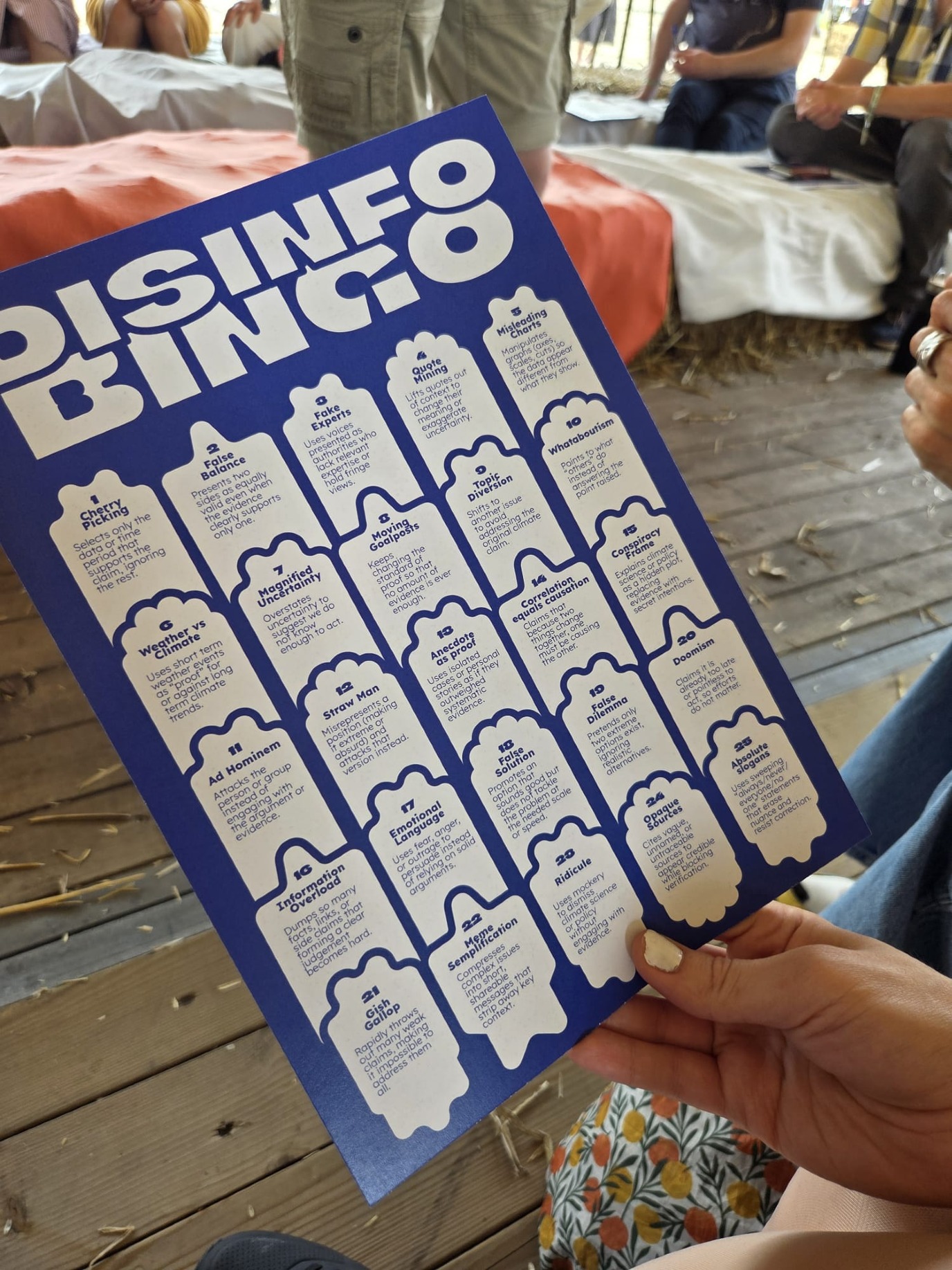
During the public festival the following day, the programme included the award ceremony of the Research Award, the Student Award, and the Professional Award, alongside several keynote speeches and hands-on sessions held in tents across the festival grounds. In the afternoon, the Wubbo Ockels School co-organised the Climate Disinformation Bingo, led by University of Groningen researchers Marc Esteve del Valle and Mariana Chaves.
Esteve del Valle compared climate disinformation to the tactics used by tobacco companies. During the session, participants received bingo cards featuring 25 disinformation tactics related to climate change. News items from various sources were then presented, and participants were tasked with identifying which tactics were being used, such as ridiculing climate change or cherry-picking arguments.

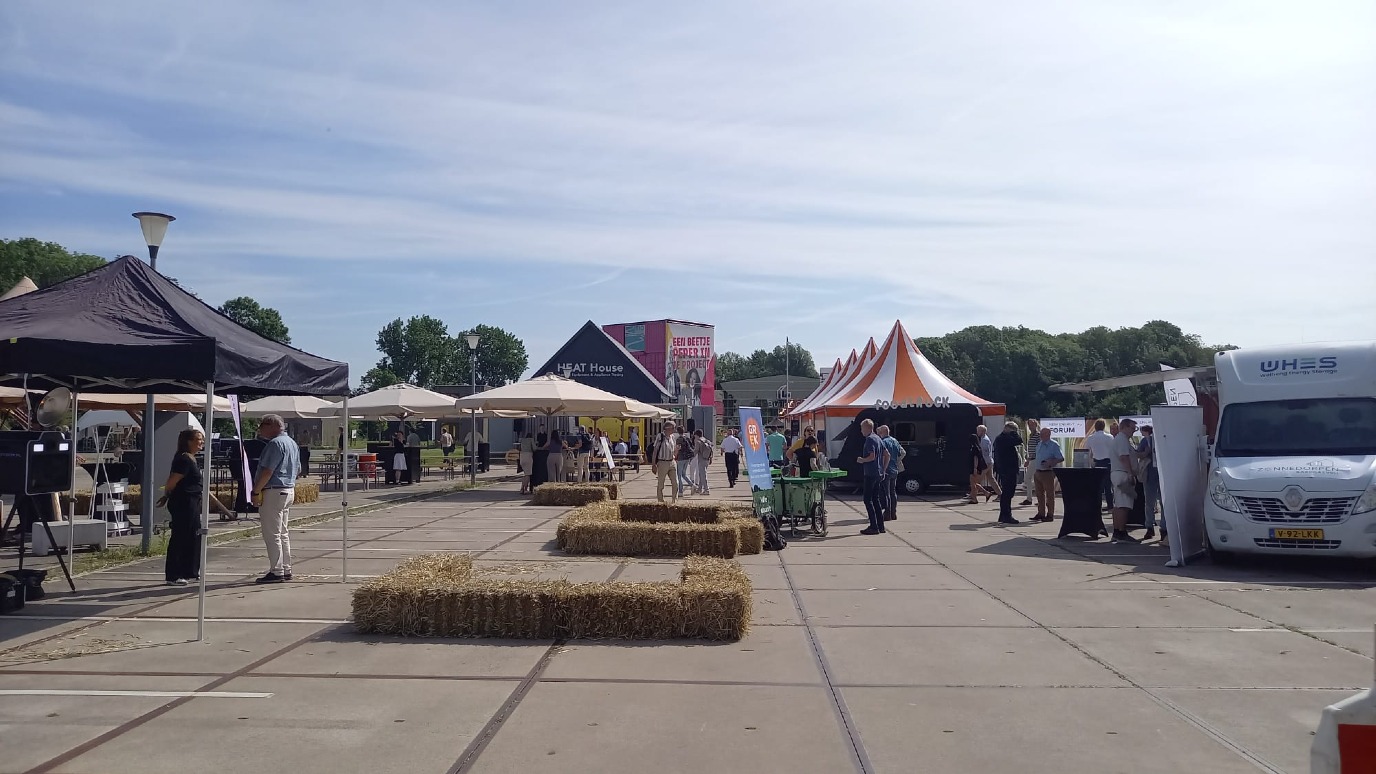
In a neighboring tent later that afternoon, a session on climate adaptation took place. 'There is no better place to emphasise the importance of climate adaptation,' remarked the session host, referring to the scorching hot concrete paving stones covering the festival grounds.
One of the speakers was Allard Roest, lecturer and researcher at Hanze University of Applied Sciences. He highlighted the gap between what we know and what we do: as a country, we have a clear understanding of the risks posed by extreme weather, yet insufficient action is being taken.
Roest pointed to the phenomenon of grey gardens, where homeowners replace greenery with concrete paving stones. While such gardens require little maintenance, they are poorly equipped to cope with extreme rainfall and heat.
Roelke Nienhuis (Municipality of Groningen) and Pieta Walma (engaged citizen) discussed what can be done to counter this greying of both public and private spaces. Several successful examples from Groningen neighborhoods were presented. Their main advice for communicating with local government: be patient and nurture the relationship.
Highlights from the Conference Proceedings
Thomas Lans (HAN University of Applied Sciences) demonstrates in his study, “Making Subjectivity Visible,” how important the mindset of small business owners is in the transition to zero-emission mobility. Due to their frequent use of delivery vans, this transition has a significant impact on their day-to-day operations.
Jantina Ottema (Hanze University of Applied Sciences) investigates contradictions in government regulations, bank lending practices, and the broad range of societal challenges faced by dairy farmers in the Netherlands.
Dennis Nientimp (University of Groningen) addresses two underlying causes of low participation rates in Community Energy Initiatives (CEIs) in Europe in his study, “One Size Fits One.” First, stakeholder engagement is often limited due to the top-down approaches adopted by researchers and policymakers, causing the energy transition to be perceived as “an elite project.” Second, the characteristics of social network structures are frequently overlooked in both research and policy design.
More news
-
-
03 September 2026
Ming Cao reappointed as scientific director of the Jantina Tammes School
-
01 September 2026
Evrim Ursavas appointed scientific director Wubbo Ockels School