
Groningen Sustainability Conference 2027: ‘This is the moment to shape the discussion’
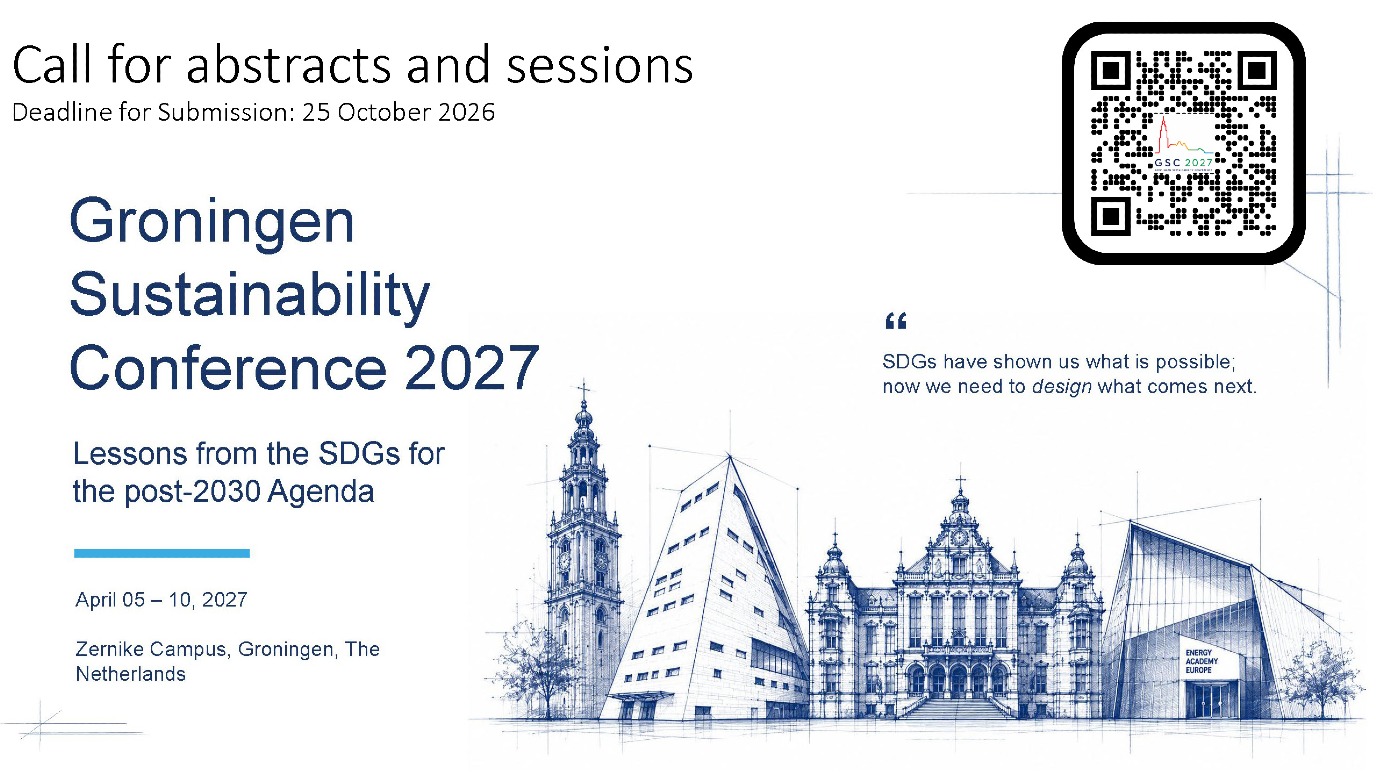
The deadline for the United Nations’ Sustainable Development Goals (SDGs) is fast approaching. To address this, the four Schools for Science and Society of the University of Groningen, the Netherlands, will host the Groningen Sustainability Conference from 5 to 10 April 2027. During the event, over 400 participants across the world will engage in discussions about the future of the SDGs.
The 2030 Agenda for Sustainable Development was adopted in 2015 to achieve 17 Sustainable Development Goals (SDGs), with a focus on tackling poverty, inequality, injustice, and climate change by 2030. The 2030 deadline is drawing near: in September 2027, the UN will hold its final SDG Summit to evaluate progress and discuss the future of the development goals beyond 2030.
The goal of the Groningen Sustainability Conference is to reflect on the SDGs and contribute inputs for post-2030 plans, says Klaus Hubacek, director of the Energy and Sustainability Research Institute Groningen (ESRIG), which is co-organising the event alongside the Schools. ‘Together, we can shape the discussion on the post-2030 agenda,’ says Hubacek. ‘This is the moment to do so. During the conference in Groningen, we will formulate a core message for the final SDG Summit.’
The Groningen event is not a traditional academic conference. Instead, it will bring together representatives from civil society, policymakers, and business to discuss the future of the SDGs. This approach aligns with the University of Groningen as a fifth-generation university – one that houses all scientific disciplines and collaborates actively with partners from the business sector, as well as other knowledge institutions and government bodies.
The conference will feature a wide lineup of invited speakers and panelists. These include Anna Pot (National Coordinator for the SDGs), Astra Bonini (United Nations Department of Economic and Social Affairs), Csaba Kőrösi (77th President of the UN General Assembly), and other leading experts from government, international organisations, and academia. The conference will focus on five central themes. The first theme is closely linked to the future of the SDGs. Additionally, the development goals will be discussed through four specific themes, each aligned with the four Schools for Science & Society.
Prof. Ming Cao – Scientific Director of the Jantina Tammes School of Digital Society, Technology and AI – on the theme ‘Artificial Intelligence, big data, and digitalisation as enablers for sustainable development’:
‘AI and digital technologies can be powerful enablers of sustainability, for example by helping us understand complex systems, optimise resource use, and support better-informed decisions. At the same time, they also raise important questions about energy use, fairness, governance, and societal impact. From the perspective of the Jantina Tammes School, the key challenge is to ensure that digital innovation is developed and used responsibly, in close connection with society and with sustainability as a guiding principle.’
Prof. Evrim Ursavas – Scientific Director of the Wubbo Ockels School for Energy and Climate – on the theme ‘Navigating the climate change–development nexus for resilient, just and equitable transformations’:
‘In the north of the Netherlands, the climate change–development nexus is something we deal with directly. This region is living through a major energy transition right now, and it only works if the technical, economic, and social sides are worked out together, not handed off from one to the next. That is the approach we take at the Wubbo Ockels School, bringing those perspectives together from the start so a plan that works on paper also works for the people who have to live with it.’
Prof. Erik Buskens – Scientific Director of the Aletta Jacobs School of Public Health – on the theme ‘Health, well-being, and societal foundations as key drivers of sustainable development’:
‘A sustainable society implies a healthy society, mentally, socially, ecologically, physically, and economically. One without all the others implies leaving people, and communities vulnerable, distressed and disappointed. A recipe for crises.’
Dr. Wanli Zheng – Scientific Coordinator Rudolf Agricola School for Sustainable Development and Faculty of Science and Engineering – on the theme ‘Building resilience through integrated sustainable transformation across natural and human systems’:
‘We are particularly pleased to join hands and create a platform where these different perspectives can meet. The conference provides an opportunity to connect societal challenges with the strong knowledge, innovation and societal engagement rooted in Groningen and the wider region, and to explore how integrated approaches can help build more resilient natural and human systems.’
The conference will begin with a programme tailored specifically for PhD candidates. The main programme will take place from 7 to 9 April, and on 10 April, a field trip will visit various locations in the Northern Netherlands where sustainability is put into practice. These visits will highlight the importance of a sustainable transition for the Groningen region.
The call for abstracts remains open until 25 October. Participants can register for the conference until 21 March 2027. More information is available on the Groningen Sustainability Conference 2027 website.
More news
-
-
03 September 2026
Ming Cao reappointed as scientific director of the Jantina Tammes School
-
01 September 2026
Evrim Ursavas appointed scientific director Wubbo Ockels School