
Advent calendar - December 9th - Jintao Hu
In the Zernike Institute Advent Calendar, we are presenting 24 short spotlights in December. In these specials, we highlight PhD students, postdocs, support staff and technicians of our research groups and team - providing a glimpse into their typical day at work. In Episode 9 meet Jintao Hu, PhD researcher in the Macromolecular Chemistry & New Polymeric Materials group and within the HyBRIt framework supervised by Dr. Dina Maniar.
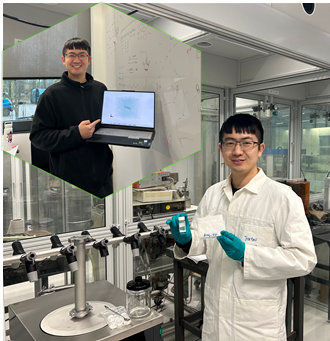
I’m Jintao Hu, a PhD candidate in the Macromolecular Chemistry & New Polymeric Materials group at the Zernike Institute for Advanced Materials, University of Groningen, working within the HyBRIt collaborative framework.
My research centers on the supramolecular self-assembly mechanisms and functional applications of amylose-based systems. I investigate both host–guest complexes, including amylose microparticles and nanoparticles, and layer-by-layer self-assembled granular hydrogels. By examining how complexation conditions and amylose molecular fine-structure influence material properties, I aim to develop systems with tunable stability and controlled-release behavior. These experimental studies are complemented by multiscale molecular simulations to uncover underlying mechanisms and guide material design.
The main direction of my work revolves around the stabilization and controlled delivery of omega-3 polyunsaturated fatty acids, especially α-linolenic acid (ALA). Although ALA is abundant in plant seed oils and serves as a precursor to long-chain omega-3 fatty acids such as DHA, it is highly sensitive to oxygen and heat. Encapsulating ALA in natural polymer matrices is therefore an increasingly attractive strategy. Amylose, the linear component of starch, provides an excellent supramolecular platform: in the presence of suitable hydrophobic molecules, it forms V-amylose single helices with hydrophobic inner cavities and hydrophilic exteriors. Imperfectly crystallized V-amylose can be selectively degraded by pancreatic amylase, enabling enzyme-responsive release in the small intestine. Altogether, these features position amylose as a versatile, bio-based carrier for sensitive bioactive compounds.
Looking back on my doctoral journey so far, I am especially grateful for the curiosity-driven scientific spirit and the supportive teamwork within our group. My daily activities involve both experimental and simulation work, whether inducing amylose assemblies of different scales or watching a molecular system finally converge. Besides, the supportive and collaborative atmosphere in the Zernike institutes allows me to work more effectively with the help of Andrea from the Micromechanics group. Outside the lab, I usually play basketball, badminton, and table tennis with my friends to release pressure and build my body by running and weightlifting.
This PhD journey has shaped me profoundly; each setback has made me more resilient, and each success has deepened my passion for research. I look forward to carrying this momentum into the next stage of my journey, exploring new structures, new mechanisms, and new possibilities.
More news
-
19 October 2026
From research to business: RUG Ventures helps ideas move forward
-
-
03 September 2026
Ming Cao reappointed as scientific director of the Jantina Tammes School