
PhD ceremony Martin Schmidt Montelius
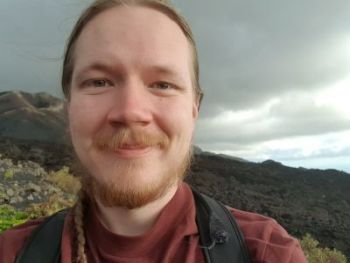
On Thursday 25 June, Martin Schmidt Montelius defends his thesis called
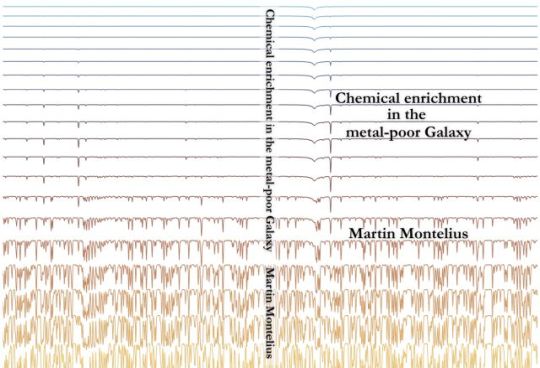
Chemical enrichment in the metal-poor Galaxy
Summary of Martin's thesis:
In the field of Galactic Archaeology, stars in the Milky Way and surrounding galaxies with widely different ages are used as tracers of galaxy evolution. Over the last few decades, astronomers have dedicated many efforts to find stars that belong to the oldest populations and to analyse their spectra. Such stars give us information on the very early stages of galaxy formation, but they are extremely rare, and thus avoiding bias in such processes can be difficult. Moreover, as the spectra of such stars differ significantly from the more solar-like norm, their analysis is more complex.
In this thesis I have explored different aspects of this process, focusing on how broad-band photometry and near-infrared spectroscopy can be used to efficiently find very rare sub-types of metal-poor stars and perform their spectral analysis. The first paper in this thesis shows how we can use high-resolution near-infrared spectroscopy to study the r-process by measuring stellar Ytterbium abundances. We perform these measurements for cooler stars with a wider range of metallicities than previously attempted. The second paper concerns identifying stars that are too metal-poor to be properly analysed by the APOGEE survey. We identify likely candidates, and study their orbits. In the third paper we analyse those APOGEE candidates, and measure abundances of magnesium and silicon. With these abundances we estimate the overall metallicities, and connect abundance ratios to possible enrichment scenarios. In the final paper we construct a method for identifying carbon-enhanced metal-poor stars with temperatures below 5500 K. Such stars are often biased against by photometrically guided surveys, as the molecular bands disguise the diagnostic atomic lines. Our method uses different combinations of broad-band photometry, selecting targets for spectroscopic follow-up with the novel WEAVE spectrograph.
Link to Martin's thesis
If available, you can follow the PhD ceremony via this livestream
More news
-
-
03 September 2026
Ming Cao reappointed as scientific director of the Jantina Tammes School
-
01 September 2026
Evrim Ursavas appointed scientific director Wubbo Ockels School