

The Two Additional Reforms Nepal's Living Goddess Tradition Needs: Shorter Tenure and an End to Period Stigma
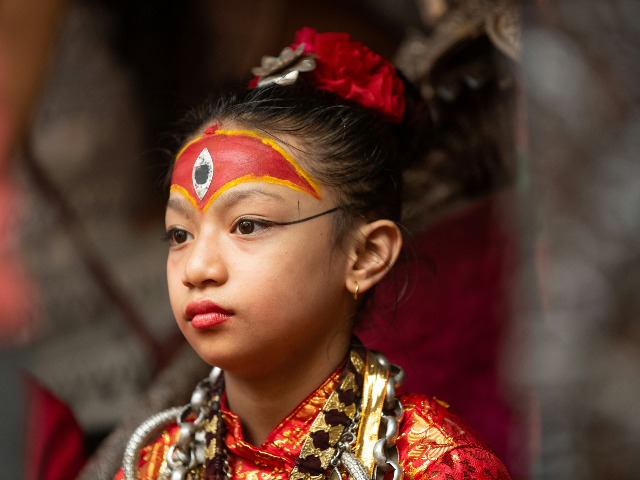
On 30th September of 2025, a two-year-old girl, Aryatara Shakya, succeeded the previous child for the living goddess (Kumari) position in Nepal. She will be expected to serve 8-9 years and be dethroned once she menstruates or hits puberty because menstruating is considered inauspicious. In this ancient Hindu-Buddhist tradition, Kumari (literally virgin), or the pre-pubescent state, is considered the overriding condition to act as a goddess (incarnation of the Hindu deity Taleju or Buddhist Vajradevi).
Until now, the debates and discourses on Kumari practice foregrounded child or human rights (family environment, diet, medical assistance, marriage, and others), while neglecting the logic of period-induced dethronement (period phobia). How would a shift in discourses, hitherto ignored, shape the additional reforms for the empowerment of Kumari girls and enable the sustainability of the practice?
Reducing Total Serving Time
The fate of the post-menstruation living goddess is analogous to the fictitious character Gregor from Franz Kafka’s novel Metamorphosis. Gregor’s transformation into an insect is accompanied by his lost value in the eyes of his family; the only breadwinner, Gregor, suddenly turns into a liability. With the lost status of a goddess, the child’s utility terminates. She is no longer eligible to serve her country, her tradition, or her devotees (lost respect).
Most of the living goddess’ tenure lasts for 7-9 years. Preeti Shakya (2001-2008), Matina Shakya (2008-2017), and Trishna Shakya (2017-2025) served as royal Kumaris for Kathmandu; Chanira Bajracharya (2001-2010), Samita Bajracharya (2010-2014), Unika Bajracharya (2014-2018), & Nihira Bajracharya (2018-still serving) were selected for Lalitpur (Patan) city. All the Kumaris’ lives resemble how Preeti Shakya lived. Beginning her living goddess reign at three years old, she spent a substantial amount of her time inside Kumari Ghar (Kumari house) during her eight years of service. Throughout the serving years, these girls follow a strict routine akin to a full-time profession: performing divine duties while sitting on the throne for hours, receiving devotees, donning the red attire, applying makeup, maintaining a strictly vegetarian diet, and completing other daily rituals. Unquestionably, this is an enormous burden to impose on an agencyless child—especially for seven to eight continuous years.
Furthermore, it would be deeply mistaken to pretentiously and presumptuously believe that a godly figure with supernatural power is immune to mundane rules and hardship (sequestered life, limited friends). Let's not forget—she is a child, after all. Many Kumaris, up until the early 2000s, missed educational opportunities because of the myth that education would be unnecessary for an “omniscient” goddess. Already in 2005, Pun Devi Maharjan’s petition had argued the adverse impact of such forms of child labor or exploitation on children’s physical and mental development. Nevertheless, pro-traditionists defend that by Nepal’s gender standards, Kumaris fare better than countless girls facing social problems: forced early marriage, prostitution, early pregnancy, underage labor, and limited educational opportunities.
In reality, a Kumari child is forced to sacrifice her formative years for the sake of our vested interests: the family’s elevated position, Nepal’s pride, continuity of tradition, the community’s glorious prestige, commodification, commercialization (foreign currency & attraction), and blessings. Sacrifices include “several years of her life, family relationships, normal upbringing opportunities, and personal desires to fulfill a public role.” Thus, there should be a concerted effort entailing a negotiation between the community and the government to reduce the serving time, bringing it down to a maximum of 3-4 years. Under this reformed tenure, Kumari girls would serve for a shorter period rather than continuing until their first menstruation.
Over the last couple of decades, reform demands have yielded notable accomplishments, with compulsory home education and a $110 monthly government pension upon retirement. However, former Kumaris have confessed the difficulty they face post-retirement to adjust to the world, which is generally defined as rehabilitation challenges or psychological traumas. In her co-authored book ‘From Goddess to Mortal’ (2005), Rashmila Shakya, who served between 1984 and 1992, lamented over lack of education and difficulties in adjusting to normal life. Samita Bajracharya in 2017 told Spanish media, “It takes at least a year to get used to lost status.” Behind such difficulties lies a long separation for service purposes.
Transcending the child rights reforms (expanding educational and post-retirement facilities), the additional reforms could foreground women’s dignity, ending the problematic period myth. Even the Center for Reproductive Rights, a global advocate for women’s reproductive freedoms, missed the menstrual stigma angle in 2006, concentrating solely on child discrimination and basic human rights. Tellingly, well-educated former Kumaris like Chanira Bajracharya’s reform demands today are usually framed around educational financial support from the government and counseling. She refrains from expressing objection or discomfort over the tradition of dismissing girls after their menarche but rather encourages families to do necessary preparations for the imminent transition. In other words, accept the change and move on.
Early Retirement Before Kumari Bleeds
Kumari practice embodies the dichotomization between “pure” and “impure” in contrast to good and evil themes in other major religious traditions. By implication, the pure, unblemished child enjoys godly status; the impure, tainted child is relegated to mortal status. Revealingly, the period phobia of Nepalese society appears to be projected on a godly figure.
The tradition, implicitly or explicitly, sends a message to the society: period blood is impure. This legitimizes and sustains the demonization and vilification of menstruation. The legacy of culturally based and religiously justified menstrual stigma involving the regressive perception about menstruation blood would be further compounded with a tangible example of a living goddess. For a society that has normalized menstrual stigma (mistreatment of ordinary girls and women), the discourse on Kumari’s dethronement becomes simply gratuitous or superfluous.
Of course, the Kumari tradition by no means deserves the blame for Nepal’s pervasive menstrual stigmas that have independent religious and cultural roots spanning centuries. “Untouchable women” deprive themselves of tika during Hindus' biggest festival, Dashain, and distance themselves from the kitchen or religious places on normal days. These women resemble the prisoners who regulate their actions in the Foucauldian Panopticon.
Panopticon’s structural design, a circular prison system where each cell faces the central tower, enables maximum control of prisoners with a minimal number of guards. As this system is based on the principle of constant monitoring and surveillance, the prisoners are tricked into assuming that their every action is constantly being watched by the guard at the central tower. Nepalese women live in a theological panopticon—supernatural guard’s constant surveillance—which renders their bodies what Foucault called docile bodies. “Docile bodies” refers to disciplined, obedient, and controlled bodies shaped by the power (religion); in other words, women self-police and self-censor themselves out of fear of impurity. Against this backdrop, the Kumari practice qualifies as not a casual but a contributing factor in strengthening the menstrual stigma.
From the feminist perspective, removal of deity evokes vestiges of oppressive patriarchal religiosity. Further, feminists face a dilemma: whether to celebrate the respectful position a girl attains in a male-dominated society or denounce the practice for its implicit or explicit condemnation of menstrual blood, an integral part of being a woman.
The Supreme Court in 2008 had ruled against abolishment, refrained from labeling the Kumari practice discriminatory, and instead highlighted the state's role in enacting social reform in compliance with human rights. As menstruation for most female children starts around the age of 11/12, new reforms entail introducing a provision of retirement before the 8th/9th birthday. Such an early retirement arrangement will reprieve the Kumari tradition from criticism for its apparent menstrual stigma. Further, it is imperative that the period myth be completely bowdlerized from the practice. Such radical reform will liberate the child goddesses, including all women, from societal or patriarchal pressure to perceive themselves as impure.
It is unintelligible that Kumari’s one biological “flaw” (menstrual blood) overshadows her 32 qualities, including beauty, boldness, calmness, and whatnot. Kumari deserves a gracious early exit—not on the grounds of blood. The process of deification of a child may have child rights repercussions for just one child, but the implications of her dethronement are beyond just one individual—women’s menstruation (dignity) is at stake. As such, the reformed Kumari practice in the areas of both child rights and period myth would be crucial to usher the tradition into a new phase, guaranteeing its continuity and sustainability in the future.
About the author
Krishna Man Rai is an Erasmus Mundus scholar in the ReD Global programme. From 2020 to 2023, he taught courses in religion and philosophy at the National College (Kathmandu University). While his primary research interests lie at the intersection of religion and politics—the rise of religious nationalism—he remains committed to the study of broader religious issues and philosophy.