

The Migratory Tou-Tei (Earth God): Continuous Past, Living Heritage and Evolving Memory (2 of 3)
In the first blog post, we explored how the customs of Tou-Tei survive as an entanglement of an ancient Chinese cosmology and an imperial governing system, and are still practised in today’s Macau. We saw how the customs have gained layered meanings through time, and how the tangible aspects of Tou-Tei shrines and niches in Macau diversify according to the needs and numbers of devotees at a particular time and space. In the following two pieces, I will further illustrate how the practice of Tou-Tei culminates at the “birthday of Tou-Tei” (土地誕) in today’s Macau, as well as how the participants relate to it as a very much alive tradition, drawing from the participation and interviews that I made in 2025.
On the second day of the second lunar month, Macau celebrates the traditional birthday of Tou-Tei. People go to their familiar shrines, bringing along paper offerings, joss-sticks and candles. Sometimes, elder aunties instruct younger worshippers on how to proceed; at others, people just follow the person ahead of them.
At the time of the celebration in 2025, I was staying at the Tou-Tei temple in a neighbourhood called Cheok Chai Yuen, one of the sites in Macau that sees the highest influx of people on this auspicious day.
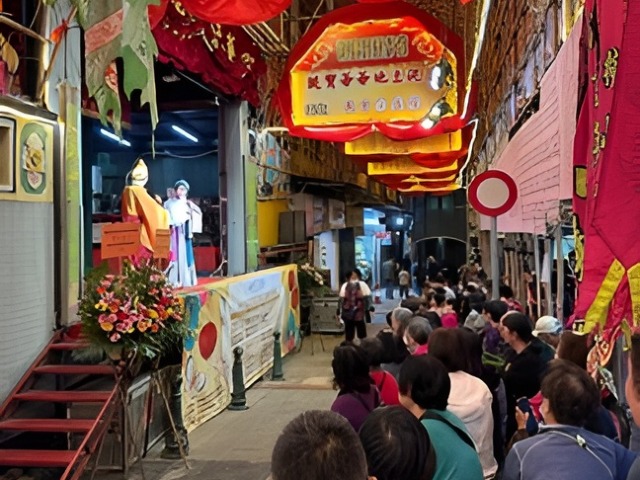
The birthday celebration was not merely one day of increased foot-traffic, however. It was a six-day celebration, starting two days before the actual day of the birthday. On the evening of the first day, the celebration commenced with an open-air Cantonese opera. For the next four days, eight more Cantonese operas were performed, gradually drawing more and more people, mostly elderly, to sit on make-shift benches in front of the stage.
Between the performers and the audience is a normal street where people lead their normal daily lives. But during this special period, herbal tea shops and bistro owners on that street benefited from being able to enjoy the operas while working, and chatted with neighbours while humming verses from the operas they had memorised over the years.
The first peak of the celebration occurs towards midnight on the second day. Eight performers, after the preceding Cantonese opera performance, appeared dressed as the Eight Immortals (八仙) of Chinese folklore, and accompanied by those who oversee the temple and the neighbourhood, as well as other patrons and neighbours. These performers went one by one into the temple and offered their “first incense” to Tou-Tei, marking the start of Tou-Tei’s birthday.
As morning broke, devotees flooded from all sides into this narrow temple and the already cramped spaces around it. Members from other Tou-Tei temples and shrines, with their own Tou-Tei statuettes, came with dancing lions and paid tribute to this Tou-Tei temple at Cheok Chai Yuen. They placed the statuettes in front of the temple, facing the “larger” Tou-Tei revered inside, set up offerings, burnt incense and candles and made their way through the temple, giving the papers to a temple volunteer to burn. Finally, concluding the whole ritual, they bore their statuettes away. At the same time, neighbours serving as volunteers were busy dividing fruits and snacks, chopping roasted suckling pigs and packing them into bags as a way to thank the patrons and neighbours who had donated money in support of the festivity.
Devotees came and went continually even after that day. The second climax of the celebration was in the evening of the final day. More than a hundred tables were set up on the streets close to the temple: two rounds of “Street Banquet” were going to happen. Elderly people and their families were invited to feast in the early evening in the first round, which served as a toast to them for their year-long participation in the neighbourhood’s affairs, and an occasion to pay respect to their seniority. They were seen enjoying socialising with each other and initiating various lively conversations here and there. At the same time, the shows had started up again on the stage, with passionate performers and elderly people going up on stage carefreely, singing popular old tunes and excerpts from famous Cantonese Operas. A second round of feasting was then prepared. Neighbours, volunteers and friends from all parts of the city joined together, well until around 11:00 pm, marking the end of the festivity.
It is a lively event. And it might be natural to think that such liveliness is due to the fact that this festivity is part of the belief and customs of Tou-Tei, which is a locally and nationally acknowledged intangible cultural heritage. On the other hand, Laurajane Smith and other critical heritage scholars have warned us that the labelling and discourse of an item as a heritage might render fixation and “musealisation” of a nevertheless lived tradition, selectively freezing elements of a tradition into museum objects that are distanced from people’s daily participation. Therefore, what our case of Tou-Tei demonstrates to us is that, albeit being a piece of heritage, its vigour and liveliness are still something remarkable in the annual returning the the festivity.
After all, no fewer than 140 Tou-Tei shrines can be found in Macau today, and there are innumerable Tou-Tei niches in front of shops and restaurants, buildings and houses, not to mention people’s homes. Each one of these shrines and niches guards a specific cluster of social relationships, be it a family, employer-employee relationships, or an entire neighbourhood. Let us also not forget the anecdote in our last blog post, where the people effortlessly agree with the omnipresence of Tou-Tei. Such a close relationship and integration into people’s lives reflects, in turn, the life of heritage itself—it is a life that does not get frozen behind the showcase and label, a life that correlates with people’s lives. Hence, people’s cross-generational experiences of the heritage make up the life of heritage, which continuously feeds back into people’s lives. It is in this loop that heritage expresses its presumed value: to be inherited, rather than merely to be appreciated as a specimen or learnt as a piece of cold fact. The sustainability of heritage lies therefore precisely in such a loop, but what, then, do the "experiences" of Tou-Tei mean to the participants and devotees?
About the author
Ka Yin (Caspar) Chan is a PhD researcher at the University of Groningen, and a senior researcher at The Heritage Society, Macau SAR. Drawing on critical heritage studies, memory studies, narratology and ethnography, his current research focuses on the dynamic relationship between the notion of cultural heritage and its constituting communities’ memory. Additionally, he also conducts archival research and writes on Macau's history within the contexts of multinational exchange and geopolitical tension.