
The Migratory Tou-Tei (Earth God): Continuous Past, Living Heritage and Evolving Memory (1 of 3)
At a lecture I attended in Macau on the relationship between the city’s urban development history and the practice of the belief of Tou-Tei (土地; “Earth God”), a speaker, historian and urbanist, made the following remark: “Tou-Tei used to represent the celestial civil administration on Earth. For the same reason, as people migrate, Tou-Tei follows; as people settle down, they also build a place for Tou-Tei; as people grow in number, Tou-Tei’s ‘office place’ becomes enlarged; but as people disperse, Tou-Tei’s worldly embodiments are abandoned.”
The speaker’s vivid and affective account of Tou-Tei is noteworthy. But equally fascinating were the audience’s fond reaction and consenting head nods in response. It was as if Tou-Tei were a familiar being whom everyone knew, as if everyone was simply acknowledging a close friend who just so happened to be out of town at that moment, who was secretly watching over us as a superhuman being, but also existed among us, down to earth. This fascinates me: how does such a millennia-long belief system of Tou-Tei evolve and attain its familiarity in the present?
To begin with, Tou-Tei literally means “Soil and Land”. Tei is often thought of together with the concept of Tin-Tei, or “Sky and Land”, which denotes the fundamental cosmological order for generations of Chinese: the Sky shelters and provides, whereas the Land yields and contains – a philosophy for the ancestors who practised agriculture since time immemorial. Concurrently: the Sky instructs, whereas the Land receives – a governing thought embodied by every emperor, acknowledged as the Heavenly Son, who constantly issued his mandates over his people from the land.
It is within this framework that the idea of Tou-Tei emerges. While Tei refers to land and earth in general, an idea quite immense, Tou expresses a more intimate sense of earthiness and locality. It is the nurturing ground where one is rooted, a sense of locus where childhood memories, family gatherings, neighbours’ get-togethers and daily lives are entangled.
The yearning for an amicable connection with one’s neighbours, as well as the wish to be able to depend on the soil for one’s livelihood, has forged a reciprocal relationship between society and various items found at hand on earth, be it a stone or a tree. These earthy and earthly items have then become the means through which people pay tribute to the Land and the Sky, and, in turn, through which the cosmological order of “Sky and Land” subconsciously influences people’s everyday life.
The governing thought of “Sky and Land” has also been extended to these local societies. Semi-autonomous institutes were set up. Members of the societies would take care of their own affairs before officials needed to be informed, in the sense that they acted as an intermediary between the people and the Heavenly Sons. This, of course, was a practice that developed in Imperial China, but it found a variation as time approaches the present.
Worldly and otherworldly powers are thus interwoven, and similarly, natural objects of worship gradually gained human aspects. Stones and wood logs were carved with human faces, becoming Tou-Tei Kung Kung (Grandpa Earth God). At the same time, altars, pavilions and finally temples were established to house Tou-Tei. Later, as if our beloved Grandpa Earth God had been too lonely, Tou-Tei Po Po (Grandma Earth God) began to be placed beside him. Hence, Tou-Tei not only represents people’s awe in response to nature and respect for the common good, but also exhibits family ideals: parents as a couple, and filial piety, which is most visibly embodied in the way one gestures towards Tou-Tei as seniors.
Finally, the larger Tou-Tei temples have also become the very makeshift places where the neighbourhood’s affairs are settled. In front of the images of Tou-Tei, people understand that they have to act with benevolence and virtue in settling communal affairs and disputes. Worldly affairs and spiritual well-being are intensely intertwined in such a use of space.
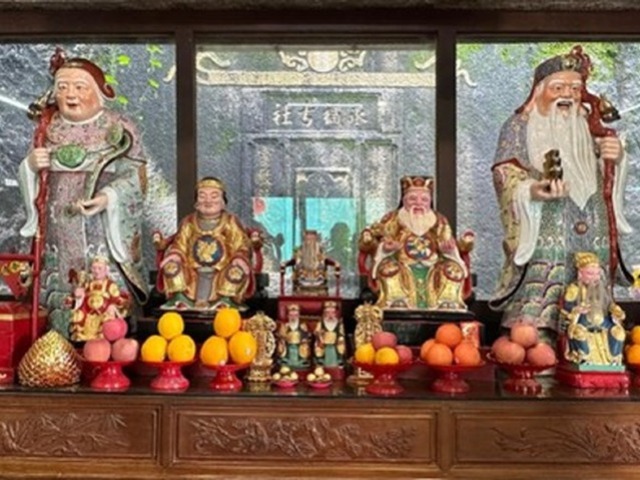
Nowadays in Macau, statuettes of a slightly chubby old couple with warm smiles and caring faces are to be seen in many Tou-Tei shrines. But, as if Tou-Tei had split images, it is also not rare to see how Tou-Tei in multiple forms is placed together under a single roof, as seen in the opening picture.
On the other hand, following the same logic that any governmental institution is expanded in accordance with the growth in the number of its subjects, the number of Tou-Tei shrines is also ‘growing’, thanks to the increasing number of devotees. From a simple stone podium on the ground, one can now find Tou-Tei raised to an altar of human height. Thereafter, multiple images of Tou-Tei are added to the altar; censers are placed reflecting the increasing popularity of the devotion, with free incense donated by anonymous neighbours; temporary joss-paper burners are supplied to cater for the burning of offerings, which, as time goes by, may be replaced by a semi-permanent furnace. Naturally, on account of its grassroots initiative and its public location, the complementary parts of a Tou-Tei shrine cannot be too big: otherwise, the Municipal Affairs Bureau and the fire brigade would come to dismantle them.
Tou-Tei, like any other continuous practice, is fluid and organic, not defined by its content at any specific time, but by how the participants make sense of it at a specific present, a present that nevertheless constrains the possibilities of how the practice can be carried out. A quick glimpse of the history of Tou-Tei allows us to see that the belief and practice not only manifest how different generations of people have understood and lived their lives, but also an assimilation of cosmology and bureaucracy, an equilibrium between practising one’s worldview and making it compatible with the present situation. We see an emerging translation of people’s vision of the world into collective practices, and at the same time, Tou-Tei’s changing images are also layered with different meanings and ideals that allow such practices to traverse from the past to the present.
From there, we would like to delve deeper: Besides what is seen from the archives and materials, how is such a practice lived in the present and on the ground?
About the author
Ka Yin (Caspar) Chan is a PhD researcher at the University of Groningen, and a senior researcher at The Heritage Society, Macau SAR. Drawing on critical heritage studies, memory studies, narratology and ethnography, his current research focuses on the dynamic relationship between the notion of cultural heritage and its constituting communities’ memory. Additionally, he also conducts archival research and writes on Macau's history within the contexts of multinational exchange and geopolitical tension.