
'This time, I went through hell and back through the archives'
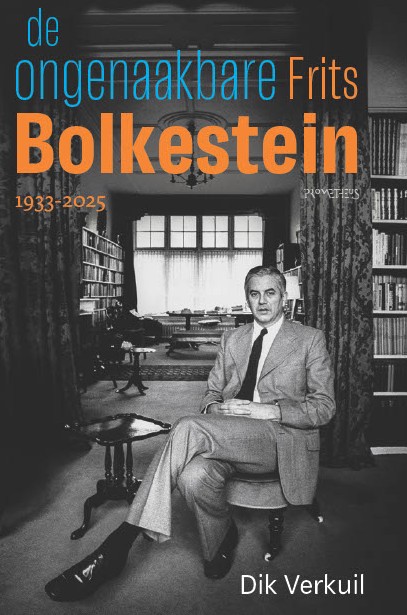
NOS journalist Dik Verkuil will receive his doctorate on 12 March at the age of 66 from the Faculty of Law for his biography of the Dutch VVD politician Frits Bolkestein (1933-2025). It was about time. 'I have always felt like a failed academic.'
Door Esther van der Meer
You already had a lot of books to your name. Why did this biography become a PhD thesis?
‘I studied history in the 1980s and seriously considered a career in academia. But the competition was fierce and a PhD student was poorly paid. That's how I ended up in journalism, but I never really felt at home there. I always felt a bit like a failed academic.
In addition to my job in journalism, I always wrote about history and politics. Professor Hans Righart from Utrecht said about my 1992 book on the origins of the Dutch political party CDA: 'You should have contacted me, you could have used it for your PhD.' That idea stuck with me.
Then I started writing the biography of Joop den Uyl, the most left-wing prime minister of the Netherlands, but I got stuck: I had four children, a job, the Den Uyl family didn't want to cooperate, and I couldn't get access to his archives. But when Annet Bleich's biography was published in 2008, I thought: I completely disagree with the picture she paints. In the end, after many nights of writing and a sabbatical, I did write the book, which was published on his 100th birthday in 2019.
One review struck me particularly at the time, by Paul van der Steen, himself the biographer of former Dutch Prime Minister Jo Cals. He wrote in newspaper Trouw: 'What a pity that such a great storyteller did not make the hellish journey through the archives. Who knows what he might have unearthed.' Then I thought: I took the easy way out. If I do it again, it has to be better.'
Did you make that journey this time?
'I originally wanted to write my next biography about Fred van der Spek, the Dutch left wing politician and leader of the PSP. Like many of my generation, I found Den Uyl too moderate. When I was a student, Van der Spek was the man who I thought understood how the world worked. Later, I was fascinated by the fact that such an intelligent man could be so straightforward and uncompromising as a politician.
But my publisher, Nieuw Amsterdam, said: who even remembers who that is? Wouldn't Bolkestein be a better idea? Bolkestein was much further removed from me: I thought he was a man on the wrong side of history. But he is an interesting figure, and I became fascinated.
My supervisors were easy to find: the publisher knew Hans Renders from the Groningen Biography Institute, and I knew Gerrit Voerman through a book about GroenLinks for which I had done research at his Documentation Centre for Political Parties.
Hans Renders asked Meindert Fennema, a good friend of Bolkestein's, to persuade him to cooperate. That's how I gained access to my main character, his close associates and his archive. I now had a wealth of material that I didn't have for my book about Den Uyl.'
Did this biography give you less freedom now that it is an academic thesis?
'In my view, every biography should be academic: you must be able to substantiate everything, every sentence must be consistent with the facts, and every interpretation must be supported by evidence.
What is more difficult is that a biographer always identifies with the subject to a certain extent, but you also have to distance yourself from that. You have to guard against the natural tendency to impose restrictions on yourself out of sympathy for your subject. I immediately told Bolkestein: you can check the biography for facts, but I am responsible for the selection of those facts and their interpretation. He agreed to that.'
You have a doctorate in law, and Bolkestein was a lawyer himself. Can lawyers learn anything about constitutional law from your book?
'Bolkestein had very clear views on the role of parliament. He believed that ministers were responsible for everything that happened in their departments, whether or not they were well informed by their civil servants. According to this Bolkestein doctrine, ministers should resign much more often. And he was a dualist. He believed that the leader of a political party should not sit in government, but should be able to speak freely. He would have disapproved of what the Dutch leader of the VVD, Yeşilgöz, is doing now.'
How would you describe Bolkestein as a person?
‘Unapproachable, which is why I chose that as the title of my book. Difficult to get close to, difficult to dissuade from a point of view. Not very socially skilled, but an impressive person. He saw himself as an Amsterdam merchant: businesslike, a man who knows how the world works, but he also had a certain naivety. An intellectual against his will.’
First Den Uyl, now Bolkestein. Who will be the subject of your next biography?
' The similarity between these two men is clear: Den Uyl dominated the intellectual scene in the 1970s, Bolkestein in the 1990s. Their ideas ruled politics. That's why I find them interesting. But now? Geert Wilders was trained by Bolkestein, and I devote a chapter to that. He now dominates the debate, but it's so shallow and vulgar. I can't name anyone in current Dutch politics that I find interesting. So maybe in my next book I'll look in a completely different direction. But it will still be a biography.'
What is so appealing about that genre?
‘You immerse yourself completely in another person, you elevate yourself to a higher level than you have achieved. It's a fascinating genre.’
'De Ongenaakbare Frits Bolkestein' (The Unapproachable Frits Bolkestein) by Dik Verkuil will be published on 13 March by Prometheus Publishers. The promotion will be live here on 12 March at 12.45 p.m.
More news
-
21 September 2026
Disinheritance is about much more than money
-
31 August 2026
A digital game of cat and mouse
-
03 August 2026
Opinion: ‘AI must not take the place of the judge’