
Universitaire Minor: Climate Change and Inequality
Lina's ervaring met deze minor
Een interview met Lina Volkmann, Minorities & Multilingualism student, die in 2025-2026 de Universitaire minor Climate Change and Inequality heeft afgerond.
Vorig jaar rond deze tijd moest jij kiezen voor een minor. Wat heeft jou geholpen bij het maken van je minorkeuze en wat zou je studenten aanraden om te doen?
De minormarkt (onderdeel van het “Kies Je Minor Event”) is een perfect moment om verschillende minoren met elkaar te vergelijken. Je kunt met studenten en docenten van de minoren praten, vragen stellen en naar hun ervaringen luisteren. Dit heeft mij enorm geholpen en maakte het uiteindelijk makkelijker om een keuze te maken.
Waarom heb je uiteindelijk gekozen voor een universitaire minor?
Ik wilde met mijn minor bewust een andere richting op dan mijn eigen studie en de werkwijze van mijn faculteit. Daarvoor is een universitaire minor perfect.
Wat onderscheidt de universitaire minor van andere minoren, zoals de facultaire of Career minor?
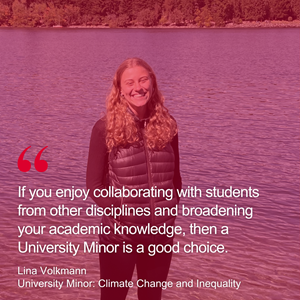
Een universitaire minor biedt je echt de mogelijkheid om buiten je eigen vakgebied te kijken. Als je het leuk vindt om samen te werken met studenten uit andere disciplines en je academische kennis te verbreden, dan is een universitaire minor een goede keuze. Je maakt kennis met een ander academisch veld en leert op een nieuwe manier naar maatschappelijke vraagstukken te kijken.
Voor welke universitaire minor en studierichting heb jij gekozen en waarom?
Ik heb gekozen voor de minor Climate Change and Inequality, omdat ik graag afstand wilde nemen van de sociale wetenschappen. Deze minor gaat in op de bèta-aspecten van klimaatverandering, zoals hoe de opwarming van de aarde werkt, en legt tegelijkertijd de link met ongelijkheden en machtsstructuren die samenhangen met klimaatverandering. Die combinatie van natuurwetenschappelijke en sociaal-maatschappelijke perspectieven vond ik erg spannend en interessant.
Welke colleges heb je gevolgd en wat vond je ervan?
Ik heb colleges gevolgd bij de faculteiten Science en Engineering en Religie, Cultuur en Maatschappij, wat een leuke combinatie was omdat ik twee andere faculteiten heb leren kennen. De vakken die ik volgde waren Global Inequality and Climate Change: Themes and Approaches, Environment and Development, Climate Change Inequalities: Challenge-Based Projects en Climate Change, End Times and Sustainable Futures. Het leukste vak was voor mij het challenge-based project. Je werkt daarin tien weken lang aan een concreet probleem, bijvoorbeeld rondom groene energie, in opdracht van een externe opdrachtgever.
Hoe zag een gemiddelde dag tijdens de universitaire minor eruit?
Een gemiddelde dag bestond uit colleges, werkgroepen en projectwerk. Daarnaast werkte ik samen met medestudenten aan groepsopdrachten en het challenge-based project, wat zorgde voor een afwisselend programma.
Hoe zou je de minor in één zin uitleggen?
Tijdens deze minor leer je meer over de natuurlijke én sociaal-maatschappelijke oorzaken en gevolgen van klimaatverandering, van de opwarming van de aarde tot de ongelijke verdeling van de gevolgen van klimaatverandering tussen het Global North en Global South en de verantwoordelijkheid die daarbij komt kijken.
Wat is een concrete vaardigheid die je later meeneemt naar je werk?
Het schrijven van policy papers, het voeren van inhoudelijke debatten en het samenwerken met opdrachtgevers binnen een interdisciplinair team.
Wat is je belangrijkste les geweest?
Hoe ongelijk de gevolgen van klimaatverandering zijn, hoe belangrijk indigenous knowledge is bij het tegengaan van klimaatverandering en hoe cruciaal, maar ook complex, het is om groene energie op een eerlijke manier te verdelen.