
Minor: Climate Change and Inequality
This interdisciplinary university minor dives into the pressing questions of climate change and global inequality, helping you understand the social, legal, political, and philosophical dimensions of climate change and inequality. You’ll explore how different regions - from the Pacific to Africa and Europe - experience and respond to climate challenges.
What will you do?
-
Learn how inequality is embedded in global climate policies and responses.
-
Examine real-world cases where climate change exacerbates injustice.
-
Work in interdisciplinary teams to develop practical solutions to climate-related challenges.
In this minor, you will analyze the causes and consequences of climate inequality using diverse interdisciplinary theories and research methods. You will develop your own interdisciplinary proposals to tackle climate inequality and injustice, focusing on practical, action-driven solutions; and you will be able to apply your knowledge to show how different types of inequality are deeply intertwined with climate change—and why that matters for real-world solutions.
The minor is ‘housed’ in the Faculty of Religion, Culture and Society, and organised in collaboration with Wubbo Ockels School for energy and climate. The multidisciplinary teaching team consists of dedicated lecturers from the faculties of Science and Engineering (FSE); Arts; Religion, Culture and Society (RCS); Law; and Spatial Sciences.
This minor is for students who want to think critically, challenge their own assumptions, and take action. Are you ready to be part of the solution?
Courses and Study Scheme
|
Semester 1, block 1
|
Semester 1, block 2
|
|---|---|
|
Global Inequality and Climate Change: Themes and Approaches (10 ECTS, Faculty of RCS) |
Climate Change Inequalities: Challenge-Based Projects (10 ECTS, Faculty of FSE) |
|
Environment and Development (5 ECTS, Faculty of FSE) |
Climate Change, End Times and Sustainable Futures (5 ECTS, Faculty of RCS) |
|
Total: 15 ECTS
|
Total: 15 ECTS
|
Programme options
This minor is possible to be taken either as a full 30 ECTS option or as a 15 ECTS option (in that case, the students only take the first two courses in block 1a).
Please note: select the correct academic year at the top of the page on the timetable website. And some courses may not be visible yet in the timetable.
More information and contact
If you have any questions about the minor, please contact Dr Gorazd Andrejc, coordinator of the minor Climate Change and Inequality. And please visit the University of Groningen minor page for more information about the information events, registration procedure and frequently asked questions.
Are you a student from either another university or a university of applied sciences (hbo)?
Please contact the Study Advisor for more information and registration.
Testimonial: Lina's student experience with this Minor
An interview with Lina Volkmann, Minorities & Multilingualism student, who completed the University Minor Climate Change and Inequality in 2025-2026.
This time last year, you had to choose a Minor. What helped you make your decision and what would you recommend other students to do?
The Minor Fair (part of the “Choose Your Minor Event”) is a perfect opportunity to compare different Minors. You can talk to students and lecturers from the Minors, ask questions, and listen to their experiences. This helped me enormously and ultimately made it easier to make a choice.
How did you come to choose a University Minor?
I wanted my Minor to be in a different direction than my own study programme and the working methods of my faculty. A University Minor is perfect for that.
The University Minors offer you a chance to take a look at another academic field. What University Minor and academic field have you chosen and why?
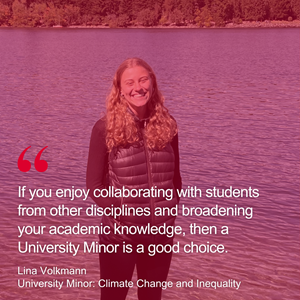
A University Minor really gives you the opportunity to look beyond your own field of study. If you enjoy collaborating with students from other disciplines and broadening your academic knowledge, then a University Minor is a good choice. You will be introduced to a different academic field and learn to look at social issues in a new way.
The University Minors offer you a chance to take a look at another academic field. What University Minor and academic field have you chosen and why?
I chose the Minor Climate Change and Inequality, because I wanted to distance myself somewhat from the social sciences. This Minor examines the scientific aspects of climate change, such as how global warming works, while also establishing the link with inequalities and power structures associated with climate change. I found this combination of scientific and social perspectives very exciting and interesting.
What lectures did you attend and what did you think of them?
I attended lectures at the faculties of Science and Engineering and Religion, Culture and Society, which was a nice combination because it allowed me to get to know two other faculties. The courses I took were Global Inequality and Climate Change: Themes and Approaches, Environment and Development, Climate Change Inequalities: Challenge-Based Projects, and Climate Change, End Times, and Sustainable Futures. My favorite course was the challenge-based project. In this course, you spend ten weeks working on a specific problem, such as green energy, on behalf of an external client.
What did an average day during your University Minor look like?
An average day consisted of lectures, seminars, and project work. In addition, I worked with fellow students on group assignments and the challenge-based project. A varied programme.
How would you explain your University Minor in one sentence?
During this Minor, you will learn more about the natural and socio-cultural causes and consequences of climate change, from global warming to the unequal distribution of the consequences of climate change between the Global North and Global South and the responsibility that comes with it.
What is the concrete skill you will take with you to your job later?
Writing policy papers, conducting substantive debates, and collaborating with clients within an interdisciplinary team.
What has been your most important lesson?
How uneven the consequences of climate change are, how important indigenous knowledge is in combating climate change, and how crucial, but also complex, it is to distribute green energy fairly.
Quality AssuranceA. 'Home base' of the minor Climate Change and Inequality is the Bachelor Religious Studies. |