
Gauss, Johann Carl Friedrich
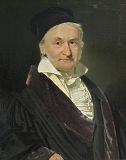
The German Johann Carl Friedrich Gauss (1777 - 1855), son of a relatively low social family, was a mathematician, astronomer, geodesist, and physicist.
As an elementary student, Gauss and his class were tasked to sum the numbers from 1 to 100. Much to their teacher's surprise, Gauss quickly replied with the correct answer of 5050: he had computed the sum as 100 sets of 101 and divided by 2.
| 1 | 2 | 3 | ... | 90 | 99 | 100 |
| 100 | 99 | 98 | ... | 3 | 2 | 1 |
| 101 | 101 | 101 | ... | 101 | 101 | 101 |
While studying, he propounded several mathematical theorems.
As an independent scholar, he wrote masterpieces about arithmetics and celestial mechanics. He produced the second and third complete proofs of the fundamental theorem of algebra. In number theory, he made numerous contributions. He also contributed to the theory of binary and ternary quadratic forms, the construction of the heptadecagon, the use of modular arithmetic, and the theory of hypergeometric series. He was the first to study non-Euclidean geometry. He developed a fast Fourier transform.
Gauss identified Ceres as a dwarf planet. He introduced the Gaussian gravitational constant and the method of least squares.
His practical work led to the invention of the heliotrope, a magnetometer and the first electromagnetic telegraph.
Due to Gauss's fundamental contributions to science and mathematics, more than 100 mathematical and scientific concepts are named after him.
He lent his name to the Gauss distribution, and to the gauss, the old unit of magnetic induction.