
Leverage Points for the Agricultural Transition
Dutch agriculture underwent a rapid transition after the Second World War. At the time, there was a clear goal: never again hunger. Based on this goal, agriculture was systematically organized around maximum food production at the lowest possible cost. However, this dominant development trajectory is no longer sustainable. This is evident in soil depletion and growing economic uncertainty for farmers. Several initiatives have searched for new possibilities, but it has proven difficult to shift agriculture in a different direction (Vink and Boezeman, 2018). The question, then, is: what is needed to set an agricultural transition in motion?
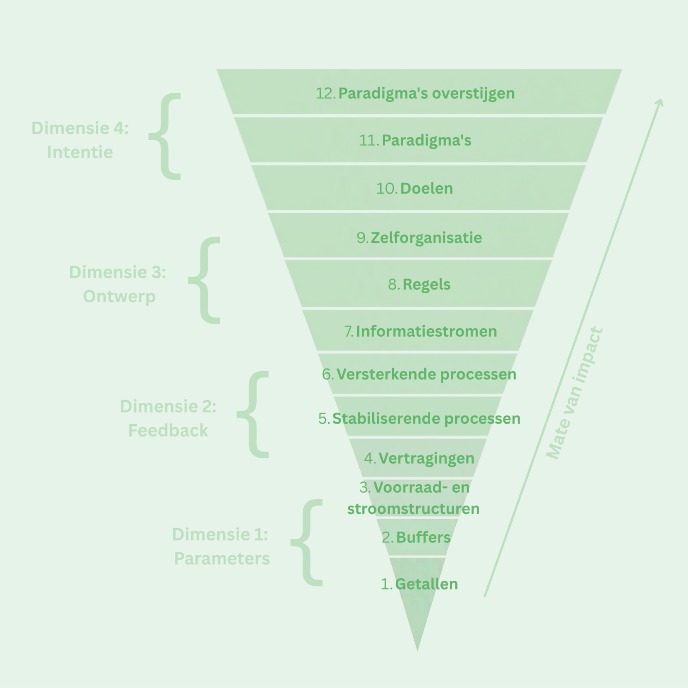
Environmental scientist Donella Meadows offered a possible answer to this question. She identified twelve leverage points for systemic transitions. Leverage points are places in a system where a relatively small change can have major consequences for the whole system. The leverage points at the top of her list are relatively superficial. Changes here are generally easier to implement, but have a limited impact. The leverage points at the bottom target the underlying structures, mindsets, and rules that shape a system. Although changes to these leverage points are harder to achieve, they can have a major impact on the system (Meadows, 1999).
The 12 leverage points can be divided into four dimensions: parameters, feedback, design, and intent (Abson et al., 2017).
Dimension 1: Parameters
The first dimension, parameters, refers to leverage points 1–3:
1. Numbers: Subsidies, taxes, and standards.
2. Buffers: The size of stocks relative to flows (for example, a water reservoir or the amount of stored livestock feed to buffer against drought).
3. Stock-and-flow structures: The way stocks and flows are organized within a system (for example, transport networks or nutrient runoff).
The leverage points in this dimension often receive the most attention. A great deal of tinkering with numbers takes place to set a transition in motion. For instance, the implementation report on nitrogen reduction cites a reduction target of 23–25% for ammonia emissions by 2030 (Ministry of Economic Affairs and Climate Policy, 2026). According to Meadows (1999), however, the leverage points within this first dimension are among the least effective ways to fundamentally change a system.
Dimension 2: Feedback
The second dimension, feedback, refers to leverage points 4–6:
4. Delays: The time needed to receive information and implement adjustments.
5. Balancing (stabilizing) processes: Self-correcting interactions that keep the system in equilibrium (for example, integrated pest management).
6. Reinforcing processes: Self-reinforcing interactions that can lead to instability in the system (for example, loss of vegetation cover leading to soil erosion).
There are two types of feedback, or interactions, between the components of a system: reinforcing and balancing. Reinforcing feedback can lead to instability. Here, two system components cause each other to change in the same direction — when one increases, the other increases too, and vice versa. For example, higher productivity can lead to greater profit, which in turn drives production even further. Balancing feedback, by contrast, has a dampening effect and helps limit fluctuations in a system. Here, two system components change in opposite directions: as one increases, the other decreases. For example, an increase in natural predators in the landscape can lead to a decrease in pests.
Dimension 3: Design
The third dimension, design, refers to leverage points 7–9:
7. Information flows: Structures that determine how information is passed on.
8. Rules: Incentives, sanctions, and constraints (for example, laws and regulations).
9. Self-organization: A system's capacity to adapt and renew itself, determined by variation, diversity, and experimentation.
The lack of progress toward regenerative agriculture can largely be explained by the limited room to maneuver that many farmers have. Scale enlargement and specialization have led to higher debt and greater dependency on other parties, making it uncertain and risky for farmers to experiment with alternative farming models (Vink and Boezeman, 2018). The leverage point "self-organization" specifically targets expanding this room to maneuver.
Dimension 4: Intent
The fourth dimension, intent, refers to leverage points 10–12:
10. Goals: The purpose of the system (for example, increasing agricultural exports versus strengthening food security in the Netherlands).
11. Paradigms: The underlying mindsets that have created the system (for example, the paradigm of the Green Revolution or an agroecological paradigm).
12. Transcending paradigms: The realization that no single mindset is complete, and that different mindsets each carry their own internal logic.
The post-war agricultural transition had a clear goal: never again hunger. This goal represented a change in leverage point 10 and provided a strong vision of the future that gave direction and stability (Vink and Boezeman, 2018). The agricultural system, including its other leverage points, was subsequently organized around this goal. From this, we can learn that changes in the fourth dimension can have major consequences for the entire system. Setting a transition in motion therefore requires a clear goal and a compelling vision of the future. Sustainability, however, is still often associated with more restrictions, regulation, and sacrifice. The best goal that most sustainability advocates offer is averting catastrophe. While there can be motivation in preventing a disaster scenario, even more motivation can be found in creating a better world (Meadows, 1996). Leverage points in the fourth dimension are the hardest to change, but the encouraging part is that everyone can contribute to this. That is why, at CDLT, we bring together practice, policy, and research to jointly build a vision of regenerative agriculture for farmers, the soil, and society as a whole.
This article was written by Noortje Wauben, post-doc researcher at the Centre of Sustainable Agriculture Transition.
Bibliography
Abson, D. J., Fischer, J., Leventon, J., Newig, J., Schomerus, T., et al. (2017). Leverage points for sustainability transformation. Ambio, 46(1), 30–39.
Meadows, D. (1996). Envisioning a sustainable world. In: R. Costanza, O. Segura, and J. Martinez-Alier (eds.). Getting Down to Earth: Practical Applications of Ecological Economics. Island Press, Washington D.C.
Meadows, D. (1999). Leverage Points: Places to Intervene in a System. Hartland: The Sustainability Institute, 1–19.
Ministry of Economic Affairs and Climate Policy (2026). Uitvoeringsrapportage maatregelen stikstofreductie [Implementation report on nitrogen reduction measures]. Available online: https://open.overheid.nl/details/0805f2a7-2886-49bf-83f2-eece00ba5acd
Vink, M., and Boezeman, D. F. (2018). Naar een wenkend perspectief voor de Nederlandse landbouw: Voorwaarden voor verandering. Netherlands Environmental Assessment Agency (PBL), The Hague.