
What comes after GPS? Sara Torres' Future Plans
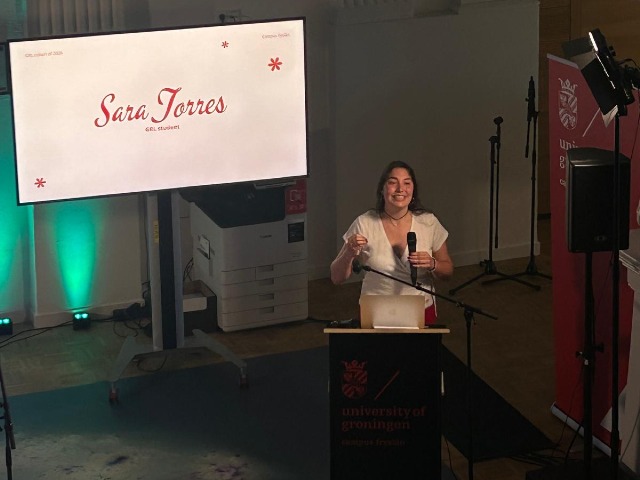
Many students wonder "what can you do with a bachelor in Global Politics & Sustainability (formerly known as Global Responsibility & leadership)?". As a fundamentally interdisciplinary programme, it leaves many doors open, and today, we are hearing from Sara Torres, an exemplary student who just graduated from the programme. She will tell us all about her journey through, her experiences, including a minor abroad and an internship, and about her future: a master's degree in International Humanitarian Action
Originally from Spain, Sara completed the Energy, Ecology and Climate major, explored the Culture and Economics tracks through electives, spent a semester in Halifax, Canada, studying International Development Studies, completed a research internship with Flynth, graduated from the Honours College, and wrote her thesis on the ethical responsibility of international NGOs to decarbonise their operations.
Now, she's about to begin a Master's in International Humanitarian Action through the NOHA network, with the University of Groningen as her home university and opportunities to study across Europe, and hopefully, as she puts it, "around the world in a partner university from the Global South".
Following the questions that stayed
Sara describes herself as someone with "a wide range of passions", although one has always found its way into everything else.
"My true devotion, however, is to the environment, and everything I do ultimately ends up relating to improving our relationship with the environment and alleviating the harm we have caused it, and indirectly, the harm we cause vulnerable populations too."
She arrived imagining a future in environmental activism, conservation, corporate social responsibility and environmental compliance. Those interests never disappeared, but the programme then introduced her to different questions, different perspectives and different ways of looking at the same problems.
"My favourite class in was Ethics and Global Responsibility and the international development courses I took during my minor contributed strongly to the choice of thesis topic and, additionally, my master's programme. I have learned how inescapable politics and economics are in the discussion of environmental protection, and that in our noble pursuits of tackling climate change, we must place vulnerable and local populations at the heart of decision making. Our ethical duties are not to either the planet or society, humans are part of nature."
Looking back, this is what she values most about studying at Campus Fryslân.
"This particular transdisciplinary, decolonial approach to seeing big problems like climate change, world hunger, or other inequalities and injustices is a key characteristic of Campus Fryslân and something I have come to appreciate how rare and necessary it is".
Choosing what comes next
After graduation, Sara decided to stay in the Netherlands, a country she says she has "fallen in love with, and in", despite "the dark winters, and sad boterham lunches".
While looking for master's programmes, she came across International Humanitarian Action and, in her own words, "instantly fell for" it.
"I have always felt drawn to the third sector, and with this degree I'm confident that I will end up there. I imagine myself making philanthropy, developmental aid, and humanitarian work more sustainable. The non profit sector, despite its good deeds, is still a big actor in global systems which contribute to climate change and environmental harm."
A message for current students
Sara has a final message for all current, or prospective students:
"I understand the frustration felt at different stages of this journey, the uncertainty of what this vague degree is about, the dissatisfaction you might feel, the impostor syndrome, comparing yourself to other students around the world."
Coming from a more traditional educational system in Spain, adapting to the programme was far from easy.
"I often felt concerned about my future prospects at... anything... I compared myself to my friends back at home, the engineers, the neuroscientists, the lawyers, and lost a lot of confidence in my value as an academic... what exactly are we, us, the so called 'globally responsible leaders'?"
She says this is a conversation many alumni recognise, one that only starts making sense when there is enough distance to look back.
"I don't want to sound patronising, but nevertheless, as a graduate, I beg of you, have faith. The reality is that it takes time for one to realise how much you grow, learn, and develop as individuals. It is only when you take a step back, reflect, compare how you approach the world before and after, how you relate to people, how you understand the complexities of life, that you'll appreciate the unique, incredibly impactful education the programme has given us.Have faith in the values of this programme, have trust in your teachers and their passions and methods, have confidence in the Campus Fryslân community. You will learn just as much outside the classroom than in it, and above all, believe in yourself and your ability to make the most of this remarkable environment, believe that you will work hard and that you will grow into a person you would admire, believe that it will all work out, and that it will all be wonderful."
And one final invitation, "If you have any doubts whatsoever, ask any other alumni, or hit me up because I'd love to talk".
About the author
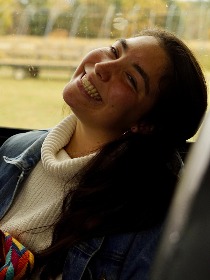
Sara Torres is a BSc Global Responsibility & Leadership and Honours College graduate at the University of Groningen. Currently, she is pursuing a Master's degree in International Humanitarian Action at the Faculty of Arts, University of Groningen.