
Defund and Defend: Health and Healthcare Costs of Rearmament
Europe is going to pay in a big way. But who?
“Europe is going to pay in a BIG way” said Mark Rutte, NATO Secretary General, ahead of the June 2025 The Hague summit, where European NATO members pledged to raise their military spending to 5% of its Gross Domestic Product (GDP).
Thanks to the Dutch coalition agreement drafted in early 2026 by the three governing parties, D66, VVD, and CDA, we are allowed to see that this pledge means, at least for the Netherlands: €10.5 billion of extra defence spending by 2030, on the way to a permanent €19.3 billion a year. That is roughly €1,000/year for every person in the country, regardless of age, gender, or passport.
Indeed, Rutte was right: Europe is going to pay in a big way. What remains to determine is who is going to pay, and at what cost for social security and health protection.
Very few people realise how closely government’s priorities and budgets’ allocations are tied to population’s health. A recent EU report estimates that over one million deaths in Europe are related to deteriorating living conditions caused by cuts to public spending on welfare: healthcare, education, pensions and social protection, to name a few. This is what we call austerity. For European countries, raising military expenditure to 5% of GDP means cutting social spending once again – in other words, deepening the austerity policies already in place.
A closer look at the Dutch coalition agreement reveals the pattern behind this increased expenditure: every euro of new spending is matched by the same amount saved elsewhere. So, if defence rises by €10.5 billion, at least 10.5 billion has to come from somewhere else.
Following the money, I deduced the defence increase is funded through two channels: a direct one, and an indirect one.
A tax you won’t notice
The direct channel is a new way of raising money: the vrijheidsbijdrage, or freedom contribution, set aside specifically to fund the NATO commitment. Here’s how it works: every year prices go up; what you could buy for €100 last year now costs €102, so the same money buys a little less over time. This is what we call inflation. To keep pace, wages usually rise too, and so do the tax bands (the income levels at which you start paying a higher rate of tax). This ensures that people keep being able to afford the same things, without being pushed into a higher tax bracket simply because their pay rose with inflation.
The freedom contribution is nothing but a mechanism that withholds the tax brackets’ adjustments. This means that salaries climb with inflation, but the tax bands don’t. Little by little, salaries shift into higher tax brackets, and income-earners will find themselves paying more taxes over time. Across the working population, this is expected to raise about €5.1 billion a year, mostly paid by lower- and middle-income earners. The mechanism is not new: the previous government already tested a milder version, which resulted in more than 800.000 lower-income earners paying up to €600 extra taxes. Because this is a hidden mechanism in the budget, it stays almost invisible and hard to contest.
Death by a thousand cuts
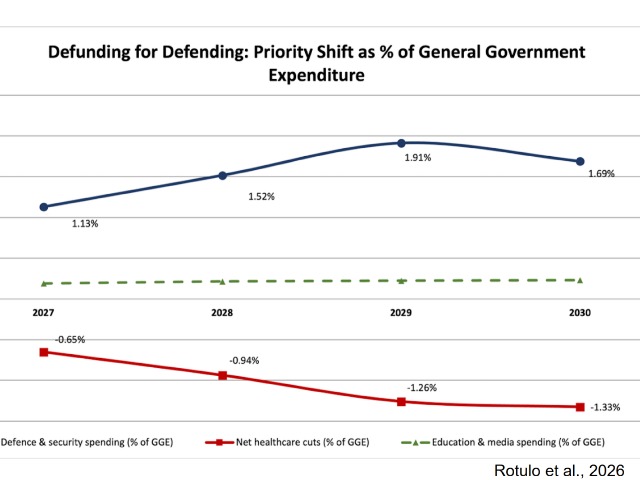
In any case, the freedom contribution covers only the smaller half of the new defence spending. The larger share comes indirectly, through cuts to healthcare: around €9 billion in 2030, and over €10 billion per year after that.
One cannot really appreciate the depth of these cuts without knowing the basic principles a health system (including the Dutch one) rests upon. The first is universality: everyone is covered. The other is solidarity: the healthy and the wealthy subsidise the sick and the poor. This works through risk pooling: everyone pays into a common fund, which then covers whoever happens to need care, so that no single person faces catastrophic costs alone.
Healthcare is made to fund defence by chipping away at these principles, through a series of measures. The first is cost-sharing – making people pay more out of their own pocket, before the insurance steps in, from €385 to €460 per year. So, whether you break a leg, battle with a chronic condition, or need home nursing, you simply pay more. This alone raises around €6 billion. The second, is managed care: narrowing what your insurance actually covers. Reimbursement is restricted to approved treatments and providers, and the partial refund you used to receive for seeing a doctor outside your insurer's network disappears. In effect, the insurer becomes the gatekeeper. The third is cost-shifting: moving expenses off the state’s budget and onto households. People in long-term care, for example, will now have to arrange and pay for their own housing and domestic help, which used to be included. The fourth is the withdrawal of financial protections from those who need the most. A tax break that since 2009 has helped people with a chronic illness or a disability meet their extra costs is scrapped. At the same time, it becomes harder to qualify for the allowance that helps lower-income households pay their premiums. Lastly, rationing on the supply side, fewer items are covered by the basic package, and fewer funded trainings are available to future medical specialists, which means longer waiting lists and thinner services down the line.
Not only the depth but also the breadth of these cuts is concerning: they do not fall on healthcare as a whole, but on the mechanisms that protect those least able to absorb the blow, i.e., the most vulnerable ones.
The debate about European security is a long and complex one, that deserves scrutiny well beyond this short post. However, when we weigh up these measures, we have to be clear about what they expect to achieve: the opposite of security and resilience. There is international consensus that population health, social cohesion, and universal access to care are themselves the conditions of security; strong health systems and fair, redistributive policies are what shield a population when something goes wrong. To equate security with military strength, and then to pay for it by dismantling the very things that keep people safe, is a contradiction that deserves our attention.
These are the kinds of questions – and the kind of thinking – we are encouraged to do every day.
Want to know more?
Anyone further interested in this debate is welcome to attend the online seminar on Tuesday 23 June at 6pm, organised by the International Association of Health Policy in Europe, where I will further talk about these issues together with German and Greek colleagues.
About the author
Arianna Rotulo is an Assistant Professor in Health Policy & Health Systems’ Research at Campus Fryslân, University of Groningen, the Netherlands