
Science for Society | MimeCure’s revolutionary treatment for chronic lung diseases
Day in, day out, scientists contribute to solutions for a wide range of societal problems. From new drugs to smart farming solutions, our research helps society move forward. However, this is not always immediately apparent. That is why, in the Science Works section, we share stories about concrete innovations, products, and ideas to show that science works!
Text: Thomas Vos, Corporate Communication, UG
Chronic lung diseases such as COPD (Chronic Obstructive Pulmonary Disease) and Idiopathic Pulmonary Fibrosis (IPF) have a profound impact on patients, but are difficult to treat. Patient care focuses primarily on managing symptoms. University of Groningen (UG) researchers Luke van der Koog and Erik Frijlink (FSE) want to change that: through their company, MimeCure, they are developing a revolutionary treatment method. The initial results are promising.
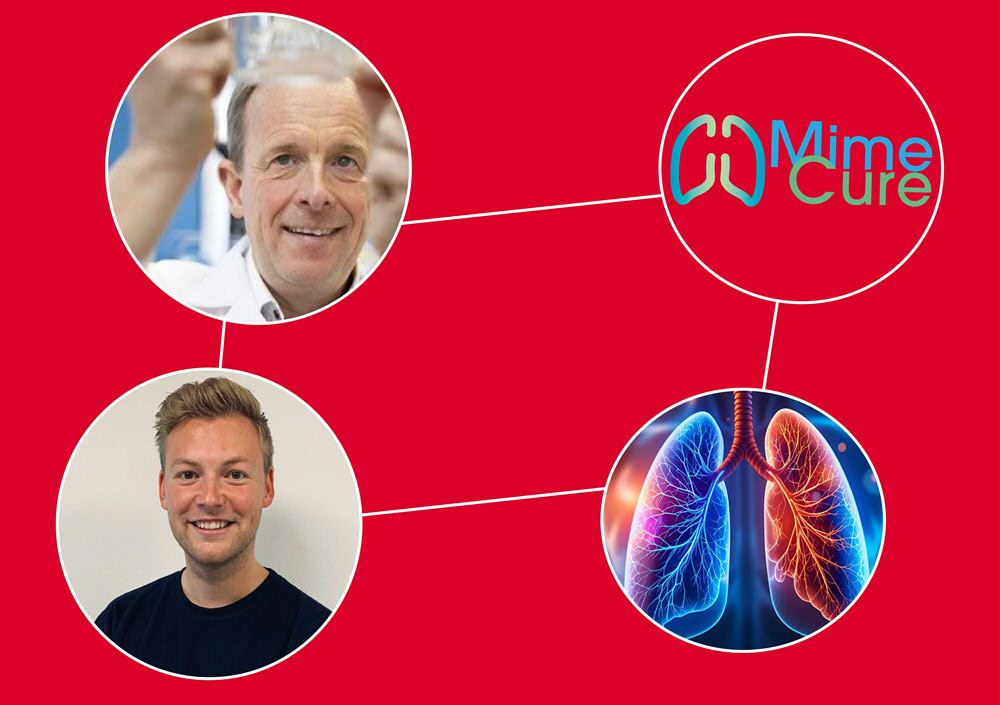
The idea behind MimeCure originated at a Christmas party. Van der Koog: ‘I was talking to Professor of Translational Pharmacology Reinoud Gosens. He had been exploring the idea for some time that extracellular vesicles (EVs) might be used as a therapy. EVs are tiny vesicles secreted by cells that carry important messages between cells. He put me forward as a PhD candidate to investigate this, and soon after brought Erik on board because of his pharmaceutical knowledge, as well as Anika Nagelkerke, who knew exactly how to isolate EVs and conduct experiments with them. Together we thought: what if we could find out what is inside those EVs? Then we would have a really great project.’ Frijlink: ‘Turning an EV into a medicine is not exactly the first thing that springs to mind as a pharmacologist, but I trusted Luke’s intelligence. And it paid off.’
Key signal
The first step was to search for the key signal within those EVs that might play a role in cell repair. Because chronic lung diseases are not yet treatable and there is a great deal of expertise on these conditions at the UMCG and the UG, Van der Koog focused on this: ‘In chronic lung diseases such as IPF and COPD, the lung tissue’s repair mechanism is disrupted. Whereas the lungs of healthy people like you and me repair themselves after inhaling harmful substances, for example, this process is disrupted in patients with IPF and COPD.’
‘In my research, I wanted to understand how repair is regulated in normal lung tissue. Stem cells in the lung play a central role in this and are supported by fibroblasts, the most important cells in the connective tissue. I wanted to investigate how these cells communicate with each other and which signals, including EVs, are involved in this process. In doing so, I hoped to find the key signal that plays a role in recovery. And in the process, I also asked myself whether we could develop this as a regenerative therapy,’ says Van der Koog.
Eureka moment
Intensive research followed. Van der Koog discovered that EVs play a crucial role. ‘But that didn’t give us a medical treatment yet,’ he explains. ‘We analysed all the proteins present in EVs. That yielded a huge list. We then devised a clever way to try and narrow this down to the proteins we believed had real potential. Ultimately, we ended up with twelve candidates. We tested these in the lab on tiny lung models, developed by Reinoud Gosens’ team. The most promising candidate was the protein osteoglycin, which we subsequently modified to leave an active fragment, which we call MC002. It does the same work as the protein, but is smaller and can therefore penetrate deeper into the lungs. Based on various models in the lab, this proved to be very effective in stimulating lung recovery.’
Frijlink: ‘The selection Luke made was very clever. There were no fewer than 2,222 proteins, and you have to identify the right one from that list. Luke made his selections in a very clever way. Otherwise, we would never have found the protein. You could certainly call it a Eureka moment.’
MimeCure
The discovery led to a patent, owned by the UG, which was licensed to MimeCure. Frijlink: ‘Groningen and the region are ideal for this. We have a fairly unique structure here in the North, such that we can make use of UG’s network and attract regional investors.’ Van der Koog: ‘At the moment, MimeCure is still in the preclinical phase, which means we are not yet permitted to test on humans. It is a long process in which we are now taking important steps. Given the scale of the research, we are initially focusing on IPF patients, as this is a relatively small group of patients. But we certainly do not rule out future applications for COPD and other diseases.’ Frijlink: ‘We want to be able to test on humans in about a year and a half. That is incredibly fast, but with smart choices and thanks to our funders, we believe it is possible. We’re making the most of the opportunities available, and I think it’s going very well.’
Spin-out helps spin-out
Ultimately, these steps should lead to a medicine. Van der Koog and Frijlink already have an idea about how it could be administered. Van der Koog: ‘We know that our protein, MC002, works and that we can develop a formulation that patients can inhale, for example using the compact inhalers from PureIMS. They would need to do this daily, although we do not yet know exactly what the dosage and frequency should be.’ Frijlink: ‘The great thing is that PureIMS is also a UG spin-out, which in turn makes our application possible. So science really does work.’
More information
Do you want to know more about Science for Society? Check out the overview page for the previous editions.
More news
-
17 September 2026
NWO-KIC funding for new route to sustainable biocatalysts
-
15 September 2026
Enzymes break down textile fibres into useful resources
-
10 September 2026
Searching for the first generation of stars