
Redrawn House maps raise the bar for a Democratic majority to 1.5 million extra votes
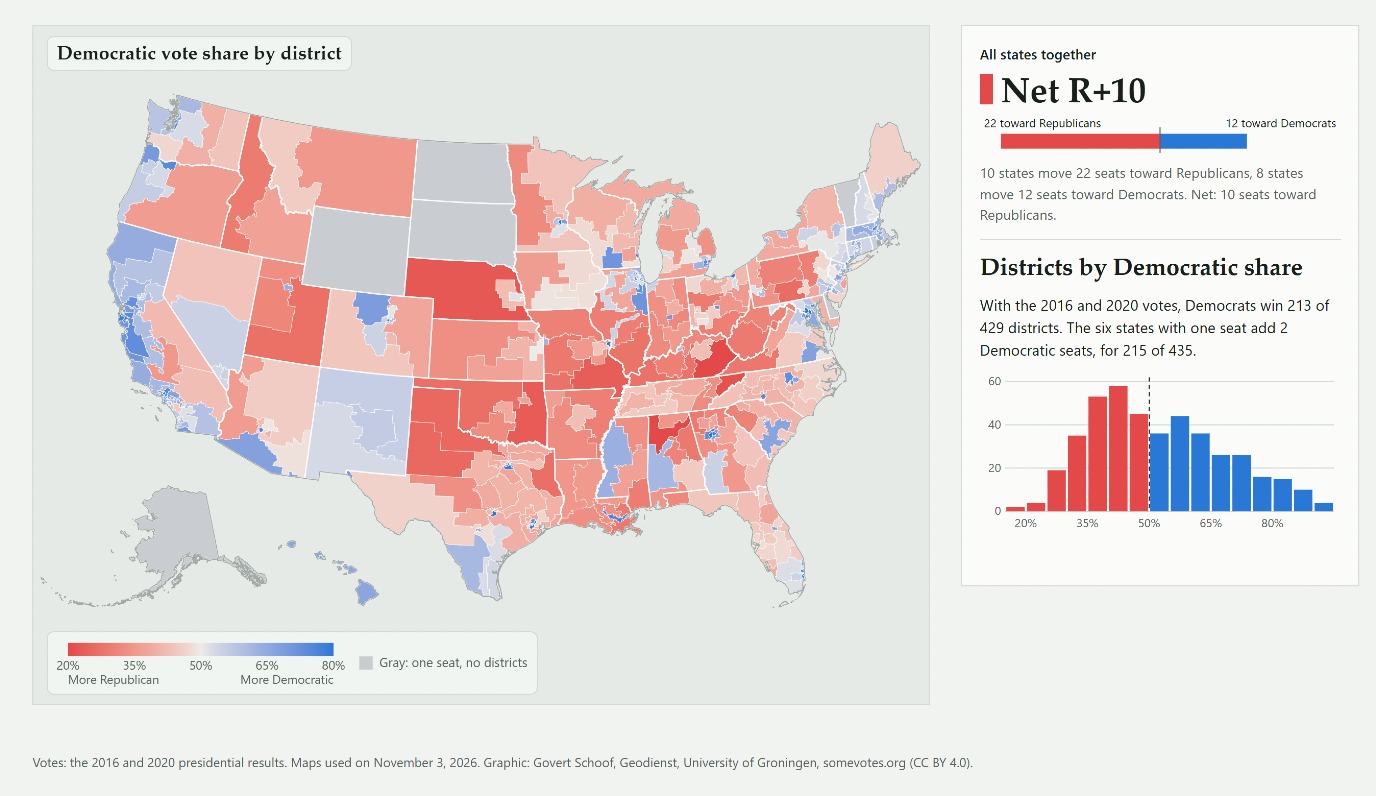
In the US mid-term elections on 3 November, the Democrats will need significantly more votes to secure a majority in the House of Representatives than they would under the 2024 voting district lines. The difference amounts to approximately 1.5 million votes. This according to an analysis by the Geodienst of the University of Groningen, which demonstrates how the redrawing of voting districts can influence US election results.
The cause is gerrymandering: the strategic adjustment of district lines to favour a political party. Both Republicans and Democrats make use of this practice, but the UG analysis Some votes are more equal than others shows that it is primarily the Republicans who benefit from the current district lines. Schoof created an interactive analysis which can be found on the website somevotes.org.
Same votes, different winner
According to the analysis, under the district maps for the 3 November election, the Democrats would need 52.4 per cent of the vote to secure a majority in the House of Representatives. Under the 2024 maps, 51.0 per cent would have been sufficient. With neutrally drawn maps, which do not take party preferences into account, that threshold stands at 51.2 per cent.
The difference of 1.4 percentage points between the 2024 and 2026 maps may seem small, but in an election with around 105 million votes, it represents approximately one and a half million voters.
Govert Schoof, founder of the University of Groningen’s Geodienst: ‘With exactly the same number of votes, you can end up with a completely different composition of the House of Representatives. Not because voters vote differently, but simply because the boundaries of their constituencies are drawn differently.’
A difference of ten seats due to the way boundaries are drawn
The researchers used the votes from the 2016 and 2020 presidential elections to compare different constituency boundaries. Under the new maps, the Democrats would win 215 of the 435 seats – three short of a majority. With neutral maps, they would win 225 seats, enough to control the House.
The differences are particularly evident in states such as Texas, Florida and North Carolina, where Republicans benefit. In California and Illinois, by contrast, the boundaries work in the Democrats’ favour. On balance, the drawn boundaries give Republicans a ten-seat advantage over neutral maps.
Furthermore, the number of close-fought constituencies is decreasing. Whilst neutral maps yield 96 competitive constituencies, the current redistricting leaves only 81. This means that in fewer constituencies, a slight shift in voting behaviour is enough to change the winner.
Text continues after visual
Not a prediction, but insight into the electoral contest
The analysis expressly does not predict who will win the election on 3 November. The researchers demonstrate how the same votes, under different constituency boundaries, can lead to different seat distributions. Moreover, in an election year with a different distribution of votes, such as 2024, the effects may turn out differently.
Schoof: ‘The battle for the House of Representatives is fought not only at the ballot box, but also when the electoral map is drawn up. We are highlighting just how much influence those boundaries can have, so that everyone can see the differences from state to state.’
The analysis was carried out independently, without any external client or funding.
About the research
The analysis Some votes are more equal than others was carried out by the University of Groningen. Using geographical data and computer models, the researchers compare the effects of existing electoral district lines with neutrally generated alternatives, in accordance with the rules of the individual US states. The neutral maps are sourced from Harvard University’s ALARM Project.
More news
-
26 October 2026
Trump as King Midas
-
22 October 2026
Seven UG and UMCG researchers awarded Vidi grant
-
14 October 2026
The Change: menopause is more than just a hormonal matter