
Astronomer Amina Helmi wins prestigious 2026 Kavli Prize

Amina Helmi, Professor of Astronomy at the University of Groningen, has been awarded the prestigious 2026 Kavli Prize in Astrophysics. Helmi will receive the prize alongside Vasily Belokurov (University of Cambridge) and Rodrigo Ibata (Université de Strasbourg). The international award is being presented for ‘uncovering fossil evidence of past mergers that demonstrate the Milky Way was formed through mergers with other galaxies.’
Alongside the Nobel Prize, the Kavli Prize is regarded as one of the highest honours in science and is awarded every two years by the Norwegian Academy of Science and Letters. The laureates will each receive a gold medal and a joint cash prize of one million US dollars. The prize will be presented by a member of the Royal Family of Norway during Kavli Prize Week in September 2026 in Oslo.
A new perspective on the history of our galaxy
The Milky Way has always been viewed as a relatively unchanging spiral galaxy. Research by Helmi and her colleagues has fundamentally changed that view. By analysing the movements and properties of millions of stars, they discovered the remnants of smaller galaxies that were swallowed up by the Milky Way in the distant past.
These so-called ‘stellar streams’ are fossilized traces of cosmic collisions that took place in the past. In this way, stellar streams provide a detailed record of the galaxy’s merger history.
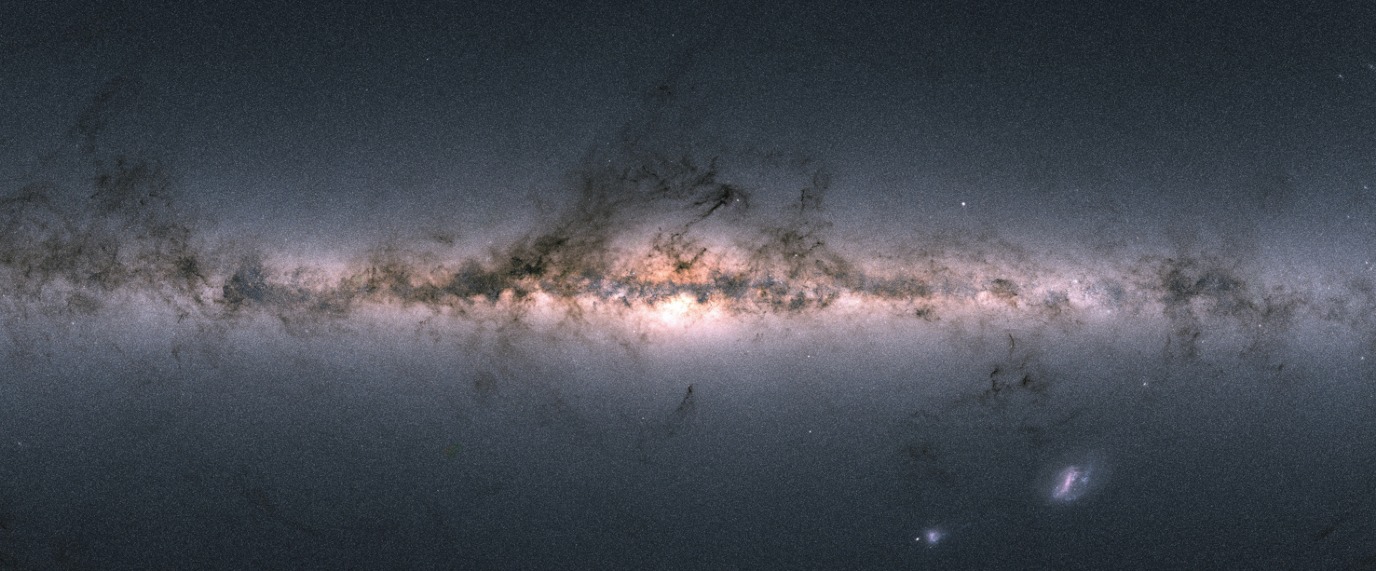
One of Helmi’s most influential contributions was the discovery of Gaia-Enceladus, a large galaxy that collided with the young Milky Way around ten billion years ago. This discovery, made possible by data from the European space mission Gaia, is considered a milestone in our understanding of the formation of our galaxy.
Cosmic archaeology
Helmi is internationally recognized as a pioneer in the field of ‘galactic archaeology’: reconstructing the history of galaxies based on characteristics of stars such as positions, movements, and composition. Her research has not only provided insights into the Milky Way’s past, but also offers new opportunities to investigate the distribution of the mysterious ‘dark matter’: an invisible form of matter that accounts for approximately 85% of all matter in the universe.
According to the Kavli Prize Committee, the research by Helmi and her co-winners has ‘fundamentally changed our understanding of how large galaxies such as the Milky Way formed.’ Galaxies are no longer seen as static systems, but as dynamic structures that are constantly changing due to cosmic interactions.
A source of pride for Groningen
Amina Helmi studied astronomy at the National University of La Plata in Argentina and obtained her PhD at Leiden University. Since 2003, she has been affiliated with the University of Groningen and has established herself as one of the world’s leading astronomers. She has previously received, among other honours, the Spinoza Prize, the highest distinction in Dutch science.
The award of the Kavli Prize brings exceptional international recognition to her research into the origin and evolution of galaxies. The prize also underlines the University of Groningen’s leading position in the field of astronomical research.
‘This prize is a wonderful recognition of years of international research into the history of our galaxy,’ said Helmi. ‘Thanks to missions such as Gaia, we are increasingly able to interpret the Milky Way as a historical archive of events that took place billions of years ago.’
More information
More news
-
01 October 2026
10 years of the Nobel Prize Ben Feringa
-
01 October 2026
Making stardust in the lab
-
25 September 2026
NASA selects infrared space telescope PRIMA featuring Dutch technology