
Student teams compete with self-driving cars
If it were up to brands like Tesla or Mercedes-Benz, self-driving cars would be the new normal in the future. But is it really safe for a vehicle without a driver to circulate in regular traffic? To gain a better understanding of the challenges posed by autonomous vehicles, the RDW (Netherlands Vehicle Authority) is organizing the Self Driving Challenge. A team of students from the UG is taking part.
Text: Nathalie Laarman, Corporate Communication RUG
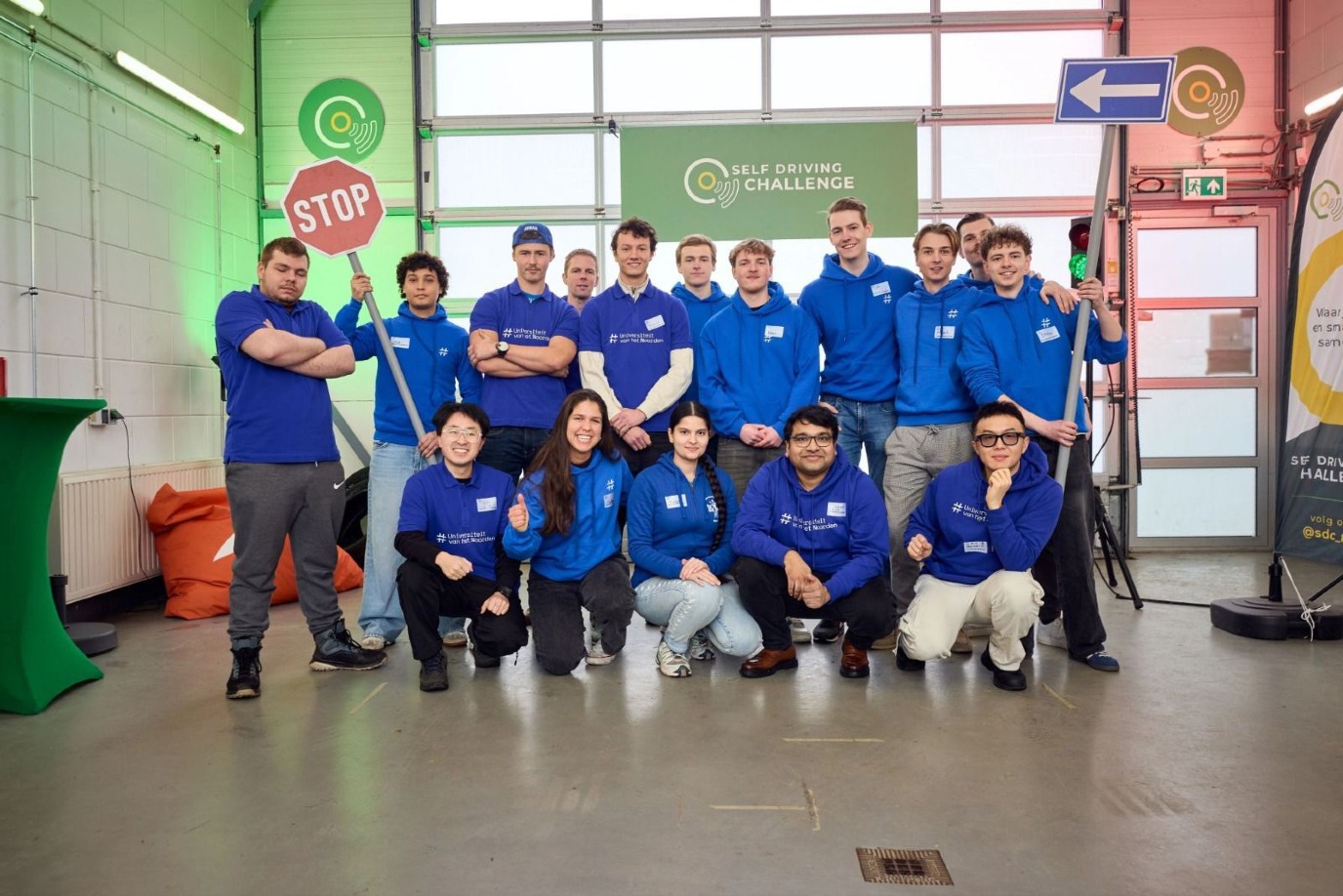
On 16 June, ten student teams will compete against each other with their own self-driving cars. The vehicles must be able to stop at a red traffic light and zebra crossing, and manoeuvre their way around a parked car. The team that gets round the course without making a mistake, and clocks the fastest time, will win. This year, there is an extra challenge: the course will only be revealed on the day of the final, so nobody will know where or when the race will start and finish, or where the obstacles have been placed. But how do you go about building a car that can respond both flexibly and safely to meet this challenge?
The team
The team representing the University of the North consists of students from the University of Groningen, Hanze University of Applied Sciences, and Noorderpoort. They have joined forces to take on the challenge, and will compete in the open category of the Self Driving Challenge. In this category, teams must build and encode the vehicle themselves, building on the car used in the previous edition. So each team has a unique car, and is expected to solve any problems with braking or steering, for example, on their own.
The team comprises 15 students with knowledge of different fields, such as industrial engineering, software engineering, smart systems engineering, and automotive engineering. There is also a sub-team per topic. Mechanics from Noorderpoort, for example, focus on the hardware, while the software team from Hanze checks and improves the IT codes. The perception team from Hanze Smart Systems Engineering trains the car with data, to ensure that it recognizes pedestrians, for example. In addition, the simulation team develops a simulation environment and the control team from the UG focuses on the car’s steering system. Constança Damásio, student of Industrial Engineering and Management at the UG, is a member of the latter team. To her mind, their strength this year is the diversity of the team: ‘Our broad-based knowledge gives us expertise in many areas, which means that we can switch our thinking very quickly to resolve problems.’
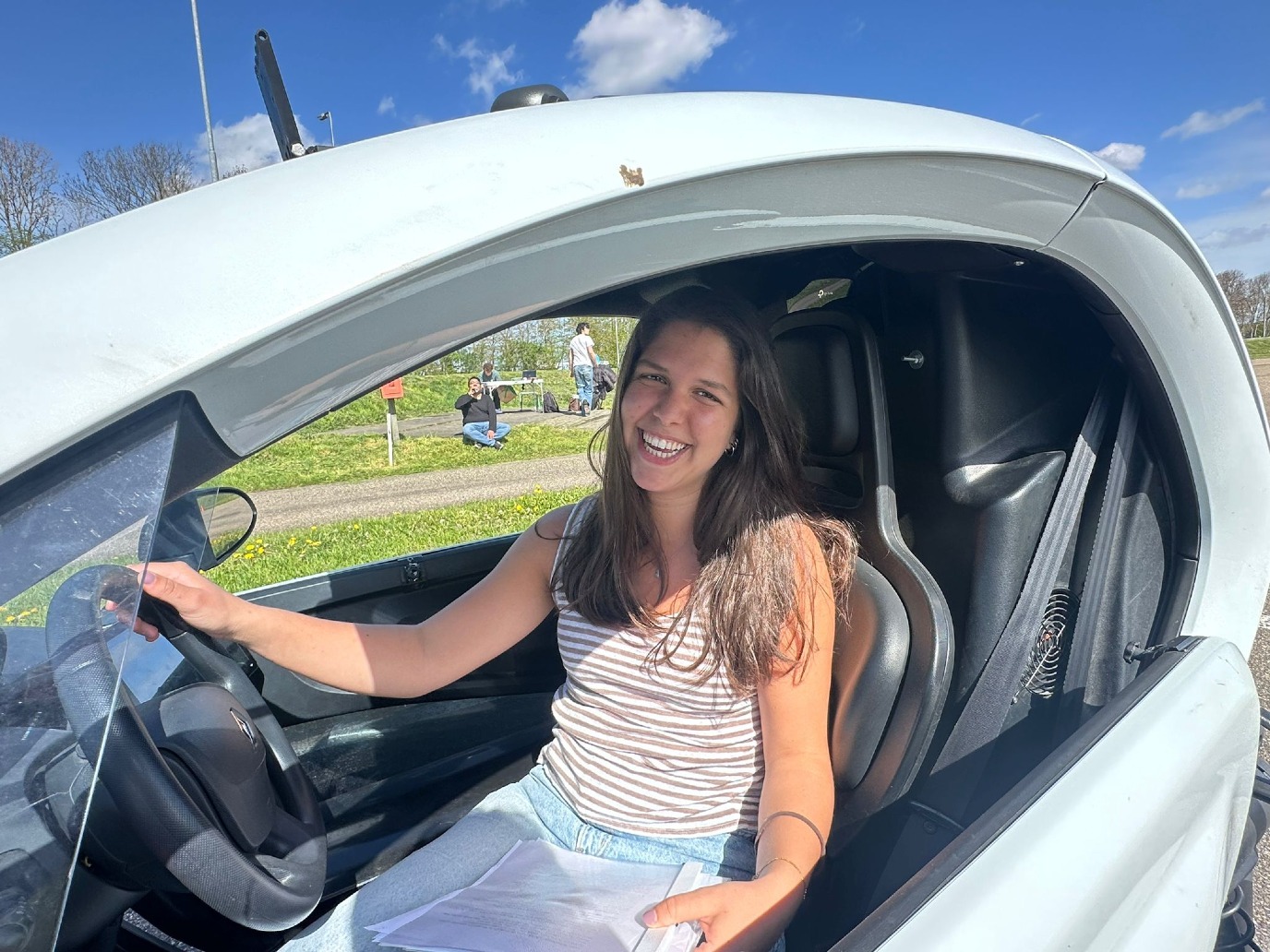
Constança’s goal
Constança: ‘I’ve always been interested in self-driving cars because I think they will play a huge role in the future. When I got the chance to take part in this challenge, I grabbed it with both hands.’ Constança also has a background in control engineering and has taken course units in mechatronics. ‘This taught me how to design and control smart mechanical systems, such as a self-driving vehicle. I’m now putting this theoretical knowledge into practice.’ Furthermore, she is writing her thesis about the challenge, which makes the project even more valuable to her. Her goal is clear: to develop a fast car, which is stable and reliable, and does not slip out of the bends. She is also keen to use her knowledge to help the team finish in first place.
The team’s working method
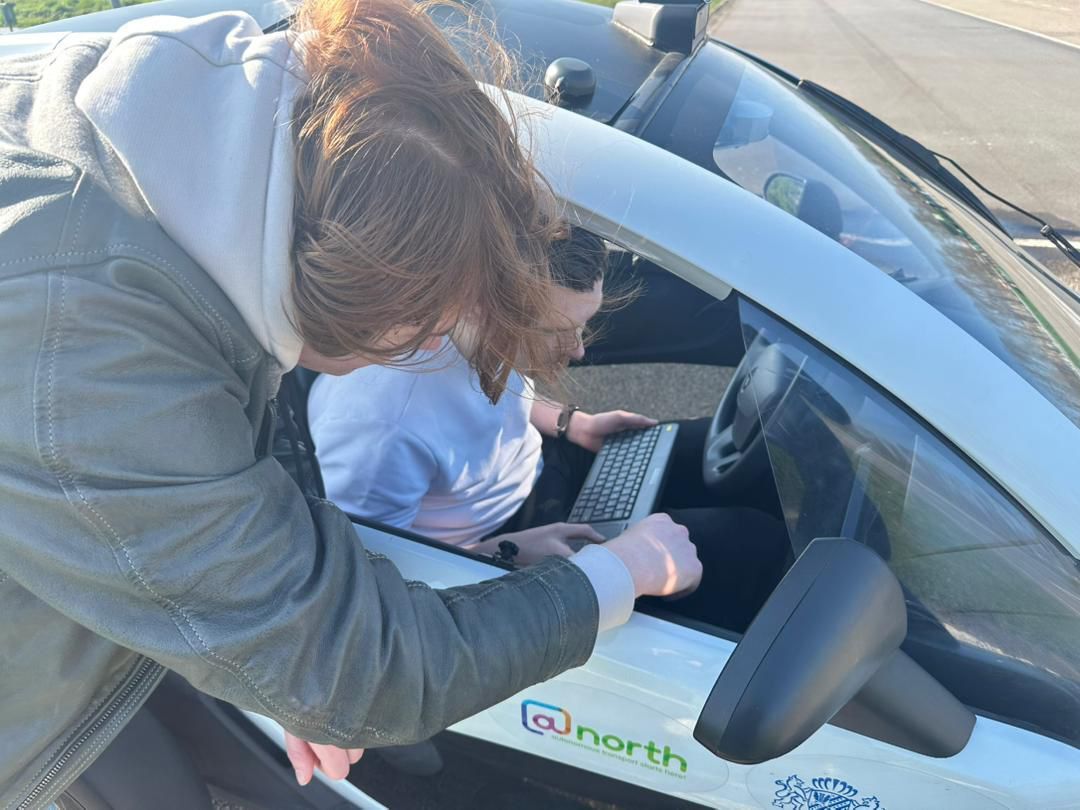
‘In order to achieve that goal, we hold weekly meetings to decide where we want to make improvements for our test days,’ Constança explains. ‘We can then test the car in Lelystad to see how it behaves on the track. During our last test day, for example, we studied how the car reacts to traffic lights in less than ideal situations. Last year, the car had trouble recognizing green traffic lights in bright sunlight.’ To improve this, the team is training the model on the test circuit using data in a variety of light conditions. Constança: ‘I just loved watching the car driving around, completely autonomously, avoiding all the obstacles. By testing again and again, you discover what can be improved . This motivates me to work even harder and make the vehicle even safer.’
Safe acceleration
In addition to reliability, the team is also focusing on the next step: increasing the speed. Last year, the car reached a speed of 5 km per hour, and Constança wants to make it faster. But it is not as simple as that: the car can become unstable at higher speeds and start ‘wobbling’ in the bends. ‘We want the car to run smoothly and steadily at all times,’ says Constança. ‘If it wanders out of its lane, for example, it must be stable enough to steer back into its lane before it moves too far across.’ This is why they are increasing the speed gradually and safely, and only when the car is functioning properly. The team always proceeds with caution, to assure safety. Although the car is self-driving, there is always someone in the driving seat to take over if it becomes dangerous.
Valuable challenge
According to Constança, the challenge is not only valuable from a technical point of view, but also to her personally: ‘I’ve acquired so many skills in programming, simulation, and data analysis, which will be of great use throughout my future career. And I know for certain now that I want to continue in control engineering.’ Communicating within a multidisciplinary team has also been a learning curve. ‘I now realize how important it is to get my ideas across in a way that people can understand, particularly in a team where people have such different knowledge and experience. Self-driving cars are highly complex, so it’s even more important that you understand each other if you want to find the best solution.’
More information
More news
-
25 September 2026
NASA selects infrared space telescope PRIMA featuring Dutch technology
-
-
24 September 2026
Arjan van der Schaft receives IEEE Control Systems Award