
Science Works | SlimSmullen teaches children all about sugar
Day in, day out, scientists contribute to solutions for a wide range of societal problems. From new drugs to smart farming solutions, our research helps society move forward. However, this is not always immediately apparent. That is why, in the Science Works section, we share stories about concrete innovations, products, and ideas to show that science works!
Text: Thomas Vos, Corporate Communication, UG
Sugar: we eat too much of it, with all the consequences that come with it. Yet we still cannot get enough of it. Professor of Chemical Glycobiology Marthe Walvoort launched the SlimSmullen initiative to raise children’s awareness of the effects of sugar, using lesson plans and other resources.
According to Walvoort, sugar is not just a villain: ‘Sugar is not necessarily unhealthy. An apple also contains sugar, but that doesn't make it unhealthy. Things go wrong when we as a society process our food too much. An apple is processed into apple juice, but when you drink that juice, you can easily end up consuming large amounts of sugar. Moreover, you miss out on lots of beneficial nutrients that are lost during the processing. And that applies to a great many products. If you consistently consume those products, it can lead to overweight, with all sorts of negative consequences for your health.’
Ready-made lesson plans
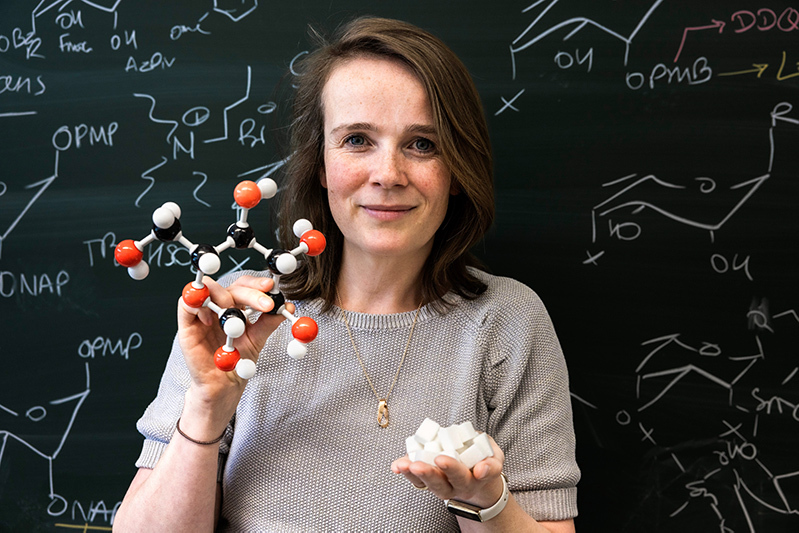
As a Professor in Chemical Glycobiology, Walvoort knows a great deal about sugars. In her own lab, she studies the mechanism and functions of sugar molecules by, among other things, examining how bacteria use sugars to infect other cells. Driven by her passion for these sweet flavours, she applies that knowledge to SlimSmullen. Walvoort: ‘I designed SlimSmullen together with nutritionists, primary school teachers, and knowledge transfer experts. It is first and foremost an initiative to share knowledge with primary school children. We offer ready-made lesson plans for primary school teachers, which they can use to help pupils learn about sugar in a playful way.’
Baking workshop
The lesson plan consists of two lessons on sugar that primary school teachers can deliver themselves. In these lessons, pupils learn more about what sugar is, where it comes from, and where it is found. They also learn how to read food labels. SlimSmullen combines this with a sugar challenge: pupils and their family members avoid one sugary product for a week to see how they get on. Walvoort: ‘After the two lessons, we come by with pupils for a baking workshop. Together with the children, we bake sugar-free biscuits. In the process, they can use all sorts of flavourings, such as raisins, ginger, or cocoa. Some biscuits are tastier than others. It’s a great way to let children experiment and learn that you can also bake without sugar.’
Learning to think for themselves
Walvoort hopes that SlimSmullen will encourage children to start thinking more consciously about food: ‘I really look at this from a scientific perspective. It's not about us spoon-feeding them information: SlimSmullen is actually a great way to invite children to learn for themselves and experiment. And that also has an effect on their parents.’ She is, however, also considering other formats: ‘The best thing would be if we could go around to schools across the province in a food truck, and have student assistants deliver the lessons. I think schools would be even more keen to join in.’
More information
Do you want to know more about Science for Society? Check out the overview page for the previous editions.
More news
-
-
03 September 2026
Ming Cao reappointed as scientific director of the Jantina Tammes School
-
01 September 2026
Evrim Ursavas appointed scientific director Wubbo Ockels School