
Science for Society | Farmers and researchers are working together on the agricultural transition
Scientists work day by day on solutions to a variety of problems. From new drugs to smart farming techniques, our research helps society move forward. But this is not always immediately visible. In the Science for Society series, we use stories about impactful innovations, products and ideas to show that science works!
Text: Jaap Ploeger, Corporate Communicatie UG
For decades, farmers have had to produce more and more to be able to earn their daily bread. Supermarket prices and the agricultural industry determine the often low prices that farmers receive for their produce. The soil is depleted and increasingly needs fertilizing. Biodiversity in agricultural regions has declined alarmingly. In addition, farmers have to comply with legislation that is constantly changing. Farmers do want to produce more sustainably, but are trapped from all sides.
For this reason, the Centre for Sustainable Agriculture Transition (CDLT) at Campus Fryslân (CF) will be guiding hundreds of farmers within the Programme ReGeNL in making the transition to a more sustainable business model in which they can operate healthily, with an eye for soil and biodiversity, while still earning a good living. Professor and director Gjalt de Jong and programme manager Ingrid van Huizen explain why and how they are going about this.
Change must happen
Around six years ago, De Jong realized together with the former dean of CF and current President of the Board of the University, Jouke de Vries, that agriculture had to change: ‘“Where is the natural Frisian landscape of our youth?”, we asked ourselves. The birds have gone and the grassland is dull. That was when we realized that we had to set up a large-scale programme and that as a “new” sustainable agricultural university, the UG could play an important role in this transition in the Northern Netherlands.’ Thanks to the efforts of many dedicated partners this has resulted in the ReGeNL transition programme, in which the CDLT plays an active role. It is no coincidence that the CDLT falls under Campus Fryslân. After all, the Faculty was established in order to tackle local societal issues.
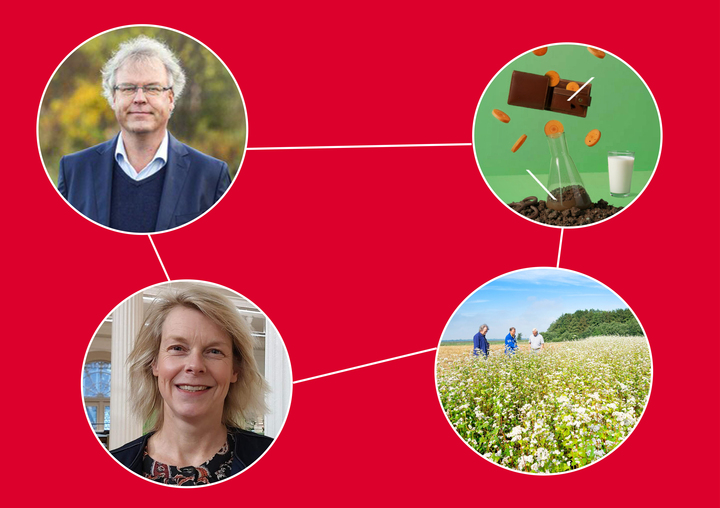
At first, De Jong experienced an incredible amount of resistance from his peers. ‘“All you need to do is write papers, Gjalt”, some of them said to me,’ he recalls affably. But he persisted and found a programme manager with her feet on the ground: Ingrid van Huizen. She had been working in the agricultural sector for a long time and still worked as a farmer. She was the key link between the University and the practical field. With millions in grants from the the Ministry of Agriculture, Fisheries, Food Security and Nature (LVVN) and the National Growth Fund, the CDLT and partners could finally get to work.
Collaboration
According to De Jong, it is quite simple: if we want to save humanity, we have to switch to a circular economy as quickly as possible. For farmers, this means transitioning to regenerative agriculture. And this is possible, in De Jong’s view. ‘Within the ReGeNL programme we are guiding farmers towards a more sustainable regenerative model. By sitting down with farmers, we are listening to their needs and we can guide them with scientific methods in a practical manner. In this way, science and practice are joining together nicely.’ And it is not just farmers who are joining the conversation; funding bodies such as Rabobank and chain partners in the agricultural industry are also getting involved, as they are also starting to see that things need to change.
A good start
By now, around 170 farming companies have started the transition programme that partly falls under the ReGeNL consortium and through which the CDLT is arranging direct guidance for farmers. In this context, UG researchers are providing scientific support for the transition process. This first group of participants will be followed by another 300 companies this year. And roughly 150 farmers have shown interest in participating this year.
Ingrid van Huizen explains how it works: ‘The farmers who participate in the programme are allocated a personal consultant, with whom they discuss all of the processes in their company. These include ecological processes, business operations, and socio-cultural and economic aspects. Together with the agricultural consultant, they look at which changes need to be made in their business.
The strength of the programme also lies in the fact that the farmers are grouped into regional clusters. This means that they can exchange thoughts with their fellow farmers and support one another. ‘The participants follow the programme for four years,’ explains Van Huizen. ‘And we use the questions we receive from the farmers to explore how knowledge and research from the CDLT can achieve lasting impact for the farmers and for the agricultural and food sector.’
Making a difference on the ground
The farmers can indicate where the major issues lie within their business processes. The researchers then get to work on those. ‘We currently have five PhD students and a postdoctoral researcher at the CDLT conducting research with the farmers on the ground,’ says De Jong. ‘The studies include analyses of sustainable business models, the establishment of a broad knowledge infrastructure on sustainable farming, and historic landscape elements that offer ecological opportunities.’
All aspects of the farming business are closely investigated. For example, whether it might be better to switch to other crops that are inherently more suited to a specific soil type. How do you approach that and can a switch like that pay off? The farmers also want to know whether ecologically responsible fertilization is sufficiently advantageous. And the same goes for decreasing pesticide use; what does that deliver ecologically and economically?
Farmers who want to transition to a regenerative business model also have internal differences of opinion, which is one of the socio-cultural aspects. ‘For example, the father may want to keep farming traditionally while his children strive for increased sustainability. How do you then bridge that difference of opinion? The CDLT can offer support in this area, too,’ explains Van Huizen.
New science
De Jong and Van Huizen are conducting a new type of science with the CDLT. ‘What we are doing here is unique’, says De Jong. ‘In the academic sense, we are working on a major societal challenge in an interdisciplinary and transdisciplinary manner. And that is taking place directly in the practical field, in which science is supporting the transition process. In this way, we are pioneers within the University and perhaps even within the Netherlands.’
Now that the practical part has been designed and the first studies are underway, teaching will also be set up this year. Seeing as the CDLT does not simply scatter research reports from its ivory tower but actually collaborates on the ground, it offers prospects for making a real difference for farmers, nature, and society.
More information
Do you want to know more about Science for Society? Check out the overview page for the previous editions.
More news
-
02 June 2026
Impact | The Grounding AI Map
-
-
31 March 2026
Islands as testing grounds for a sustainable society