
Smart computing power for healthier water plant management
Profilerating aquatic plants can be detected more quickly using drone technology and AI. This requires a great deal of computing power. The University of Groningen’s Hábrók high-performance computing cluster provides the computing capacity needed to train the AI model.
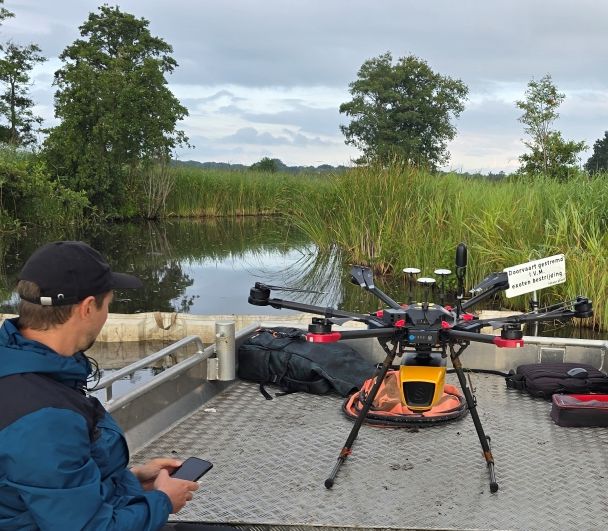
Climate change and invasive species are putting pressure on the management of aquatic plants, yet healthy waterways are essential for our natural environment and society. To manage aquatic plants effectively and in a data-driven way, more is needed nowadays than just field knowledge. The use of drones and sensor technology, combined with a platform that brings all the data together, offers a solution for speeding up the tackle of profilerating aquatic plants.
AI recognition model
The Platform Data-Driven Aquatic Plant Management (PDW) has recently started mapping aquatic plants using an AI recognition model. This makes it possible to take action against unwanted aquatic plants more quickly. The AI model is currently being developed and trained. And that requires computing power. A lot of computing power.
High Performance Computing
To provide the necessary computing capacity, two developers behind the platform – the KOWW (Knowledge Center Rooting Aquatic Plants) and Objectherkenning.com – work closely with the Center for Information Technology (CIT). By utilising the Hábrók High Performance Computing (HPC) cluster, they benefit not only from the computing power but also from the expertise in the field of AI development.
Greater computing power, faster processing
Hábrók is a powerful computer specifically designed for complex calculations, large datasets and intensive AI training. Whereas a standard computer takes days or weeks to train large models, Hábrók can do this in a fraction of the time. The collaboration with the University of Groningen ensures that work can be carried out faster and more efficiently in practice. There are several reasons why retraining is necessary:
-
unprecedented conditions are arising
-
the introduction of new plant species
-
the use of new state-of-the-art models that deliver even better performance
By using Hábrók, the model is trained more quickly and efficiently, iterations can follow one another more rapidly, new types can be added more quickly, and there is greater scope for experimentation and model improvement. In other words: less waiting time and more innovation.
The partnership with the University of Groningen ensures that work can be carried out more quickly and efficiently in practice.
Collaboration as a driver of innovation
This collaboration demonstrates how academic institutions and practice-oriented organisations can strengthen one another. The University of Groningen provides access to advanced infrastructure and scientific expertise. KOWW contributes practical data, field knowledge and a clear societal challenge. This combination accelerates progress in several areas: science is applied directly, innovation has a practical impact, and data-driven aquatic plant management becomes scalable.
AI Factory
That is precisely where the strength of this partnership lies. KOWW can tackle its challenge more quickly. For the University of Groningen, the partnership fits in with its ambition to become a fifth-generation university. This entails comprehensive, long-term collaboration with private and public institutions in the fields of research, education and knowledge exchange. The high-quality HPC and AI infrastructure and extensive expertise available within the university are particularly well-suited to shaping these collaborations, especially in light of the planned AI Factory in Groningen.
More information
More news
-
-
03 September 2026
Ming Cao reappointed as scientific director of the Jantina Tammes School
-
01 September 2026
Evrim Ursavas appointed scientific director Wubbo Ockels School