
Advent calendar - December 5th - Emiel de Wit
In the Zernike Institute Advent Calendar, we are presenting 24 short spotlights in December. In these specials, we highlight PhD students, postdocs, support staff and technicians of our research groups and team - providing a glimpse into their typical day at work. In Episode 5 meet Emiel de Wit, PhD researcher in the Ion Interactions group of Prof. Ronnie Hoekstra, located at the Zernike Institute and the Advanced Research Center for Nanolithography (ARCNL).
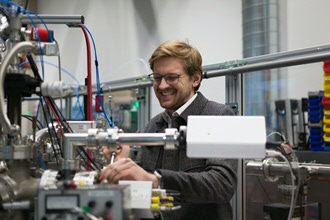
I am a PhD student working in the Ion Interactions group lead by prof. dr. ir. Ronnie Hoekstra. As well as being associated with ZIAM, our group is the only part of the Advanced Research Center for Nanolithography (ARCNL) that is not located in Amsterdam. The centerpiece of our lab is the ZERNIKE Low Energy Ion Facility (ZERNIKELEIF) with its two permanent setups. If you ever get the chance to visit us, it’ll be hard to miss; the beamline is about 15m in length and takes up more than half of our floorspace!
My days are mainly spent at CHEOPS (CHarge Exchange Observed by Particle Spectroscopy), one of the two permanent setups attached to the beamline, where I study the interactions taking place when multiply charged tin ions collide with (mostly) molecular hydrogen. Understanding these Snq+-H2 collisions on a fundamental level is crucial for optimization of EUV nanolithography machines: these make use of a pulsed tin laser-produced plasma as an incredibly powerful EUV light source. This plasma is embedded in a H2 buffer gas, which attenuates the expansion of the plasma before it can damage the optics inside the machine. Using our beamline, we can reduce this complex plasma expansion problem to separate studies of single isotope, monoenergetic ions with a specific charge state. Even so, we run into surprising phenomena with almost every measurement we do!
These surprises might be my favorite thing about this job. My work is very hands-on, so when we run into new stuff we immediately get to work modifying our setup in order to be able to measure those as well. Most recently, that has resulted in us building a completely new detector and method of analysis which we used to find some remarkable trends in the breakup of the hydrogen molecules during these collisions, which we are hoping to publish soon! Of course, none of this would be possible without my colleagues, who, aside from collaborating a great deal to the research, make sure we don’t get completely absorbed in our work through our regular coffee breaks, lunch walks, and the monthly pub quiz (that we are yet to win…). They really make this group a delight to work in.
Happy holidays and a happy new year!
More news
-
-
03 September 2026
Ming Cao reappointed as scientific director of the Jantina Tammes School
-
01 September 2026
Evrim Ursavas appointed scientific director Wubbo Ockels School