
Advent calendar - December 2nd - Rick Beltman
In the Zernike Institute Advent Calendar, we are presenting 24 short spotlights in December. In these specials, we highlight PhD students, postdocs, support staff and technicians of our research groups and team - providing a glimpse into their typical day at work. In Episode 2 meet Rick Beltman, PhD researcher in the Quantum Devices group of Prof. Caspar van der Wal.
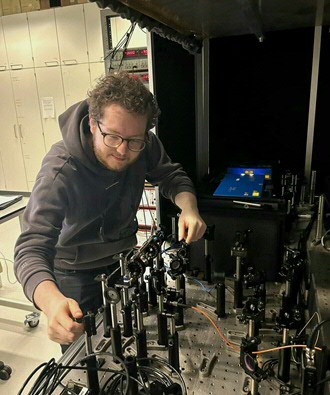
I am a third-year PhD candidate in the group of Quantum Devices under the supervision of Caspar van der Wal. In our group we collaborate with other universities across Europe to determine the quantum properties of color center defects inside silicon carbide (SiC). These color centers are similar to the famous nitrogen vacancy (NV) centers in diamond, except, that they emit light in and around the telecom waveband. This makes them highly interesting for quantum telecom devices, because it would allow us to use the current fiber-optic network to transfer quantum information.
My current research mainly focuses on trying to control the electron spin (which serves as our qubit) of a vanadium defect. In particular we are looking into using oscillating electric fields instead of magnetic fields to drive electron spin flips. Normally, electric fields should not be able to manipulate the electron spin directly, but is theorized that the electric field can influence the electron spin indirectly through the hyperfine interaction with the nuclear spin of the defect. This sounds very tricky (and it is), but in practice we mainly observe the change in the absorption of our laser. The laser only excites electrons with a particular spin direction, so when the electron spin flips we see a dip in our absorption spectra.
At the end of the first year of my PhD, I was largely responsible for rebuilding the lab after our move to the new Feringa building. For me, this was a complete new experience and a huge undertaking. Not only did all the optical components have to be placed and aligned, (which can be as much as a hundred pieces), but I also had to reinstall the lasers and make sure all the equipment communicated properly, such as wavelength meters and RF-generators. And then there was still the vacuum and cryogenic components of our cryostat to be reassembled as well. Because in our case nature only allows us to probe its hidden quantum properties a few degrees above absolute zero, so keeping everything cold with liquid helium is also a nice part of the challenge.
After a hard day of work, I also like to dabble with lower frequencies, (not just the MHz to THz range), as I pick up my electric bass to practice some new songs.
More news
-
19 October 2026
From research to business: RUG Ventures helps ideas move forward
-
-
03 September 2026
Ming Cao reappointed as scientific director of the Jantina Tammes School