
Publication Alert -Trimerized Niobium Halides: An Ideal Quantum Laboratory
In quantum materials Coulomb interactions between electrons give rise to some of the most remarkable emergent properties such as magnetism, superconductivity, or unconventional insulating behavior. Although these fundamental interactions promise a transformative technological impact, it remains incredibly challenging to study their microscopic role in all necessary detail.
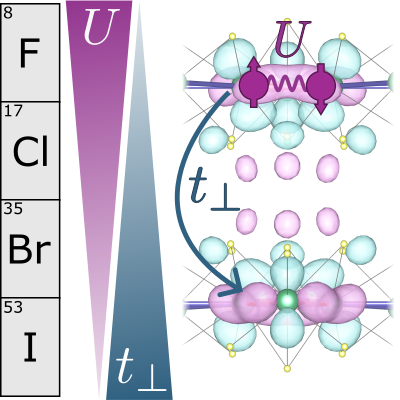
In a collaborative effort of Radboud University, University of Groningen, University of Amsterdam, Aarhus University, Delft University of Technology, Constructor University, Örebro University, Lund University, and Bielefeld University, it was shown that a family of layered van der Waals materials, trimerized Nb3X8 (where X can be fluorine, chlorine, bromine, or iodine), offers a rare chance to study the effect of continuously tuning Coulomb interactions within a single structural framework. Simultaneously, the team found that Nb3X8 offers a platform that is stable and simple enough to be accessible to state-of-the-art computational techniques and experimental probes.
Their key finding is that by changing the halogen element, the number of layers, or electron doping via modifications to the chemical composition, they can precisely control the strength of electron-electron interaction and, in turn, the material’s fundamental quantum electronic state. As such trimerized Nb3X8 opens the door to designing materials with wide range of emergent quantum states that can be precisely studied in close collaboration between theory and experiment.
Groningen part of the study
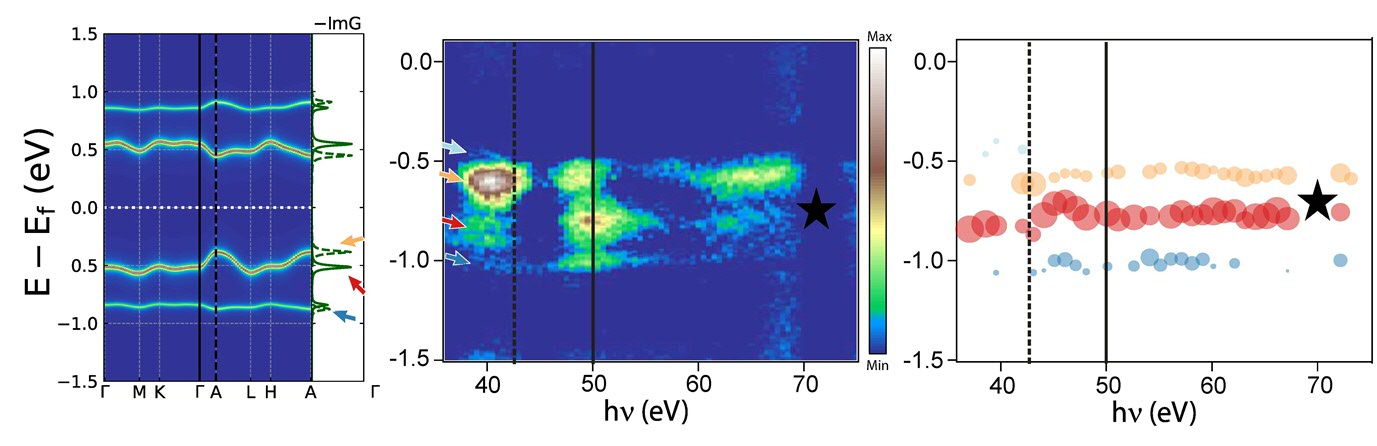
The team of Dr. Antonija Grubisic-Cabo, particularly PhD researcher Xiaojing Liu, performed complementary ARPES measurements providing direct spectroscopic evidence for the evolving correlation strength across the Nb₃X₈ material series. By performing extensive analysis of energy-distribution curves over a wide photon-energy range, the team was able able to resolve not only the primary lower Hubbard band, but also a faint secondary lower Hubbard band, a new and more conclusive signature of strong correlation effects predicted by cluster DMFT. To confirm that this feature is intrinsic and non-dispersive rather than an artifact, the Groningen team carried out hundreds of fits at photon-energy step of 0.2 eV. These measurements ultimately verified their systematic behavior, thus providing a clear experimental validation of the theoretical trend: the strength of electronic correlations systematically decreases with increasing halide atomic mass.
Reference: From Strong to Weak Correlations in Breathing-Mode Kagome van der Waals Materials: Nb 3 (F;Cl;Br;I) 8 as a Robust and Versatile Platform for Many-Body Engineering ; Joost Aretz, Sergii Grytsiuk, Xiaojing Liu, Giovanna Feraco, Chrystalla Knekna, Muhammad Waseem, Zhiying Dan, Marco Bianchi, Philip Hofmann, Mazhar N. Ali, Mikhail I. Katsnelson, Antonija Grubišić-Čabo, Hugo U. R. Strand, Erik G. C. P. van Loon, and Malte Rösner
More news
-
-
03 September 2026
Ming Cao reappointed as scientific director of the Jantina Tammes School
-
01 September 2026
Evrim Ursavas appointed scientific director Wubbo Ockels School