
PhD ceremony Marta Borchiellini

On Tuesday 10 March 2026, Marta Borchiellini defends her thesis called
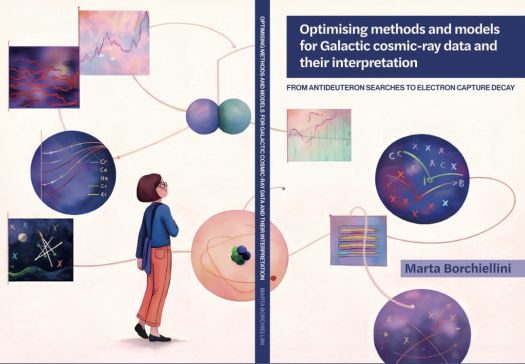
Optimising methods and models for Galactic cosmic-ray data and their interpretation.
From antideuteron searches to electron capture decay
Summary of her thesis:
Cosmic rays are high-energy charged particles that constantly reach the Earth from space. By studying their energy and composition, it is possible to learn how cosmic rays are accelerated in extreme astrophysical environments, how they propagate through the Galaxy, and whether they contain traces of new physics.
The first part of this thesis focuses on the search for antideuterons, extremely rare antimatter nuclei that are expected to be produced only in small amounts by known astrophysical processes. Their detection would therefore be a strong hint of exotic phenomena such as dark matter annihilation or decay. Using 12.5 years of data collected by the Alpha Magnetic Spectrometer (AMS-02), a precision particle detector on board the International Space Station, a systematic study of data-driven machine learning classifiers is performed to develop a background rejection estimator specifically tailored for antideuteron identification.
The second part of the thesis focuses on how cosmic rays propagate through the Galaxy, with particular attention to the role of electron-capture (EC) decay. This process is re-examined in light of recent high-precision measurements to assess its impact on cosmic-ray fluxes and to improve the reliability of propagation models. Although EC decay does not dominate cosmic-ray behaviour, its effects are found to be non-negligible for a few cosmic-ray isotopes, in particular 49V, 51Cr and 57Co.
Link to Marta's thesis
If available, you can follow the PhD ceremony via this livestream
More news
-
-
03 September 2026
Ming Cao reappointed as scientific director of the Jantina Tammes School
-
01 September 2026
Evrim Ursavas appointed scientific director Wubbo Ockels School