

Leading the dance with prayer beads
I was at the after-party of a theater show produced by a volunteer-based artistic community of newcomers in Groningen, the Netherlands, called Bab Ad-Daar. There, volunteers from the group—mostly of Syrian, Palestinian, and Lebanese backgrounds—along with an external audience, danced together. They were dancing dabke (for a video illustration of dabke, click here, a popular and lively dance originating in present-day Syria, Lebanon, Jordan, and Palestine. This dance is often performed at social gatherings and festivities, especially at weddings, as an expression of play and pleasure (Silverstein 2024) in Muslim, Christian, and Druze communities (e.g., Silverstein 2012; Silverstein 2019; Almohammad et al. 2023; Kastrinou 2016). We should have in mind that the dance is not directly related to religious ritual, which was also the case that afternoon. Dancers clasped hands with each other, forming a semi-circle, and followed the typical six-step sequence in unison to the rhythm of the music.
As usual in this group, it did not take long for prayer beads to appear in the dabke performance. In this case, a string of thirty-three yellow beads made of plastic was immediately spun in the air by the first dancer at the head of the circular formation. On his left, he remained hand in hand with the dancer next to him, while his right hand playfully twirled the prayer beads as he guided the rest of the circle. One might wonder how it is that an apparently religious object is used in a non-religious, leisurely context of dabke by dancers who come from communities where religion is surely important, and seemingly without raising any eyebrows? This was the question that initially prompted my research.
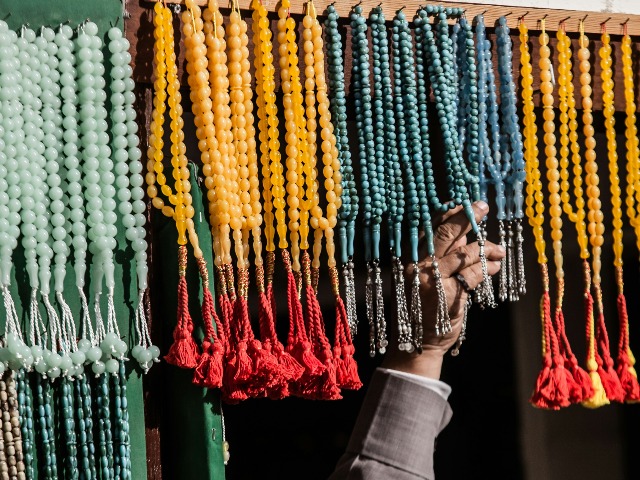
First, we should note that different kinds of prayer beads may be used in this dance. Although at that particular event, people danced with a thirty-three-bead version, it is not uncommon to see leaders spinning prayer beads with a string of ninety-nine beads or fifty-eight beads featuring a cross. While prayer beads with thirty-three and ninety-nine beads are typically associated with the glorification of God in the Islamic tradition, the presence of a cross on the fifty-eight-bead kind signifies Christian devotional usage. But what determines which of these prayer beads will be used during a dabke performance? Among the Syrian, Palestinian, and Lebanese participants of the Bab Ad-Daar community, such concerns do not apply very strictly; on the contrary, it depends entirely on who is present and who happens to have their prayer beads with them at the moment. If the person has prayer beads of ninety-nine beads, that version will be danced with, yet if theirs is with fifty-eight beads and a cross, or if it is a thirty-three-bead version, then that one will be used instead.
Here, another question arises: what happens in a situation when no one at the dabke gathering has prayer beads at hand? There are other solutions. In the simplest case, leading is possible without holding any objects, in which situations the first dancer’s right hand remains empty. Apart from prayer beads, objects like a scarf, handkerchief, or cane can also serve as leadership tools for first dancers (although priority is usually given to dancing with prayer beads when possible). This suggests that prayer beads are not a necessary ingredient in dabke, albeit a frequent one. Thus, by framing them in parallel to secular objects, prayer beads gain a kind of nonreligious function within the dabke for the majority of the Syrian, Palestinian, and Lebanese volunteers in Bab Ad-Daar. This otherwise religious object becomes affiliated more with the leadership position than with devotional connotations. Such a marked connection between dabke and prayer beads is made further visible by virtual representations, such as when the prayer beads emoji functions as a common symbol of dabke in the private text messages and public social media communications of Bab Ad-Daar, as well as in online discourse on dabke more generally. All this suggests that while prayer beads are not a strictly essential tool for facilitating the dabke semi-circle, it nonetheless holds a significant role within the practice.
It is also interesting that becoming the first dancer does not necessarily require bringing one’s own prayer beads, scarf, or other items for leading. Rather, any dancer may offer theirs to the leader. This also implies a kind of collective sharing, which generally happens in an interreligious context in this community in Groningen, where Muslim, Christian, and Druze participants dance together. My research has shown that the three types of prayer beads—with thirty-three, ninety-nine, or fifty-eight beads—are imbued with different religious values and importance and hence evoke varying emotional associations. Because of this, volunteers of Muslim, Christian, and Druze backgrounds do not articulate a homogeneous opinion on the appropriateness of dancing dabke with these objects. Some accept, while others contest. Regardless, once someone’s string of prayer beads enters the dabke circle—irrespective of its usual religious implications—it often stays with the leader, even when other dancers switch places and take over the role. Thus, Syrian, Palestinian, and Lebanese first dancers of any religious community might twirl any type of prayer beads, whether it belongs to them or someone else present, which indexes interreligious exchange through the sharing of prayer beads.
We can see, then, a rather dynamic engagement with prayer beads in a multireligious but secular context of social dabke dancing. Depending on the specific kind and its associated religious convictions and practices, there are multiple ways in which Syrian, Palestinian, and Lebanese participants in Bab Ad-Daar relate to prayer beads as both an object with religious significance and a tool assisting the dabke leader. What to a casual observer might look like a religious activity due to the usage of religious objects is rather a recontextualisation of prayer beads as performative objects that contribute to leadership and collective participation.
Bibliography
Almohammad, Adnan, Ayman Al-Nabo, and Hussein Houri. 2023. “ISIS’s Impact on Syrian Intangible Cultural Heritage: Marriage Customs and Rituals in the Region of Manjib.” Contemporary Levant 8 (2): 123–141.
Kastrinou, A. Maria A. 2016. Power, Sect and State in Syria: The Politics of Marriage and Identity amongst the Druze. I.B. Tauris.
Silverstein, Shayna. 2012. “Mobilizing Bodies in Syria: Dabke, Popular Culture, and the Politics of Belonging.” PhD diss., University of Chicago.
Silverstein, Shayna. 2016. “Public Pleasures: Negotiating Gender and Morality Through Syrian Popular Dance.” In Islam and Popular Culture, edited by Karin van Nieuwkerk, Mark LeVine, and Martin Stokes, 178–197. University of Texas Press.
Silverstein, Shayna. 2024. Fraught Balance: The Embodied Politics of Dabke Dance Music in Syria. Wesleyan University Press.