

Carved in Stone: The Cult of Hārītī in Java and Bali
Nestled within a quiet valley in Central Java, Indonesia, the ninth-century Buddhist temple of Candi Banyunibo rises with serene grace amid shimmering rice paddies. Far from tourist crowds, visitors can explore its grounds in near solitude, encountering centuries-old carvings in an atmosphere of quiet intimacy. The loudest sound is the whisper of the wind, deepening the sense of stillness.
Inside, the inner walls preserve faded yet discernible reliefs. One depicts Hārītī, the Buddhist patroness of children and fertility. Though her face is missing, she remains recognisable by the cluster of playful children around her, some climbing a tree.
The cult of Hārītī is rooted in a tale of divine transformation, in which a fearsome child-devouring ogress is converted into a benevolent mother-goddess. According to Buddhist tradition, her change followed an encounter with the Buddha, after which she renounced her monstrous ways. Worshipped thereafter as a protective deity, Hārītī blesses women with children, safeguards their well-being, and offers solace during childbirth.
Facing Hārītī at Candi Banyunibo is a relief of her consort, Vaiśravaṇa or Kuvera, the yakkha king associated with wealth, power, and protection.
A more prominent depiction of the divine pair appears at Candi Mendut, a ninth-century Buddhist temple near Borobudur, the world’s largest Buddhist monument. On its south panel, Hārītī sits surrounded by a joyous throng of plump children—one clambers onto her shoulder, another rests on her lap—while a bowl of mangoes beneath her bench symbolizes fertility. On the north wall, her consort Kuvera, god of wealth and protector of children, is shown seated on a bench, framed by fluttering parrots as children play around him and climb fruit trees.
Another Hārītī figure, made of terracotta, is preserved in the Trowulan Majapahit Museum in East Java. Unlike normative depictions with multiple children, this piece shows a mother nursing her infant.
Notably, while temple reliefs at Banyunibo and Mendut, and the terracotta piece in Trowulan attest to Hārītī’s popularity across premodern Java, Old Javanese kakawins composed under royal patronage pay relatively little attention to motherhood. Still, the anxiety over fertility and male heirs does surface in kakawin literature. In Indic Java, ancestral rites traditionally required male descendants to ensure lineage continuity. When Sutasoma, hero of Mpu Tantular’s famous fourteenth-century poem Kakawin Sutasoma, chooses asceticism over worldly life, the poet underscores a moral lesson: he must also fulfil his duty to produce heirs.
This ritual and cultural emphasis on sons crystallized in the ideology expressed as biar punya anak laki (“better to have a son”).
Localization of Hārītī in Bali
In Bali, where Hindu Javanese elites sought refuge in the sixteenth century after the Islamic conquest of Java, Hārītī became known as Men Brayut or Ratu Brayut. The Balinese lontar poem Geguritan Brayut recounts the tale of Pan and Men Brayut, a poor couple with eighteen children. While Men Brayut constantly tends her infants, Pan Brayut is overwhelmed by domestic duties. Their unruly brood eventually grows into adulthood, forming a troupe that performs the Barong drama, bringing prosperity to the family.
Bali’s agrarian culture historically valued large families as a source of labour and security, embodied in the proverb banyak anak, banyak rejeki (“many children, much fortune”). In modern times, however, this ideal has shifted toward the state-promoted concept of keluarga kecil bahagia dan sejahtera (“a small family for happiness and well-being”). This transformation is reflected in the retelling of the Men Brayut narrative within state-sponsored family planning discourses, which increasingly emphasises the economic and social burdens of raising too many children.
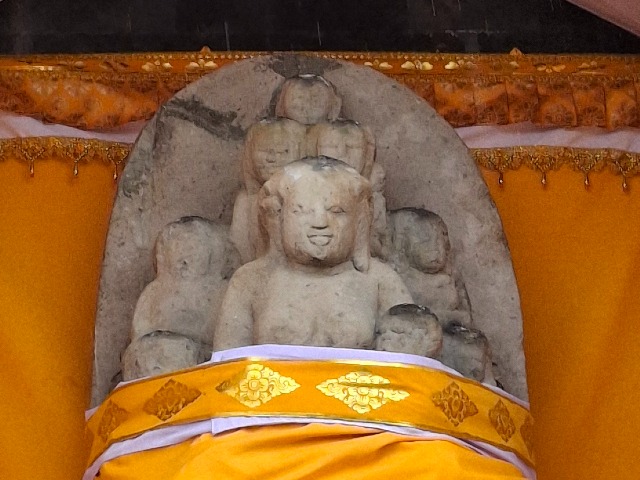
Nevertheless, Men Brayut remains a familiar presence. Figures of her abound in temples, public spaces, and museums, with at least two often identified with Hārītī. In East Bali’s Pura Candidasa, Hārītī is honoured as Men Brayut, the mother of many children, linking Balinese devotion to the Buddhist traditions that once flourished across Java and Bali. The statue there depicts a mother with a serene, rounded face, surrounded by small child figures beside and behind her, embodying maternal protection and fertility. A related figure, Ratu Brayut, is enshrined at Goa Gajah, an ancient temple in Gianyar mentioned in the fourteenth-century Javanese poem Deśavarṇana/ Nagarakṛtāgama.
While Hārītī resonates in these forms, the Geguritan Brayut narrative is more vividly expressed in Balinese art. The most striking example is housed in the Bali Museum, Denpasar. Undated and unlabelled, this small wooden statue portrays an androgynous figure with female breasts, a distended belly suggestive of pregnancy, and a prominent phallus. Two diminutive child figures cling to its hands, while another pair sits beside each leg, powerfully evoking themes of fertility and generative abundance.
The representations of Hārītī across Java and Bali, from ninth-century Buddhist reliefs to Balinese Brayut figures, illustrate both continuity and transformation in her cult. While her image in Java foregrounded her role as a Buddhist guardian of fertility and protector of children, in Bali she became embedded within local narratives such as the Geguritan Brayut, reflecting agrarian values and social concerns with lineage and prosperity. These traditions demonstrate how Indic religious symbols were not simply transplanted but localized, reshaped, and sustained within distinct cultural contexts of Java and Bali.
About the author
Bikash K Bhattacharya is an MPhil student in the Faculty of Asian and Middle Eastern Studies (AMES) at the University of Oxford, UK.
Soe Sandar Win is an undergraduate student at Sampoerna University in Jakarta, Indonesia.