
STeP Talks 2026

25 June 2026
Legal Theory and Digitalisation – The Impacts of Digital Technologies on the Nature of Law
The ongoing digital revolution offers opportunities to advance legal theory’s analytical endeavour of providing an accurate understanding of law as a social phenomenon. The impacts of digital technologies - whether they bring about change (transformative impacts), open up new possibilities for a more accurate understanding (revelatory impacts), or provide opportunities to look more closely at dimensions of the legal phenomenon that are not always adequately explored (highlighting impacts) - are important not only for law as a social phenomenon, but also for furthering the understanding of the nature of law. The lecture aims to answer the following questions about the impacts of digitalization on the nature of law: (i) Are there - from an analytical perspective - revelatory, transformative or highlighting impacts on the nature of law? (ii) Is it reasonable - from a predictive perspective - to expect revelatory, transformative, or highlighting impacts on the nature of law? When considering the nature of law, legal theory must take into account the typical and not just the necessary properties of law. These properties go far beyond the question of the basic criteria of legal validity, contested between legal positivism and antipositivism. Explanations of the nature of law must also include law’s specific purpose, normativity, coerciveness and legal institutionality. As this lecture aims to reflect on the impacts of digital technologies on the nature of law, the first part clarifies certain assumptions about legal theory and the central features of the nature of law. The second part examines these central features in order to assess the impacts of digital technologies on the nature of law - whether revelatory, transformative or highlighting, and also whether in progress or looming on the horizon. The third part focuses on issues of legal reasoning. Even if legal reasoning in its entirety is not central to the nature of law, it encompasses interpretive reasoning. And depending on how digitalization affects the latter type of reasoning, conclusions can be drawn about the impacts of emerging digital technologies on the nature of law.
Join us on the 25th of June from 13.00h online or onsite in Groningen (Bakker-Nortzaal (ground floor), Rölingbuilding, Oude Boteringestraat 18) by registering here!

Pedro Scherer de Mello Aleixo
received his law degree from the Pontifical Catholic University of Porto Alegre in 2004. From 2007 to 2011, he worked as a research assistant at the Faculty of Law of the University of Augsburg, where he completed his doctorate in 2012. In 2018, he was appointed professor at the Federal University of São Paulo, obtaining a tenured position. During the academic year 2024–2025, he served as a visiting professor at the University of Bielefeld.

Jeanne Pia Mifsud Bonnici
is a professor of European Technology Law and Human Rights at the Faculty of Law of the University of Groningen. She is the Head of the Transboundary Legal Studies Department and chairs the STeP Research Group, which she has also co-founded. Her research spans different areas of technology and law, with a particular emphasis to the rights of private life and data protection. She has led and contributed to over 20 major European and national funded projects in the areas of technology and law. Her ongoing research interests focus on regulating digital technologies being extensively used in public spaces, healthcare and for national safety and security. Ever since her research on 'Self-regulation in Cyberspace', the debates and reflections on how and what to regulate in technology use has fascinated her and kept her curious to explore different approaches to understand technology, regulation and fundamental rights.
13 February 2026
Blowing the whistle: Is there a “right to warn” about advanced AI risks?
The development of advanced AI models and systems involves high potential impact, complex technical detail, and private-sector progress covered by secrecy and non-disclosure agreements. In certain instances, whistleblowers’ disclosures have led to the timely identification of serious AI safety-related risks and harms. Current and former employees at frontier AI labs have issued public warnings, highlighting the urgent need for robust protections to ensure accountability. In particular, they advocate for a “right to warn” about AI risks without retaliation. This raises the pressing need for, on the one hand, nurturing and exercising professional ethical responsibility and, on the other hand, having a normative framework supporting this responsibility in the name of the public interest.
In this talk, Mando Rachovitsa discusses the following questions/issues:
-
Do AI researchers have an ethical responsibility to warn about AI risks and credibly attest to their employers’ claims about such risks in AI R&D?
-
What is the rationale underpinning the value of whistleblower protection in connection to AI safety? AI safety scholars and practitioners highlight whistleblower protection as a part of advanced AI risk governance and risk management and as a mechanism for AI developers and deployers to verify transparency on AI risks.
-
Do AI companies and research labs (e.g., OpenAI, Anthropic, Google DeepMind, Microsoft and META) have whistleblowing policies and, if yes, what do these policies provide?
-
Does the EU regulatory framework address whistleblowing concerns in AI R&D?
We will explore the relevance of the following: the EU AI Act and the Code of Practice for General-Purpose AI Models (Safety and Security Chapter), the EU Whistleblowing Directive and the AI Whistleblowing Channel recently launched by the EU AI Office, the recent California Senate Bill No. 53 on Transparency in Frontier AI Act.
Join us for this STeP Talk on February 13th from 15.00-16.30 online or on-site in Groningen (Bakker-Nortzaal (ground floor), Röling Building, Oude Boteringestraat 18) by registering here!

Mando Rachovitsa
Mando Rachovitsa is an Associate Professor in Human Rights Law at the School of Law, University of Nottingham. She is also the Deputy Director of the Human Rights Law Centre. Her expertise lies in the area of Human Rights and Technology Law. Mando has written on the human rights assessment of the use of new technologies, including encryption, digital ID systems, and how human rights law may inform the design and implementation of Internet standards. Her latest research focuses on the intersection of human rights law and technologies, including advanced AI and AI safety.

Ida Varošanec
Ida Varošanec works as an Assistant Professor of Technology Law at the Faculty of Law, University of Groningen. Her research focuses on AI regulation, IP law, Transparency, Technology law, and Public policy. She will be moderating this STeP Talk.
11 February 2026
STeP Talks x POWER Edition: Workshop on Future Technological Trends in Clean Energy and Energy Security
The global transition to clean energy is increasingly shaped not only by technological innovation, but also by security considerations, geopolitical dynamics, and the information environment surrounding energy debates. Emerging technologies play a critical role in enhancing energy resilience, yet they are also targets of disinformation and information manipulation. This workshop will present findings from Romania, Malta and Spain on climate-related disinformation and discuss emerging and future clean-energy technologies, interactions between technology, communication, and disinformation, as well as strategies to strengthen public trust and resilience in clean-energy transitions.
This workshop is organised within the framework of the POWER Project (Prevention Of Weaponization and Enhancing Resilience against security-related disinformation on clean energy), an ERASMUS+ funded initiative implemented by:
-
Mihai Viteazul National Intelligence Academy, Bucharest, Romania
-
University of Malta
-
University Rey Juan Carlos, Madrid, Spain
-
Eurocomunicare Association, Bucharest, Romania
This workshop is designed for a diverse audience, including academics, researchers, students with an interest in clean energy, technology, security, and public communication. We would be delighted to welcome you to this timely discussion and to benefit from your expertise and perspectives!
Join us for this special edition of STeP Talks on February 11th from 16.00-17.30 online or on-site in Groningen (Diephuiszaal (ground floor), Röling Building, Oude Boteringestraat 18) by registering here!

Ruxandra Buluc
Ruxandra Buluc is a senior researcher in the National Institute for Intelligence Studies, and a PhD coordinator at the Doctoral School of “Mihai Viteazul” National Intelligence Academy, Romania. Her main research interests are strategic communication, disinformation, foreign information manipulation and interference, and security culture. She works in European-funded projects which are aimed at building security culture and resilience to disinformation and radicalization.
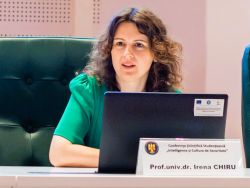
Irena Chiru
Irena Chiru is a professor of intelligence studies with expertise in intelligence in emergent democracies, intelligence analysis, and strategic and intelligence culture. She currently serves as director for doctoral research at the “Mihai Viteazul” National Intelligence Academy in Romania and as a member of the Advisory Board of the International Association for Intelligence Education (IAFIE) Europe. Across her professional roles—as professor, researcher, and member of academic advisory boards—she has been a consistent advocate for strengthening the relationship between the intelligence profession, intelligence education, and intelligence research, as well as for promoting a whole-of-society approach against security threats.

Aitana Radu
Dr. Aitana Radu is a Lecturer within the Department of Information Policy & Governance and the Chairperson of the Security and Intelligence Research Cluster (INSIGHTS) at the University of Malta. Her research focuses on different aspects of security science, from disinformation to crime analysis and intelligence oversight. She regularly trains Maltese and international practitioners, including EU LEAs and Interpol on crime-related topics, from OSINT to digital investigations related to cross-border crimes (trafficking, smuggling). Dr. Radu obtained her B.A. in Political Science at the University of Bucharest, an M.A. in Comparative Politics, an M.A. in the Management of Intelligence Activities for National Security from the National Intelligence Academy in Romania with a thesis on the security risks posed by the radical Islamic discourse, and her PhD in Intelligence and National Security from the same Academy with a thesis on the transformation of intelligence organizations.

Ritumbra Manuvie
Dr Ritumbra Manuvie is Assistant Professor at the University College Groningen, where she is the coordinator for the Law and Politics cluster, and teaches courses on international and human rights law. Her research focuses on governance of digital technologies especially given the role social media platforms play in setting critical policy agendas and in democratic processes. She has extensively researched on disinformation and hate speech in context of elections, and other hot-issue public policies.
|
Each month, the Security, Technology and ePrivacy research group organizes an exciting workshop on a wider variety of topics related to tech law. Together with a speaker from the STeP research group, an invited speaker from a different institution will shed light on current developments in the field of law and technology. We will cover a broad range of topics, from the digital aspects of the energy transition to AI-generated art and intellectual property. Join us, in Groningen or online, by registering for the STeP Talks!
|
|
We look forward to seeing you there!
For any questions, please contact us via step-talks step-rug.nl |