
Practical information
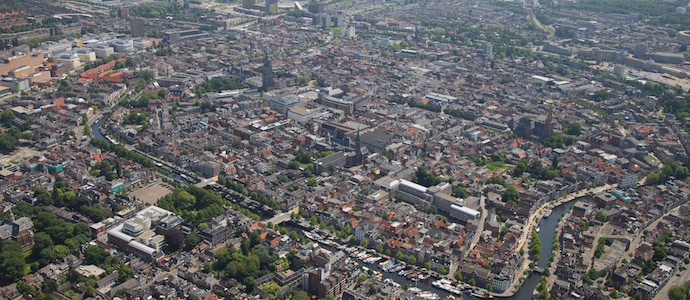
(Image: Groningen city centre, from above. Photo by Aerophoto Eelde)
In addition to all arrangements for your study programme, it is also important to arrange for other necessities beyond being accepted to participate in an LLM programme. In the sections below you will find brief information about, and links to, practical information about moving to and living in Groningen.
Accommodation
The University of Groningen does not have a campus, meaning the University itself does not have rooms available on offer for students. Students are responsible for securing their own housing and accommodation for the duration of their studies. Further information and advice about finding accommodation in Groningen can be found here.
Estimation of living expenses
Your living costs can vary from that of others, depending on e.g., how much rent you have to pay, if electricity and gas are included in your contract, which stores you frequent, etc. The largest expense in most cases is accommodation. For further details about estimation of monthly costs, please see here.
Insurance
If you are a foreign student, you will have to arrange for your own health insurance, third-party liability insurance and/or baggage insurance. Adequate coverage for medical costs is essential, and is a requirement for obtaining a residence permit.
The University of Groningen will not accept responsibility for medical costs or costs resulting from damage or accidents caused by a student during their stay in the Netherlands. For more information about health insurance, please see here.
Visa and residence permit
If you are a non-EU/EEA student, you very likely will need to obtain a residence permit for study and possibly an entry visa. The University of Groningen applies for these to the Dutch Immigration Services ('Immigratie en Naturalisatie Dienst', als known as IND) on your behalf.
For full, and up-to-date information about all issues related to necessary permits and visas, please visit the visa and residence permit webpages of the University, which are maintained by the Immigration Service Desk (ISD).
Please contact the ISD (ISD rug.nl) should you have any questions regarding entry visa for the Netherlands and residence permits.
Student facilities
Röling Building
The Faculty of Law is located in the Röling Building, which is in the city centre of Groningen and right next to the University Library and diagonal from the Academy Building.
The Office for Student Affairs, which includes the International Office, as well as the administrative offices of the Faculty and all departments are housed in the Röling Building.
Library
The University Library (UB) is situated in the centre of Groningen. All students registered at the University of Groningen (UG) and all UG staff members can use the library. You can use your student card to borrow a book or journal. The University Library is also home to the Law collection.
Computer facilities
In the Röling Building, computer (including internet, e-mail and printer) facilities are available for all students as well copy, print and scan machines. In addition, there is a Wi-Fi-connection for all the UG community and many outlets available, so you can very easily plug in your laptop when it needs charging. As such, you can use your devices everywhere on the premises of the Law Faculty.
Electronic learning environment (Brightspace)
Brightspace is the electronic learning environment of the University of Groningen. Lecturers can use this system to provide you with all kinds of information about their course, but also to support their course.
Language courses
If you are interested in taking language courses while you are in Groningen can contact the UG Language Centre. The University of Groningen also offers Dutch language courses to international students that are participating in an English-taught degree programme.
Associations
Groningen has many options to explore life outside the University. There are many associations which you could join when interested, e.g., sports associations, cultural associations, political associations, student associations, and study associations. You can find more information here.