
Colourful Characters: Jacobus Cornelius Kapteyn
On 9 December 2025, it was exactly 400 years since Ubbo Emmius, the founder of the University of Groningen, passed away. In his tracks, various people who worked and studied there through the centuries made the UG a brighter place. Some of them have been exceptionally important, due to their remarkable achievements, ideas, and activities. This series sheds a light on some of these ‘Colourful Characters’ . This week: Jacobus Cornelius Kapteyn.
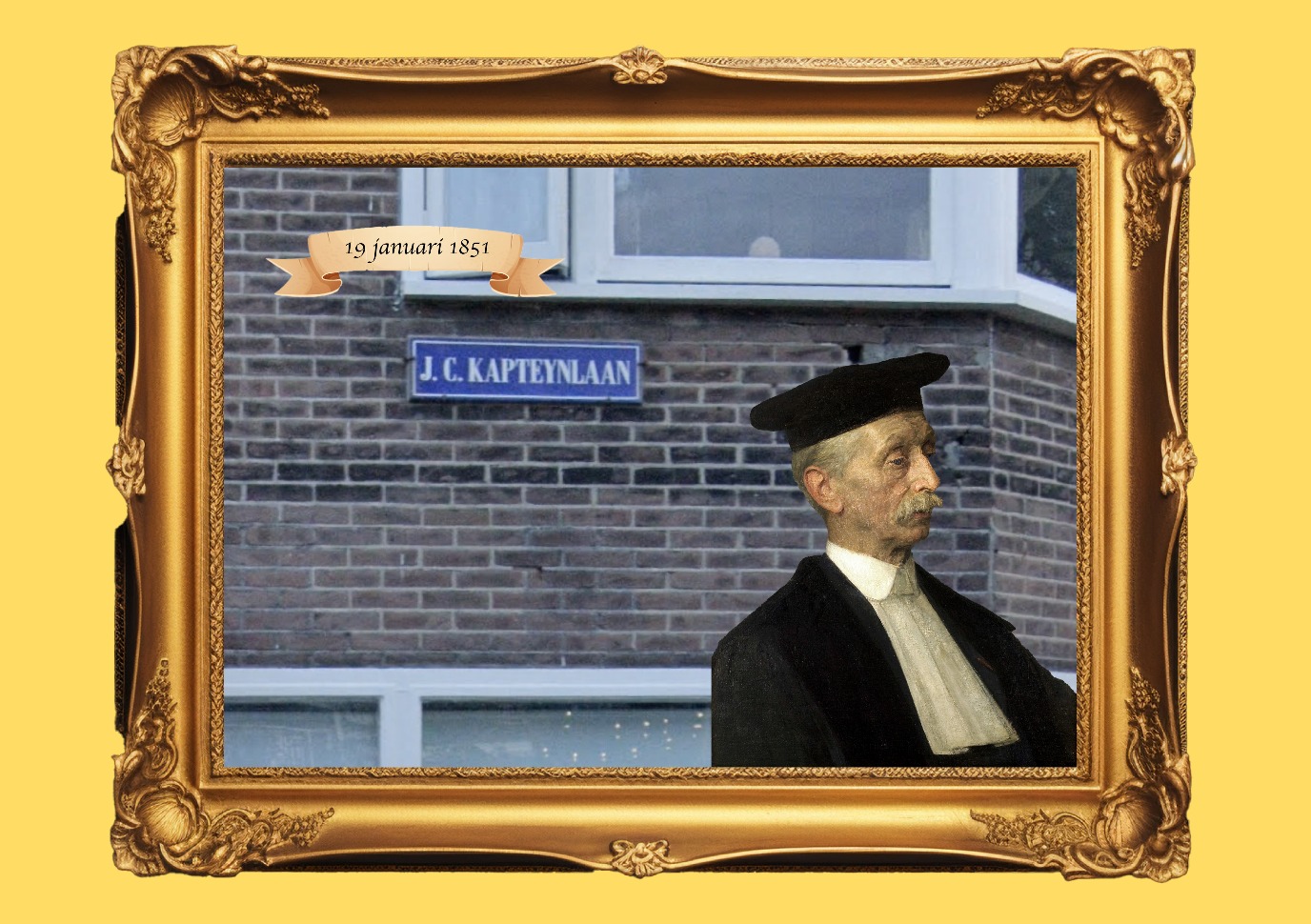
16 January 1896: Kapteyn receives his own astronomy laboratory
At last, Kapteyn could have his own laboratory, on Oude Boteringestraat. At that time, he had already been Professor of Astronomy in Groningen for almost 20 years. Yet, he was still having to make do without a true observatory with telescopes. That would not happen during his 44 years as a professor in Groningen. Nevertheless, he was one of the greatest astronomers of his time.
Appointment in Groningen
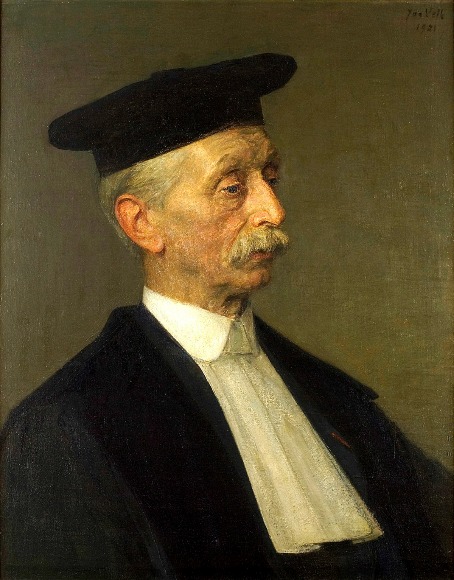
Jacobus Cornelius (‘Ko’) was only 26 years old in 1877, when he was appointed Professor of Astronomy in Groningen. He had not even been trained as an astronomer, but had become an observer at the Leiden Observatory shortly before. Despite repeated requests, Kapteyn was not able to obtain the necessary viewing equipment. The Minister of Education considered two observatories (in Leiden and Utrecht) sufficient. Of necessity, Kapteyn sometimes climbed the roof of the Academy Building with his students to make observations using a demonstration telescope. In the summer, Kapteyn went to work at the observatory in Leiden for a few weeks. The situation also had advantages for him. Unlike his colleagues in Utrecht and Leiden, he did not have to concern himself with literally ‘mundane’ matters, like time measurement and positioning for the purposes of the maritime industry.
International collaboration
Kapteyn recognized that he could also collect astronomical data by other means. To this end, he joined forces with the British astronomer David Gill in Cape Town, South Africa. Gill had a large number of photographic plates of the southern night sky, but lacked the time and staff to examine them thoroughly. Having a PhD in physics and mathematics, Kapteyn was well suited to help him. Between 1885 and 1889, therefore, as many as 2,400 glass plates came to Groningen. With these plates, Kapteyn and a few assistants took measurements with an instrument they had pieced together themselves. It resulted in catalogues of the southern night sky: The Cape Photographic Durchmusterung for the Equinox, 1875–1900. In all, the coordinates of more than 450,000 stars were established. This tedious work brought Kapteyn international fame.
Groningen as the centre of the astronomic world
Kapteyn was particularly interested in the structure of the Milky Way, and he hoped to construct a dynamic model of the galaxy. Having discovered the benefits of international collaboration, he continued. He developed the ‘Plan of Selected Areas’ to study the immense night sky. In this plan, more than 200 areas were randomly selected, and each was individually assigned to about 30 observatories around the world for systematic and statistical investigation.
California
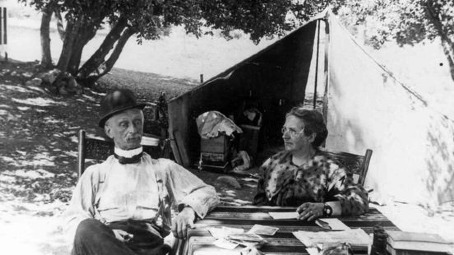
All these international contacts enabled Kapteyn to spend every summer and early autumn in California from 1908 until 1914 (the outbreak of the First World War). The world’s largest reflecting telescope had been built on Mount Wilson near Pasadena. The Groningen professor was given observation time there as a research associate. As delicately noted by Van Berkel: ‘The astronomer to whom an observatory had been denied by the minister had now achieved something great with small means. He had an observation spot at the most advanced observatory in the world, atop a mountain in bright, sun-drenched California, whilst his Dutch colleagues were having to make do with outdated equipment in the damp and cloudy Netherlands’.
Regeeringshôtel
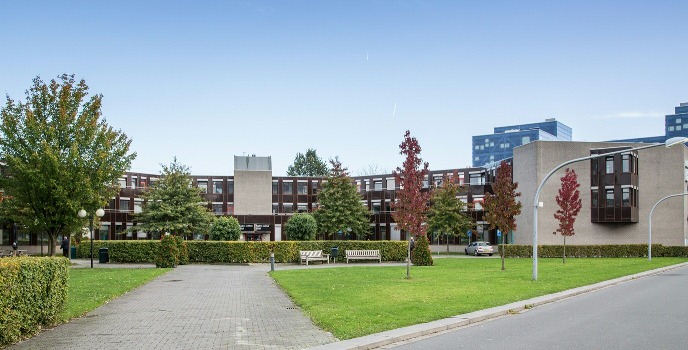
Despite his status and success, Kapteyn did not obtain a proper observatory. For a long time, he did not even have a permanent workplace. Upon his arrival in Groningen, he was given two rooms in the Physiological Laboratory behind the Academy Building and, in 1896, accommodations in the ‘Regeeringshôtel’ (the official residence of the Queen’s Commissioner, now the UG Administration Building). He then had to move to the Corps de Garde, supplemented in 1909 by a few rooms in the basement of the newly constructed Academy building. He did not obtain a true institute until 1913, when the Physiological Laboratory became vacant (the same place where he had started earlier).
Kapteyn in the city of Groningen (and the rest of the universe), 2025
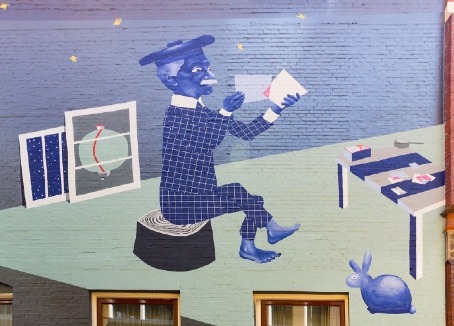
He would not live to see the University of Groningen obtain its own observatory: the Kapteyn Sterrenwacht in Roden. His name lives on in the UG’s Kapteyn Institute (located in the Kapteynborg) and the Kapteyn Telescope on La Palma. In the universe, a red dwarf star, an exoplanet, an asteroid, and a lunar crater are named after him. There is a J.C. Kapteynlaan in the city of Groningen, and a mural about him is on display at the entrance to the University Museum. From 1910 to 1918, Kapteyn lived at Ossenmarkt 6. The building has a plaque bearing the following text in reference to his life: ‘Quand on n’a pas ce qu’on aime, il faut aimer ce qu’on a’. (‘If one does not have what one loves, one must love what one has’.)
Jacobus Cornelius Kapteyn
-
19 January 1851: Born in Barneveld
-
1868: Studies in mathematics and physics in Utrecht
-
1875: Doctoral defence
-
1877: Professor of Astronomy and Theoretical Mechanics in Groningen
-
1879: Marriage to Elisabeth Cornelia Koomans
-
1921: Retirement
-
18 June 1922: Died in Amsterdam
More information
More news
-
-
03 September 2026
Ming Cao reappointed as scientific director of the Jantina Tammes School
-
01 September 2026
Evrim Ursavas appointed scientific director Wubbo Ockels School