
Colourful Characters: Bert Röling
On 9 December 2025, it will have been exactly 400 years since Ubbo Emmius, the founder of the University of Groningen, passed away. In his tracks, various people who worked and studied there through the centuries made the UG a brighter place. Some of them have been exceptionally important, due to their remarkable achievements, ideas, and activities. This series sheds a light on some of these ‘ Colourful Characters ’. This week: Bert Röling.
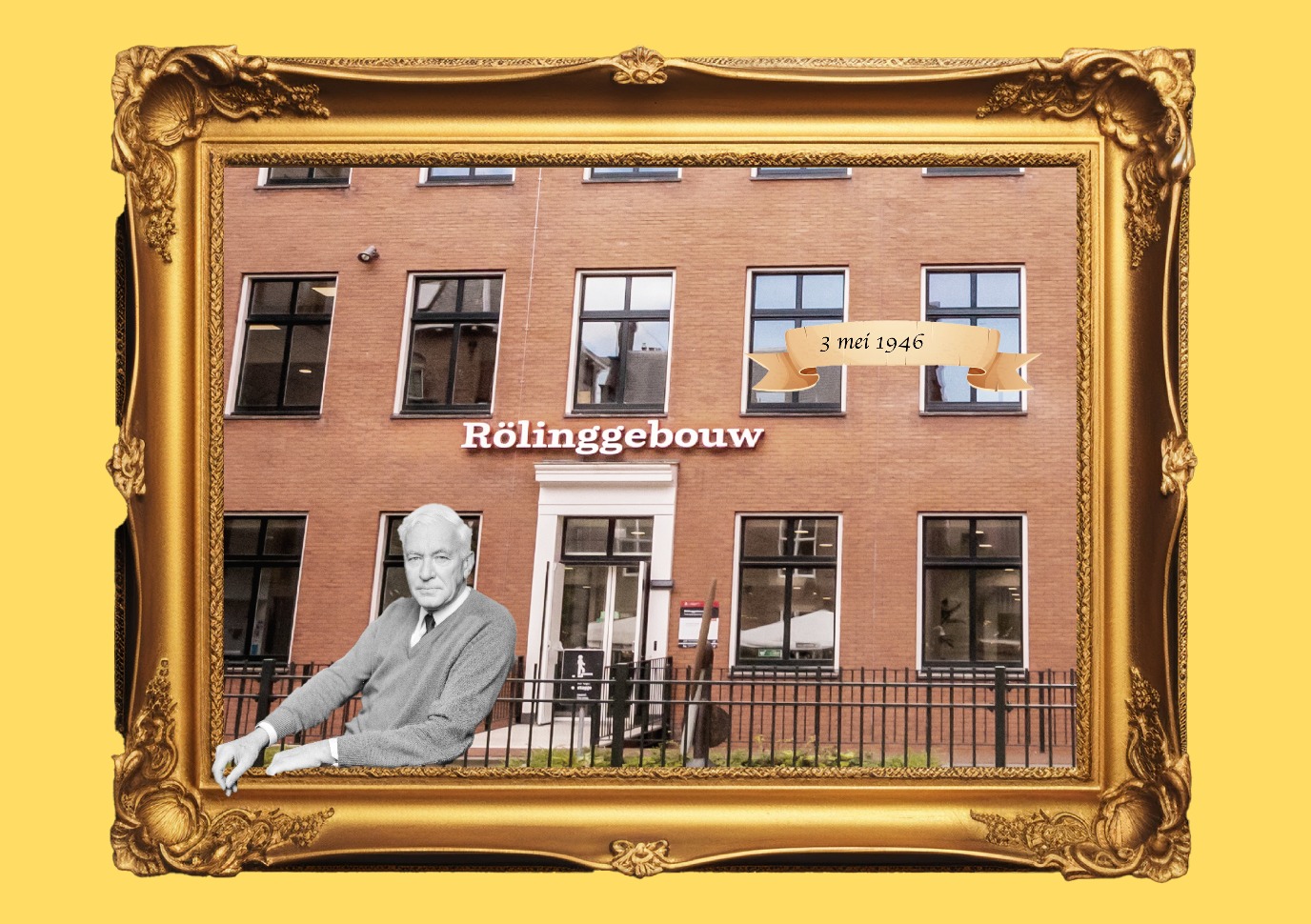
3 May 1946: Start of the Tokyo Tribunal
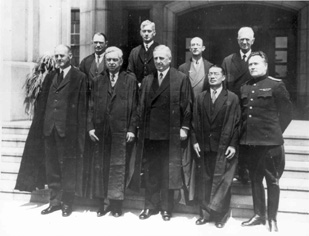
Because of Japanese aggression in the Dutch East Indies, the Netherlands was permitted to send a judge to the International Military Tribunal for the Far East in Tokyo. That is the place where Japanese war criminals were tried. The young Professor Bert Röling distinguished himself as the legal conscience of the Tribunal, and it became a turning point in his life.
Dissenting opinion
At the time, many people viewed the Nuremberg and Tokyo trials as a form of retributive justice. ‘We’ll give them a fair trial and then hang them.’ Röling, however, did not share that view and instead posed probing legal questions. Ultimately, Röling did not support the majority decision, even under pressure from the government in The Hague. He wrote a dissenting opinion, in which he concluded that a number of defendants should be acquitted. In this matter, Röling was undoubtedly influenced by R. Pal, a judge from India. Nevertheless, Röling came to his conclusion independently, partly based on his thorough study of the trial material. The president of the Tribunal referred to him as the only judge who had read all the documents.
The main reason for his dissenting opinion was that he did not regard the objectives of Japanese policy — establishing a dominant position in Asia and eliminating the European powers — as criminal in themselves. It already revealed some of the views that would later come to define Röling: showing understanding of and even agreeing with the desire to change dynamics dating from the colonial era, that is, to revise European international law.
The questions that arose in Tokyo would stay with Röling and mark a turning point in his life. The boundaries of the legal field turned out to be too narrow; it was necessary to study not only norms, rules, and laws, but also the social and political backgrounds.
International law
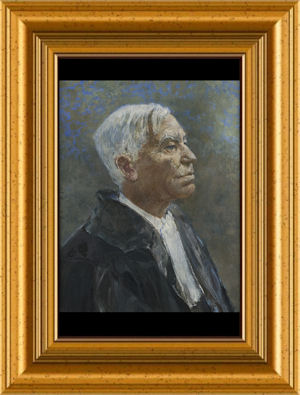
In 1948, after returning to the Netherlands, he accepted an invitation from the Board of the University of Groningen to become Professor of Criminal Law, Criminal Procedure, and Criminology. His academic interests increasingly focused on international law, which he had described ten years earlier as an ‘unattractive and dull’ field.
Even though the government in The Hague was not always pleased with Röling's views, in 1950, as a Groningen professor, he was asked to join the Dutch delegation to the United Nations General Assembly. He was told: ‘Keep in mind that this time you will be under government instruction!’. However, that did not change much. Röling could only regard the French-British invasion of Egypt in 1956 and the Dutch position on New Guinea in 1962 as illegitimate attempts to preserve the colonial system.
This generated significant opposition to his views in politics and public opinion, but also among his peers. Few supported his understanding of, for example, Egypt’s nationalization of the Suez Canal as an adaptation to changed circumstances. His warnings against the dangers of nuclear weapons were widely viewed as covert pacifism, and his criticism of American politics was often dismissed as a sign of sympathy for the Eastern Bloc. A typical question reflecting the suspicions directed at Röling was asked by the chair of the Board of the University of Groningen, who asked whether he was a communist.
Polemological Institute
Röling was convinced that a lot had to change in the world and in international law in particular. He thought we could not afford the ‘luxury’ of war anymore and believed that much study and research was needed to answer the questions of what and how. For this reason, in 1960, he proposed the establishment of a polemological institute to study the causes of war and the conditions for peace. The Polemological Institute was indeed established two years later, with just one office and one staff member.
Charisma, knowledge, and understandable language
During the 1960s, mainly as a result of the Vietnam War, Röling’s views resonated more broadly. His prestige grew, just like the scope of the Polemological Institute. Until his death in 1985, he continued to play a central role in discussions on peace and security policy. He consistently advocated for this policy to be more rational and supported by academic insights from various disciplines. Having been raised in a legal tradition, Röling remained the judge who weighed the facts and arguments before reaching his conclusions, and he was willing to revise those conclusions if there was sufficient reason to do so.
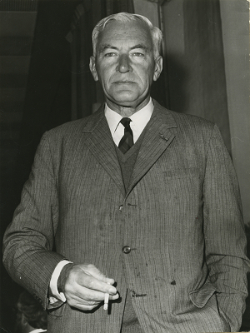
Röling focused predominantly on topical global issues and was frequently asked about them. He possessed the authority and credibility to independently make critical observations on official policy. On the one hand, this was due to his charisma and his stature as a distinguished lawyer and professor, and on the other hand, to his factual knowledge, his always reasonable arguments, and his language that was understandable to everyone. In 1973, he was asked to join the Den Uyl Cabinet as State Secretary for Disarmament and Arms Control. He did not accept the position and continued his work at the Polemological Institute. Three years later, in 1976, he retired at the age of 70. But the following morning, he was back on his bicycle, on the way to the Institute.
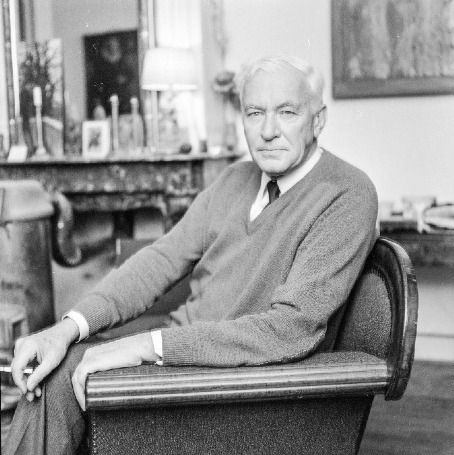
Huis Groenestein
Since 1950, Röling lived in Huis Groenestein, a distinctive building dating from 1685 located in Helpman. He had five children with his wife, Lies Sloth Blaauboer. While Bert Röling was in Japan, Lies was mostly on her own at home, something she did not always find easy. The children turned out to have an artistic and creative nature. Their daughter Jet was a pianist, their son Wiek was an architect, their son Matthijs was a well-known painter, and their son Hugo wrote a book about his father, titled: De rechter die geen ontzag had, Bert Röling en het Tokiotribunaal [The judge who did not bend: Bert Röling and the Tokyo Tribunal]. In the book, Hugo describes the adventures of his father Bert, within and outside the courtroom in Tokyo.
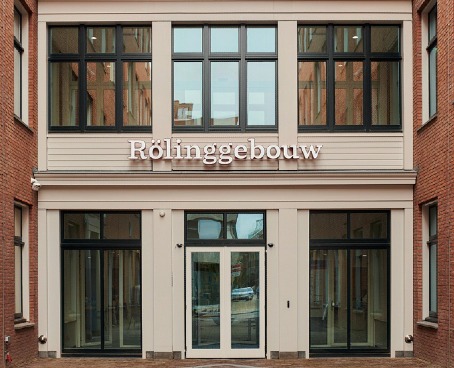
Bert Röling in the city of Groningen in 2025
The University of Groningen’s Faculty of Law has been based in the old public library on Oude Boteringestraat since 2023. The building is called the Röling Building. His son, Matthijs Röling, together with Wout Muller, portrayed his father in a large mural in the Aula of the Academy Building.
Bert Röling
-
1906: Born in ’s-Hertogenbosch on the second day of Christmas
-
1933: Doctoral defence at the Willem Pompe Institute for Criminal Law and Criminology in Utrecht
-
1934: Establishment of the Criminological Institute in Utrecht
-
1946: Appointed to the International Military Tribunal in Tokyo
-
1950: Appointed as Professor in Groningen
-
1962: Established the Polemological Institute in Groningen
-
1985: Died in Groningen on 16 March
More information
More news
-
21 September 2026
Disinheritance is about much more than money
-
31 August 2026
A digital game of cat and mouse
-
03 August 2026
Opinion: ‘AI must not take the place of the judge’