This Master's programme has started for the last time and is coming to an end; applications are no longer being accepted.
How does the nervous system control voluntary movement? What are the benefits of exercise? And are these things the same for all people? Find out in this programme.
The two-year selective Master's programme is meant for students
who are fascinated by the complexity of human movement. You will
study human movement from multiple perspectives, using theories
from Medicine, Biology, Mathematics and Behavioural Sciences.
In this programme, you will acquire an advanced theoretical
understanding of human movement. You will also gain research skills
and professional skills, learning to apply your knowledge in a
practical setting.
The programme has two central themes. In 'motor function and
cognition in healthy ageing' you will explore how physical activity
and innovative solutions can prevent chronic diseases, and preserve
cognitive function. You will also study slow ageing. In
'rehabilitation and functional recovery' you will improve your
understanding of impaired movement and the restoration of
functioning in rehabilitation practices.
• Two-year selective programme in English (120 ECTS) • Building bridges between fundamental lab research and applied societal practice • Room for personal tracks with academic assignments and hands-on experience to match your interests, under expert supervision • Collaborate with staff and (PhD) students on your own research project • Develop scientific and professional skills in an ambitious environment • Direct link to the clinical environment of the University Medical Center Groningen (
Compulsory courses are:
In addition to the compulsory courses, you have a lot of freedom within the first year to cho
| Semesters | ||||
|---|---|---|---|---|
| CoursesCourse Catalog > | 1a | 1b | 2a | 2b |
| 3D-Movement Analysis (5 EC) BWM176 | ||||
| Human Movement Sciences in Rehabilitation and Healthy Ageing (10 EC) BWM190 | ||||
| Master monitor (5 EC) BWMMO | ||||
| Motor Control (5 EC, optional) BWM137 | ||||
| Academic Assignment(s) (5 EC, optional) | ||||
| Advanced Statistics (5 EC) BWM136 | ||||
| Introduction to Dynamical Systems (5 EC, optional) BWM142 | ||||
| Physiology of Training and Exercise (5 EC, optional) BWM134 | ||||
| Musculoskeletal modelling and biomechanics (5 EC, optional) BWM177 | ||||
| Review article (10 EC) BWM152 or BWM162 | ||||
| Sport and Talent (5 EC, optional) BWM139 | ||||
| Big data in Sport Sciences & Human Movement Sciences (5 EC, optional) BWM146 | ||||
| Philosophy of Science and Ethics (5 EC) BWM143 | ||||
| Semesters | ||||||||||||||
|---|---|---|---|---|---|---|---|---|---|---|---|---|---|---|
| CoursesCourse Catalog > | 1a | 1b | 2a | 2b | 3a | 3b | 4a | 4b | 5a | 5b | 6a | 6b | 7a | 7b |
| Signal Analysis using machine learning (5 EC, optional) BWM149 | ||||||||||||||
| Master Graduation Project (40 EC) The Graduation Project is an individually performed project and involves the independent development and execution of research during an in- or external internship, which leads to a scientific article | ||||||||||||||
In the first year of this selective two-year programme, you will get a head start with our specialization courses, where you will meet our experts and scientists working in the field of Rehabilitation and Healthy Ageing. These courses will give you a broad understanding of current research topics.
In addition to the compulsory courses, you are free to choose your individual study programme (40 EC). For example, you may follow internal or external course units, or decide to carry out an academic assignment, which could involve gaining teaching or applied research experience, doing consultancy work, or writing a scientific article for publication. In the second year of the Master’s programme, you will spend most of your time on your graduation project, which should concern a relevant and current research topic. You will work together with a team of researchers, students, and PhD students, taking measurements and collecting data in one of our state-of-the-art research labs with outstanding facilities, or in a field setting at a Dutch or international research institution, a health institution, or other educational institution.
This Master's programme has started for the last time and is coming to an end; applications are no longer being accepted.
| Study programme | Organization | Transition |
|---|
| Study programme | Organization | Transition |
|---|
| Study programme | Organization | Transition |
|---|
| Study programme | Organization | Transition |
|---|
| Study programme | Organization | Transition |
|---|---|---|
| Bewegingswetenschappen | University of Groningen |
Additional requirements More information:Follow selection procedure. |
| Study programme | Organization | Transition |
|---|---|---|
| Human Movement Sciences | VU University Amsterdam |
Additional requirements More information:Follow selection procedure |
This Master's programme has started for the last time and is coming to an end; applications are no longer being accepted.
Information for students with a Dutch diploma Human Movement Sciences (RUG or VU)
1. Apply via
Studielink
for
the master Human Movement Sciences before March 1st,
2026
2. Upload the documents for selection (information available
after January 6
)
before March 1st, 2026 in the Brightspace course: Selection HMS and
SpSc
3. No later than May 1st 2026 you will receive information
about your ranking
4. Accept your place before June 1st 2026. After this date
the waiting list will be updated.
5. Start with the master in September 2026
Information for students with a Dutch relevant WO- bachelor degree
1. Apply via
Studielink
for
the master Human Movement Sciences before March 1,
2026
2. Upload documents for admission (
admission
form
) AND selection (available after January
6
)
before March 1, 2026 in the Brightspace course: Selection HMS and
SpSc
3. No later than May 1st, 2026 you will receive information
about whether or not you are directly eligible for the master and
if you are selected for the one of the 10 places or will be placed
on the waiting list first
4. Accept your place before June 1st. After this date the
waiting list will be updated.
5. Start with the master in September 2026.
This Master's programme has started for the last time and is coming to an end; applications are no longer being accepted.
This Master's programme has started for the last time and is coming to an end; applications are no longer being accepted.
| Specific requirements | More information |
|---|---|
| previous education |
Bachelor degree (Bachelor of Science) in Human Movement Sciences or a strongly related field (e.g. kinesiology, sport and exercise sciences, etc.). Or education and experience on a comparable level. |
| Exam | Minimum score |
|---|---|
| C1 Advanced (formerly CAE) | C1 |
| C2 Proficiency (formerly CPE) | C2 |
| IELTS overall band | 6.5 |
| IELTS listening | 6 |
| IELTS reading | 6 |
| IELTS writing | 6 |
| IELTS speaking | 6 |
| TOEFL internet based | 90 |
This Master's programme has started for the last time and is coming to an end; applications are no longer being accepted.
This Master's programme has started for the last time and is coming to an end; applications are no longer being accepted.
This Master's programme has started for the last time and is coming to an end; applications are no longer being accepted.
In a survey we held under graduates we see that 69% had applied for a job, and found one. 16% has chosen to do another master, 13% started with another programme and 3% made some other choise.
After graduation, you can continue your academic career in a PhD trajectory or perform research at health care research institutes. In addition, you can consult at rehabilitation centres, hospitals and specialized care facilities. It is also possible to evaluate and develop ergonomic or orthopaedic products or to develop health and welfare policies for government agencies. With a teacher's certificate you can work as a lecturer in education.
Study for a PhD or perform research at health care research centers
Consult at rehabilitation centers, hospitals, or specialized care facilities
Teacher/Lecturer of health and exercise science in Higher Education
Develop health and welfare policies for government agencies
Evaluate and develop ergonomic or orthopedic products in/or outside industry
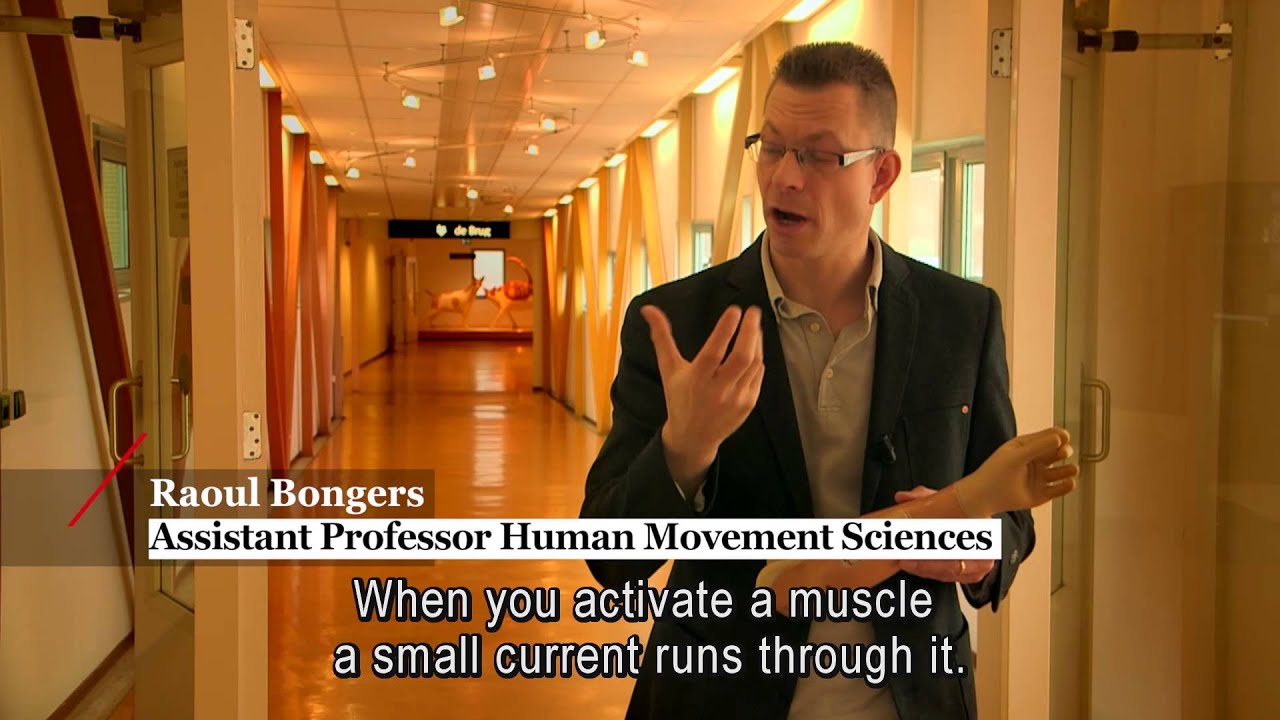
Education and research are intensely connected in the department of Human Movement Sciences. PhD's, master and bachelor students work together in an academic learning community and inspiring environment, playing a pivotal role in our research success.
There are 2 research domains within the master Human Movement
Sciences shown with some examples of research questions:
• Falling in the elderly: predicting individual fall risks
and developing preventive exercise programmes
• The relationship between movement and diseases such as
dementia, stroke and Parkinson’s disease
• Effects of physical activity and inactivity on cognitive
and mental processes (e.g. attention, memory)
• Recovery of normal skills levels after a stroke or paraplegia
• Sensorimotor adaptation processes during the rehabilitation of people with an artificial arm or leg or when learning to operate an arm-drive wheelchair
• Children with DCD (Developmental Coordination Disorder) and adults who need to relearn motor skills after a stroke or other impairment of the cognitive/sensorimotor system
• Physical fitness, physical activity, fatigue and health related quality of life after burn injury
Where?
Student research projects within this domain are usually conducted
on-site in nursing homes and/or geriatric wards of hospitals,
residential facilities for the elderly or individual homes. The
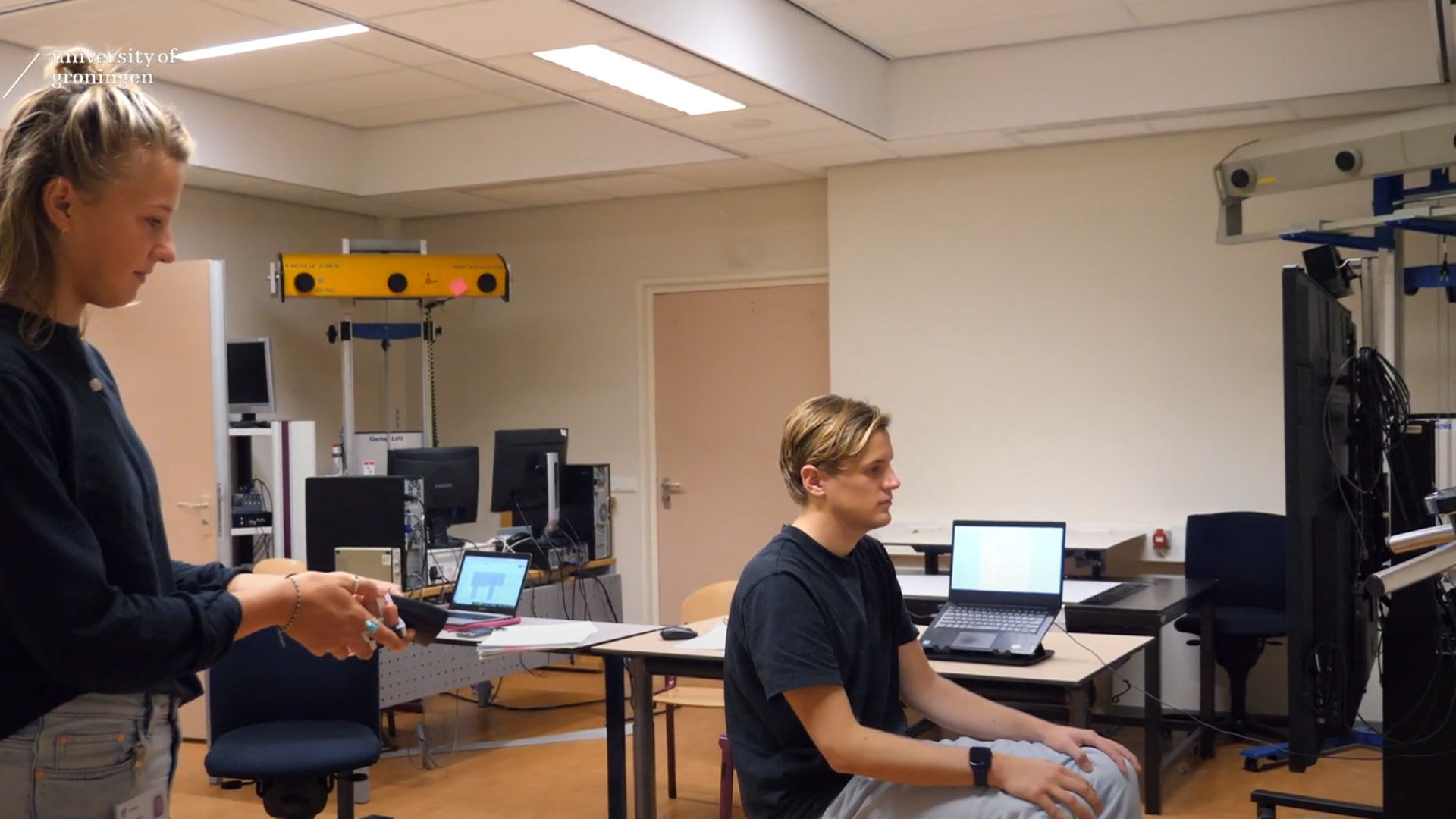
department of Human Movement Sciences also has great lab facilities
to conduct research. There is a large number of lab facilities
consisting of laboratories, equipment and software. In 2020, the
construction of a completely new Virtual Reality Lab has started.
In the coming years, this will be further developed into three
different Virtual Reality Laboratories, each with its own specific
character.
More information about our research can be found on the UMCG research website!