
Career Minor

Doel
De Minor start met een competentie- en persoonlijkheidstest en een gesprek met een trainer van het Career Service Center om je zelfinzicht te versterken en je leerdoelen vast te stellen. Je leert je kennis in de praktijk toe te passen, je talent uit te bouwen en relevante kennis en vaardigheden te ontwikkelen.
Het is een uitdagend programma waarin je experts uit het veld ontmoet, praktijkgerichte opdrachten doet, op excursies gaat, maar ook leert solliciteren, netwerken, onderhandelen, projectplannen maken, ondernemend denken, beleidsadviezen schrijven, in teamverband werken en nog veel meer.
Voor wie
Je bent geïnteresseerd in het uitbreiden van je netwerk, het delen van je ideeën en het ontwikkelen van je persoonlijke vaardigheden. De Career Minor staat open voor studenten van alle faculteiten van de RUG of zelfs andere universiteiten in Nederland.
Leeruitkomsten
- Je leert de arbeidsmarkt en de organisaties daarbinnen kennen
- Je leert je kennis toepassen op concrete vraagstukken uit de praktijk
- Je leert jezelf en je expertise presenteren in deze praktijkomgeving
- Je verkrijgt inzicht in je eigen persoon en wat nodig is om een stage, opdracht of functie te verwerven
- Je leert te werken in een multidisciplinair team
- Je leert gebruik te maken van je eigen creativiteit en kennis om te komen tot concrete oplossingen en adviezen voor actuele problemen of vraagstukken
- Je hebt meer inzicht gekregen in een specifieke arbeidsmarktsector en bijbehorend thema
Aanmelding
Je kunt je aanmelden voor de Career Minor in het voorjaar van 2026. Je hoeft je slechts op te geven voor een thema en je wordt dan automatisch voor de andere onderdelen (Humanities at Work en de Practical Assignment) aangemeld. Om organisatorische redenen wordt iedereen dringend verzocht zich zo snel mogelijk in te schrijven via Ocasys, vanaf 21 mei (18.00 uur).
Meer informatie intekenprocedure
Vragen?
Voor vragen over de Career Minor kun je contact opnemen met minorcoördinator Sean White (en studentassistent): careerminor rug.nl
Blok 1a - Oriëntatie (15 ECTS)
Tijdens het eerste blok volg je twee modules van respectievelijk 5 en 10 ECTS waarin je:
-
kennis en vaardigheden opdoet;
-
opdrachten uitvoert;
-
je inhoudelijk steeds verder verdiept in een specifiek thema en bijbehorende organisaties.
Module 1 - Humanities at Work (5 ECTS)
Humanities at Work
Humanities at Work bereidt je voor op de arbeidsmarkt. Enerzijds leert de student zichzelf dankzij een ‘assessment’ en een gesprek met een trainer beter kennen (wie ben ik, wat wil ik, wat kan ik en wat heb ik daarvoor nodig) en anderzijds maak je kennis met de belangrijkste algemene vaardigheden die je nodig hebt om een baan te verwerven ('job hunting skills' zoals netwerken en solliciteren) en specifieke vaardigheden die nodig zijn in organisaties en die je nodig hebt om jezelf staande te houden op de snel veranderende werkvloer van de 21e eeuw. Je kunt hierbij denken aan projectmatig werken, onderhandelen, leiderschap, teamwerk, communicatie, interculturele competenties, ondernemend denken.
Contacturen
Je hebt 8 contacturen per week: op maandag en dinsdag tussen 9.00/10.00 en 16.00/17.00 uur.
Module 2 - Thema's (10 ECTS)
Thema's
In deze module kies je één van de drie thema's/sectoren:
- Working in and on Governance (Engelstalig - LBA036B10 )
- Vrede en Veiligheid (Nederlandstalig - LBA035B10 )
-
Entrepreneurship and Leadership in the Humanities (Engelstalig - LBA034B10 )
In de thematische werkgroep wordt de kennis uit blok 1a verbonden aan een specifieke arbeidsmarktsector (bijvoorbeeld lokaal of internationaal bestuur, het veiligheidsdomein of de culturele sector) en oefen je met vaardigheden behorende bij die sector (bijvoorbeeld een subsidieaanvraag doen, een projectplan of beleidsadvies schrijven, een onderhandeling voorbereiden en uitvoeren). In tegenstelling tot de eerste plenaire module, volg je deze thematische module in de eigen werkgroep. Werkbezoeken en excursies versterken je inhoudelijke en organisatorische kennis.
Contacturen
Je hebt 8-12 contacturen per week: op woensdag en donderdag tussen 9.00 en 16.00 uur.
Blok 1b - A Practical Assignment (15 ECTS)
Tijdens het tweede blok van de Career Minor heb je 32-40 contacturen per week en kun je kiezen uit drie mogelijkheden:
-
het uitvoeren van een concrete opdracht voor een organisatie in een projectgroep
of -
een individuele opdracht in de vorm van een stage of
-
een praktijkopdracht in combinatie met een opleiding tot reservist bij Defensie in het kader van de Nationale Weerbaarheidstraining, (let op: hiervoor moet je een selectie doorkomen bij Defensie voordat je wordt toegelaten en aan een aantal voorwaarden voldoen. In de Career Minor moet je het themavak Vrede en Veiligheid in blok 1 hebben gevolgd).
1. Werken voor een opdrachtgever in een projectgroep
Kunnen samenwerken in interdisciplinaire teams aan kortlopende of langlopende projecten is een gewaardeerde en zeer essentiële vaardigheid op de snel veranderende arbeidsmarkt. Wanneer je kiest voor een project, kun je deze vaardigheid ontwikkelen en ontdekken wat jouw kennis in de praktijk waard is. Projecten hoef je niet zelf te verwerven, maar ‘staan gereed’ bij de start van de Career Minor.
Praktische informatie over werken voor een opdrachtgever
Bij een project werk je in een team van studenten van verschillende opleidingen aan een opdracht van een organisatie. Het doel is om een goed onderbouwd advies of product te ontwikkelen, dat past in de praktijk van de opdrachtgever. De projecten sluiten waar mogelijk aan op de thema’s in blok 1a van de Career Minor. Afhankelijk van het thema, de opdracht en de samenstelling van je groep krijg je te maken met verschillende taken, zoals onderzoeken, presenteren, teksten schrijven voor verschillende doelgroepen en doelen, het ontwikkelen van educatieve of digitale formats, organiseren van bijeenkomsten, onderhandelen, adviseren, plannen, budgetteren en evalueren. Je wordt nadrukkelijk uitgedaagd om de kennis en vaardigheden opgedaan in je opleiding praktisch in te zetten en aan te vullen met nieuwe kennis en vaardigheden. Deze projecten hoef je niet zelf te verwerven, maar ‘staan gereed’ bij de start van de Career Minor.
Voorbeelden van projectopdrachten:
Stappen die je moet volgen om een teamopdracht af te ronden.
2. Kiezen voor een stage (Career Minorstage)
Werkervaring is een belangrijke vereiste op de arbeidsmarkt. Wanneer je kiest voor een stage leer je een organisatie en de heersende cultuur goed kennen en ontdek je hoe jouw vaardigheden van pas komen. Ook verkrijg je inzicht of de organisatie wel bij jou past. Deze stage moet je zelf verwerven en moet passen bij je opleidingsprofiel en belangstellingsveld.
De stage start net als de groepsopdracht in het tweede blok van het eerste semester.
Meer informatie
Vragen?
Maak een afspraak voor het stagespreekuur via https://placementarts.youcanbook.me.
3. Praktijkopdracht: Nationale Weerbaarheidstraining
Praktijkopdracht: Nationale Weerbaarheidstraining
Voor studenten die de Career Minor volgen in het kader van de Nationale Weerbaarheidstraining bij Defensie, wordt de praktische opdracht uitgevoerd in combinatie met de training tot reservist. Deze training is onderdeel van de nieuwe Nationale Weerbaarheidstraining (NWT), opgezet door Defensie in samenwerking met diverse onderwijsinstellingen. Ga voor meer informatie over NWT naar https://werkenbijdefensie.nl/nwt.
Tijdens blok 1b van de Career Minor word je voor deze praktijkopdracht officieel aangesteld als reservist. Daarna studeer je verder en blijf je, als je dat wilt, actief als reservist. Zo kun jij bijvoorbeeld werken in de beveiliging van kritieke infrastructuur of ondersteun je beroepsmilitairen tijdens oefeningen. Ook wordt onderzocht of je bijvoorbeeld dankzij de combinatie van je opleiding tot reservist en jouw specifieke studieachtergrond op het vlak van weerbaarheid relevante taken kan uitvoeren in de eigen veiligheidsregio, bijvoorbeeld voor de gemeente, de brandweer of andere veiligheidspartners.
Wat kun je verwachten?
Tijdens de training bij Defensie worden de deelnemers zowel praktisch als theoretisch uitgedaagd. De opleiding biedt een rijke leeromgeving waarin de student ervaringen opdoet en de theorie toetst in de praktijk middels wekelijkse opdrachten waarin de student reflecteert op een specifiek thema en/of een praktijkervaring. Je leert militaire basisvaardigheden zoals kaart en kompas lezen, veilig omgaan met een wapen, militaire EHBO en militair straf- en tuchtrecht. Daarnaast ga je op bivak: een intensieve training in de buitenlucht. Hier slaap je in het veld, leer je hoe je met beperkte middelen een onderkomen bouwt en oefen je tactisch verplaatsen.
Voor de Career Minor werk je tijdens de training bij defensie aan je persoonlijke ontwikkeling, het werken in teamverband en je leiderschapsvaardigheden en reflecteer je op je leerdoelen binnen een unieke omgeving die je nergens anders kunt vinden.
Leeractiviteiten
De verdieping op leiderschap, persoonlijke effectiviteit en samenwerken betreft een combinatie van leeractiviteiten. Ter voorbereiding op de training zal een theoretische verdieping worden gedaan door zelfstudie aan de hand van lesmateriaal van de Open Defence Academie (ODA). Het deel tijdens de weerbaarheidstraining zal bestaan uit extra (groeps)opdrachten en het deel erna zal bestaan uit een eindopdracht. Bovendien wordt van studenten verwacht dat zij eigen reflecties op persoonlijke effectiviteit bijhouden en dat zij indien gewenst gebruikmaken van (online) coaching voor welzijn, groei en probleemoplossend vermogen.
Toetsing en eindopdracht (15 ECTS)
Tijdens de opleiding bouw je een portfolio op waarin reflectie en visievorming op persoonlijke effectiviteit, teameffectiviteit en leiderschap binnen Defensie centraal staan. Toetsing van de leerdoelen en leeruitkomsten vindt plaats aan de hand van dit portfolio, een eindopdracht en een mondeling assessment, bijvoorbeeld in de vorm van een criterium gericht interview, dat door examinatoren van de universiteit wordt afgenomen.
In de eindopdracht voor de universitaire Career Minor in het kader van de Weerbaarheidstraining dient de student vanuit alle aangeboden bronnen en perspectieven tot een eigen persoonlijke visie te komen met daarbij een reflectie op hoe dat aansluit bij de eigen kernwaarden, de eigen ontwikkeling van een militaire identiteit. Ook gaat de student in op de relatie tussen de eigen studie, de gevolgde training en het gewenste carrière- en toekomstperspectief. Bij dat laatste dient ook nadrukkelijk te worden gereflecteerd op de vraag op welke wijze de student waarde kan hebben in de burgermaatschappij en op welke wijze de student kan bijdragen aan de veerkracht, veiligheid en weerbaarheid van Nederland.
Voor de eindopdracht wordt gekozen uit één van de volgende mogelijke formats: een pitch video, een powerpoint-presentatie of een toespraak. Deze eindopdracht mag alleen worden gedaan als alle opdrachten in het portfolio zijn goedgekeurd. De examinator van de RUG is verantwoordelijk voor de toetsing van de leeruitkomsten.
Ingangseisen
Om deel te nemen aan het militaire deel van de weerbaarheidstraining moet je het militaire keuringstraject succesvol doorlopen en voldoen aan enkele voorwaarden:
-
Je bent minimaal 18 jaar.
-
Je bent in het bezit van een Nederlands paspoort of identiteitsbewijs.
-
Je bent geschikt bevonden tijdens een psychologische selectie.
-
Je bent geschikt bevonden tijdens een medische en fysieke keuring.
-
Je mag niet afhankelijk zijn van medicatie.
-
Wil je meer weten over de stappen in het keuringstraject? Check de website: https://werkenbijdefensie.nl/sollicitatie
Aanmeldingsprocedure
Stap 1: Schrijf je in voor de Career Minor in Ocasys. Teken daarnaast ook in voor het themavak Vrede en Veiligheid en de practical assignment, onderdeel Nationale Weerbaarheidstraining.
Meer informatie over de intekenprocedure.
Stap 2: Meld je ook direct aan bij Defensie (uiterlijk 15 juli) via https://werkenbijdefensie.nl/vacatures/solliciteren/wo-nwt-e59310.
Stap 3: Defensie controleert of je voldoet aan de ingangseisen.
Stap 4: Je doorloopt het keuringstraject. Deze bestaat uit een psychologische selectie, een medische en fysieke keuring en een veiligheidsonderzoek.
Stap 5: Je bent klaar om te starten.
|
Let op: je schrijft je dus op twee plekken tegelijk in: bij de Rijksuniversiteit Groningen en bij Defensie. Als je je aanmeldt voor de opleiding tot reservist, ga je ermee akkoord dat de Rijksuniversiteit Groningen en Defensie jouw gegevens met elkaar uitwisselen.
|
Wat als je de keuring niet haalt?
Geen zorgen! Dan kan je voor het tweede deel van de Career Minor kiezen voor de teamopdracht, dat is een andere variant binnen de Career Minor - Vrede en Veiligheid. Hierbij werk je in een interdisciplinair team van 4-5 studenten fulltime samen aan een concrete opdracht vanuit het veiligheidsdomein. Dat kan zijn voor een ministerie, voor een gemeente of voor een ngo.
Samenvatting over de Practical Assignment
Misschien overweeg je een master te doen, maar weet je nog niet goed welke. Of wellicht denk je erover eerst een jaar of langer te gaan werken, maar vind je het moeilijk te bedenken welke soort beroepen geschikt zijn en, vervolgens, hoe daar een entree te vinden. Of je hebt een heel gericht doel en je wilt je loopbaan direct na je bachelor op een bepaalde plek starten. Zowel de projectopdracht als de individuele opdracht geven je een kijkje in de keuken bij een organisatie.
Meer informatie?
Laat je inspireren door de verhalen van Nikky en Miruna hieronder of lees de ervaringen van andere studenten.
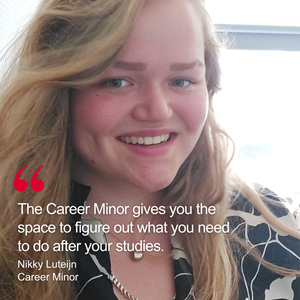
Nikky koos voor een stage in het tweede blok van de Career minor
Een interview met Nikky Luteijn, student Communicatie- en Informatiewetenschappen die in 2025-2026 de Career minor heeft afgerond met een stage.
Vorig jaar rond deze tijd moest jij kiezen voor een minor. Wat heeft jou geholpen bij het maken van je minorkeuze en wat zou je studenten aanraden om te doen?
Toen ik mijn minorkeuze moest maken, was ik verbijsterd over de hoeveelheid keuzes die ik had. Ik twijfelde of ik iets moest kiezen waar ik veel interesse in had, wat er goed uit zou zien op mijn CV, of iets wat me gewoon erg leuk leek. Wat mij hielp bij het maken van de beslissing, was dat ik nadacht over wat er zou komen na mijn bachelor. Ik wist eigenlijk niet zeker wat ik hierna wou doen, waar ik paste op de arbeidsmarkt na mijn studie en ik wilde graag wat anders doen dan alleen theoretische kennis opdoen. Na twee jaar (voornamelijk) dat te hebben gedaan, was ik klaar voor praktijkervaring.
Waarom heb je uiteindelijk voor de Career minor gekozen?
Ik heb gekozen voor de Career minor omdat ik praktijkervaring wilde opdoen en me wilde voorbereiden op de arbeidsmarkt. Ik wilde graag een betere grip op mijn toekomst, ontdekken wat ik had aan mijn opleiding en beter voorbereid zijn op het leven na studeren.
Welk themavak heb je tijdens het eerste blok gedaan en wat vond je ervan? Tijdens het eerste blok heb ik “Entrepreneurship en Leadership” gekozen, omdat ik in de toekomst misschien zelf een bedrijf wil beginnen en het me waardevol leek om te leren over ondernemerschap. De stof die ik heb geleerd en vaardigheden die werden toegepast tijdens dit vak, heb ik gelijk kunnen toepassen op de stage die ik het blok daarop heb gedaan. Zelfs nu ik weer met mijn bachelor Communicatie en Informatie Wetenschappen bezig ben, is er een directe vertaalslag te merken. Het waren hele interactieve, constructieve lessen waar ik oprecht wat aan heb én het was leuk en gezellig. Je leert je “werkende zelf” kennen, hoe het werkende leven functioneert en hoe je daarin kan slagen na je studie.
Welke praktische opdracht heb je gedaan tijdens het tweede blok van de Career minor en waarom heb je hiervoor gekozen?
In het tweede blok heb je de keuze om een opdracht te volgen in een team of zelf een stageplek te vinden. Dankzij de begeleiding, zowel vanuit inspirerende gastdocenten, de Career Services-begeleiders en de docent, heb ik een stageplek weten te bemachtigen als Communicatie- en Marketing stagiair bij een IT-bedrijf in Utrecht. Ik heb hiervoor gekozen omdat het goed aansloot bij mijn studie, het mij uit mijn comfortzone heeft getrokken en me de mogelijkheid gaf om praktijkervaring op te doen.
Kun je nog meer vertellen over de praktische opdracht? Hoe zag een gemiddelde dag er bijvoorbeeld voor je uit?
Ik werkte 40 uur in de week, maar bijna geen enkele dag zag er hetzelfde uit. Ik ben bij bedrijven langs geweest, maakte bedrijfsfoto’s, heb kerstpakketten rondgebracht, verbreedde mijn netwerk, maakte wandelingen door Utrecht en werkte aan het versterken van de interne en externe communicatie van het bedrijf. Ik heb heel veel geleerd in een korte tijd door in de praktijk te werken, dingen die ik nooit gekregen zou hebben op de universiteit. De minor geeft je de ruimte om alles uit te vogelen wat je anders moet doen na je studie en ze begeleiden je door alle informatie die je nodig hebt.
Hoe zou je de Career minor in één zin uitleggen?
Op een leuke, interactieve en manier jezelf klaarstomen voor het leven na de universiteit.
Wat is je belangrijkste les geweest tijdens het volgen van deze minor?
Hoe mijn “werkende zelf” kan aansluiten op de arbeidsmarkt, zodat ik gelukkig kan zijn in het werk dat ik zal gaan doen.
Wat is de concrete vaardigheid die je mee gaat nemen naar je baan later?
Het bouwen van een netwerk, hoe een bedrijf functioneert.
Heb je nog tips voor studenten die de Career minor willen gaan doen?
Ga er met open ogen in en als je meewerkt aan het programma dan heb je er zoveel aan!
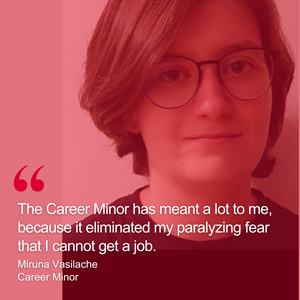
Miruna besloot iets heel anders te gaan doen naast haar studie Biologie
Een interview met Miruna Vasilache, die in 2025-2026 de Career minor met haar studie Biologie heeft gecombineerd.
Vorig jaar rond deze tijd moest jij kiezen voor een minor. Hoe ben jij tot je keuze voor de Career minor gekomen?
Ik wilde eens wat anders doen, naast mijn studie, iets dat me écht verder zou helpen in mijn toekomstige carrière. Daar paste de Career Minor perfect bij: iets nieuws en spannends, iets wat deuren voor me zou openen, of me in ieder geval zou leren hoe ik ze zelf kon openen.
Wat vond je uiteindelijk van de Career minor?
Toen ik aan de minor begon voelde ik me als een vis op het droge. Ik kwam rechtstreeks vanuit biologie en was de enige van buiten de Faculteit der Letteren. Ik had ook maar weinig werkervaring, met af en toe assisteren op het laboratorium en ondersteunen bij het lesgeven. Maar gelukkig besefte ik al snel dat we allemaal hetzelfde wilden: onszelf verbeteren en leren hoe we beter onze weg konden vinden op de arbeidsmarkt, met al zijn uitdagingen (en, als je het goed speelt, ook al zijn voordelen). De Career minor heeft me enorm geholpen. Ik voel niet langer die verlammende angst dat ik geen baan zou kunnen vinden.
Welk themavak heb je tijdens het eerste blok gedaan en wat vond je ervan?
Ik heb gekozen voor het vak “Working in and on Governance”. Ik heb ervan genoten, het was erg interactief en leuk.
Welke praktische opdracht heb je gedaan tijdens het tweede blok van de Career minor en waarom heb je hiervoor gekozen?
Ik heb stage gelopen bij een Wateronderzoekscentrum in Leeuwarden, waar ik me bezig heb gehouden met mangaan-oxiderende bacteriën in waterfilters. Ik heb hiervoor gekozen omdat het meer aansloot bij mijn studierichting. De stage was een fantastische manier om veel te leren.
Kun je meer vertellen over de praktische opdracht? Hoe zag een gemiddelde dag er bijvoorbeeld voor je uit?
Mijn stage was in Leeuwarden, dus ik ging elke dag heen en weer met de trein. Ik bracht het grootste deel van de dag door in het laboratorium, waar ik verschillende experimenten uitvoerde of onderhoudswerkzaamheden verrichtte voor de apparatuur van mijn supervisor. Ik heb geleerd hoe ik met waterdruksystemen en omgekeerde osmosefilters moet werken. Als ik niet in het lab was, analyseerde ik de gegevens die ik tijdens mijn experimenten had verzameld of schreef ik in mijn lab journal.
Hoe zou je de Career minor in één zin uitleggen?
Het is een leuke verrassing die je zelfvertrouwen een boost geeft en je uit je comfortzone haalt.
Wat is je belangrijkste les geweest tijdens het volgen van deze minor?
Er is niet zoiets als ‘te veel’. Als jij die kans niet pakt, doet iemand anders het wel, terwijl die misschien net zo goed is als jij. Dus ga ervoor!
Wat is de concrete vaardigheid die je mee gaat nemen naar je baan later?
Netwerken. Ik weet nu hoe ik dat op een professionele en efficiënte manier kan doen.
Heb je nog tips voor studenten die de Career minor willen gaan doen?
De Career minor is ideaal voor studenten die de arbeidsmarkt een beetje intimiderend vinden en wel wat hulp kunnen gebruiken om zichzelf te laten zien. Met de Career minor kun je jezelf professioneel ontwikkelen en ontdekken waar je thuishoort. Het is het perfecte startpunt om je carrière vorm te geven. Maak dus ook gebruik van het feit dat er veel sprekers worden uitgenodigd en praat met zoveel mogelijk mensen.