
Excavation of Ezinge terp iconic in Dutch archaeology
Ezinge has been continuously inhabited since approximately 500 BC. This is unique in the Netherlands and makes Ezinge roughly the same age as the city of Rome. Facts such as these can be found in the second volume of 'Ezinge Revisited' - an exhaustive analysis of all available data from excavations at Ezinge. Annet Nieuwhof worked on this massive project for over ten years.

It was Professor Van Giffen who began excavating the Ezinge 'wierde' (artificial dwelling mound) well over a century ago. The project ran from 1923 to 1934 and remains iconic in the history of Dutch archaeology. The exceptionally well-preserved material ranks among the crown jewels of the Groningen Institute of Archaeology.
Iron Age Houses
The organic remains include the impressive remnants of Iron Age houses—finds that attracted significant interest from both the Netherlands and abroad at the time. The results of those excavations were never fully published; until now, a proper, comprehensive analysis of the excavation had been lacking. That has now been rectified.
Annet Nieuwhof analyzed all available data and published the results in two books. The second book was released this month. Nieuwhof is a lecturer and researcher affiliated with the Groningen Institute of Archaeology. Her area of specialization is the history of the landscape and settlement in the 'terp' and *wierd* region of Groningen and Friesland.
Digital analysis of complex material
The completion of the project 'Ezinge Revisited: The Ancient Roots of a Terp Settlement' fulfills a long-held ambition of hers. Nieuwhof says: ‘Ezinge is the most extensively excavated 'wierde' - or 'terp' - in the Netherlands. I have always been intrigued by the knowledge regarding the settlement’s inhabitants and their unique way of life that remained hidden within the excavation records and the artifacts themselves. Without processing the data, an excavation is essentially a wasted effort. However, analyzing the vast array of finds and structures was too complex to complete using the tools available in the 1920s and 1930s. Today, we have a wide range of digital tools and improved dating techniques at our disposal. That is why, in 2011, we resumed the analysis of the excavation results.’
Ezinge before the arrival of dikes
The results are impressive. For instance, the remains of 119 houses dating from 500 BC to AD 900 were discovered in Ezinge. Furthermore, greater insight was gained into how the inhabitants of the 'wierde' (artificial dwelling mound) lived in the unprotected and frequently flooded salt marsh area prior to the construction of dikes in the Middle Ages. Until the dikes were built, they did not fight the sea but adapted to it; the structure of the 'wierde' clearly illustrates how they achieved this. Book two also devotes considerable attention to the remains of rituals; over 500 such traces have been identified.
The aim was not only to rescue the excavation from oblivion and reveal new insights into the history of settlement, but also to showcase the unique archaeology of the terp and 'wierde' region to an international audience.
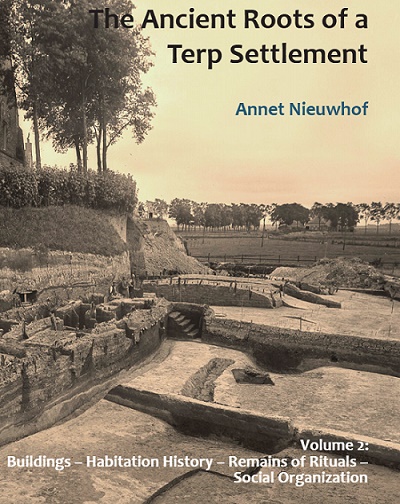
'Ezinge revisited. The ancient roots of a terp settlement' by Annet Nieuwhof.
-
Volume 1 focuses primarily on the excavation itself, the natural environment, and the means of subsistence offered by the salt marsh landscape. The bulk of this volume consists of a catalogue illustrating all the excavated areas, alongside numerous finds and photographs from the excavation.
-
Volume 2 is dedicated to the history of settlement in all its facets, starting from the establishment of this terp settlement around 500 BC.
More news
-
-
14 September 2026
Dementia in migrants: does care in the native language help?
-
14 September 2026
Cesspits reveal what the Dutch ate centuries ago