

Exploring leadership, agency, power, and authority through play
|
Course:
|
Entrepreneurship and Leadership
|
|
Institution:
|
Faculty of Arts, University of Groningen
|
|
Date:
|
9 September 2026
|
|
Teacher:
| |
|
Facilitator:
| |
|
Game used:
| |
|
Format:
|
Playing the Open Innovation format
|
|
Participants:
|
16 Students of the Career Minor
|
The context
One of the assumptions of this course is that a) leadership is a matter of agency, and is not necessarily coupled with authority and power; and that b) leadership and authority are emerging products of an ecosystem composed of alliances and power distribution (also an emerging property). This course takes place from 9:00 to 16:00 twice a week for eight weeks (including evaluations at the end). Therefore, the course has plenty of room, and a clear need, for practical experiences and switching of mediums.
The session in action
Usually, mornings are reserved for lectures and theory development, while the afternoons are used for practical experiences. However, this day’s lecture would be better served by beginning with the experience and then referring back to it during the lecture part of the day. Also, that afternoon we had a guest speaker who actually engages in real-life situations that mirror the board game, thus bringing it all into a complete view of emerging leadership in ecosystems through entrepreneurial attitudes to forge alliances and align resources.
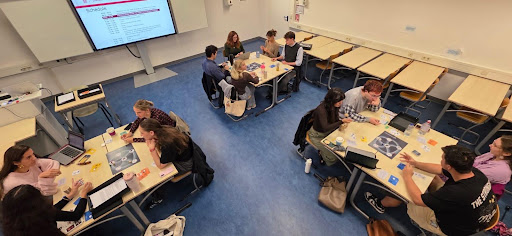
Tables were set up for groups of four students. The first round was done with considerable supervision and facilitation from the lecturer, with step-by-step guidance slowly waning into general instructions as students eased into the rules. We also used Google Sheets to facilitate view of the emerging decision styles of each player, which helped them to forge alliances and strategically shun players during the game.
The outcome
Each group ended with a distinct configuration, which meant that most possible leadership and alliance configurations were, in broad strokes, represented in the classroom. Some of the winning Deans of the board were surrounded by like-minded partners, with perhaps a single dissident in the mix. Others ended up occupying the authority position, but surrounded by partners who were completely their opposite. This led to fruitful thought experiments: in the first case, would the dissident be able to find their role in this team by channeling their dissent? Would the dissenting authority be able to exert their control on resources in a way that would counterbalance their dissenting team’s concerns and ambitions, with enough flexibility to select and promote the truly remarkable proposals, while avoiding resentment?
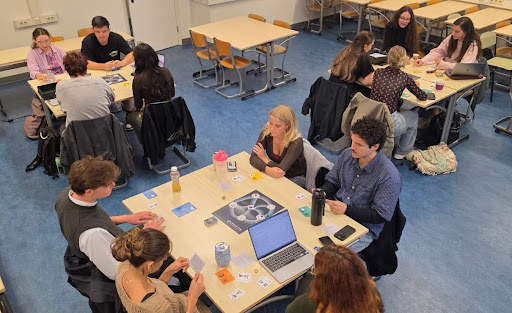
Students also reflected on the experience of settling into the game itself. At first, the gameplay seemed quite daunting, but after a couple of rounds they managed to internalize them. This allowed a more meta-level reflection about culture as the internalized “rules of the game”, and how enculturation involves initial shock and then settling into the processes.
Educators takeaway
This game is worth the time it takes. Overall, results from this course demonstrate that students benefit from more time in class, bringing lectures through the teacher-centered monologues to action-based learning and contact with real-world practitioners who experience in the real world the content of the class. Much like games themselves, explaining real-world processes verbally is quite cumbersome and difficult to follow; a theory-driven teacher-centered monologue does just the same. It covers important details, but to really let it land, practice is needed. While many students and practitioners are turned off by discussing sociological processes and assumptions for feeling they are too abstract or a waste of time, playing it as a game that mirrors players’ own experiences in such sociological or psychological situations allows them to name and reflect on those same processes. This opens the way to a grounded discussion of established theories of socio-psychological (or other abstract academic) themes.