Making Ethical Tensions Tangible in Speech Technology Education
|
Course:
|
Research Design, programme MSc Speech Technology
|
|
Institution:
|
Campus Fryslân, University of Groningen
|
|
Game used:
|
UnExpected Values: The Free Market with the Environmental Dilemmas card set
|
|
Date:
|
13 February & 6 March 2026
|
|
Format:
|
1.5-hour interactive workshop
|
|
Participants:
|
5 students
|
The context
Master’s students in speech technology are expected to design research that is both technically rigorous and socially responsible. However, early in the thesis process, ethics often feels abstract–something to “add later” rather than something that actively shapes research design.
At the same time, speech technology is deeply value-laden. Systems interact with identity, consent, emotion, and power, and every technical decision–datasets, metrics, performance definitions–already embeds ethical assumptions.
To address this gap, the course integrated UnExpected Values: The Free Market in two stages: first to surface ethical tensions through discussion, and later to experience those tensions through gameplay.
The session in action
Session 1: Ethical Dilemmas as a Starting Point
The first session focused on the Dilemma Cards. Each student selected a card based on a real-world speech technology case, read it aloud, and shared their perspective.
Students then:
-
Took a position on the dilemma
-
Justified their reasoning
-
Engaged in group discussion
The discussions were structured around:
-
Identifying the ethical tension (e.g., fairness vs. efficiency)
-
Examining trade-offs
-
Connecting decisions to real-world pressures (e.g., deadlines, funding, scalability)
The QR codes on the cards allowed students to explore the real cases behind the dilemmas, grounding the conversation in actual industry practice.
This session helped students move from abstract ethical awareness to explicit reasoning and argumentation.
Session 2: Experiencing Ethical Tensions Through Gameplay
In the second session, students played the full UnExpected Values board game.
Here, the focus shifted from discussion to experience.
As players took on roles within a simulated market environment, they had to:
-
Balance profit, survival, and ethical responsibility
-
Respond to constraints such as limited resources and competition
-
Make decisions under pressure
This created a different kind of learning: students didn’t just talk about ethical dilemmas–they felt the tensions that stakeholders face in real-world decision-making.
The gameplay made visible how:
-
Ethical compromises can emerge from structural pressures
-
“Good” decisions are not always easy or feasible
-
Trade-offs are often unavoidable
The outcome: Deep engagement and meaningful discussions
Using the game in two stages created a powerful learning trajectory:
- Session 1 (Discussion) → Students developed language and confidence to analyze ethical dilemmas
- Session 2 (Gameplay) → Students experienced the complexity and pressure behind those dilemmas
Together, these sessions supported the development of critical thinking by helping students:
- Identify assumptions in technical decisions
- Consider multiple perspectives
- Evaluate consequences and trade-offs
- Reflect on their role as future researchers and professionals
Students reported feeling:
- More confident engaging with ethical issues
- Better able to articulate their positions
- More aware of the societal impact of their work
Importantly, ethics shifted from being seen as a constraint to being understood as an integral part of research design.
Educator takeaways
- Start with dilemmas, then move to systems
- Beginning with discussion helps students build confidence before experiencing the complexity of full gameplay.
- Make ethics tangible
- Real-world cases and role-play move ethics from abstract concepts to lived experience.
- Support critical thinking, not “correct answers”
- The value lies in reasoning, debate, and reflection
- Combining discussion and gameplay reinforces learning and deepens understanding.
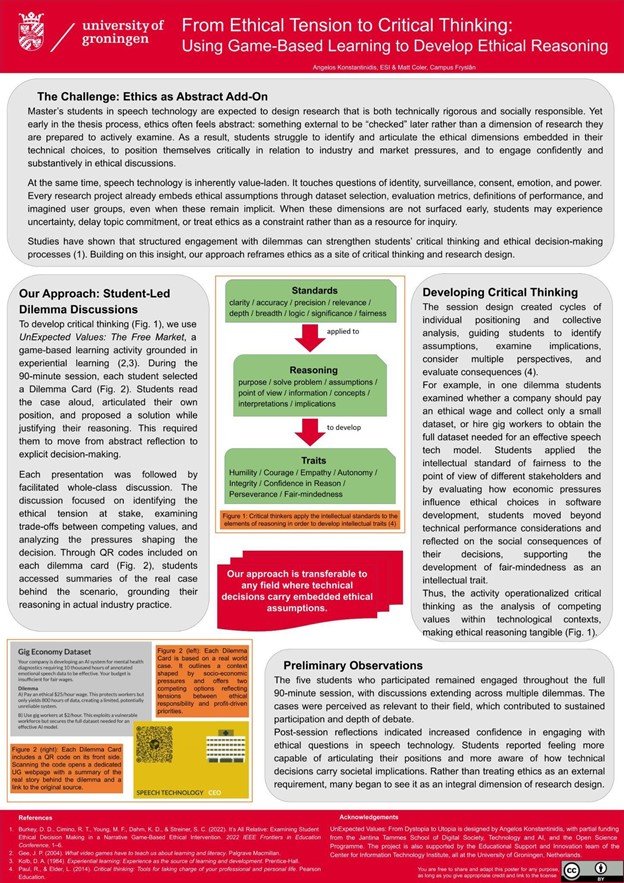
Sharing the Approach
This approach was presented at the Education Festival 2026 through a poster highlighting the use of UnExpected Values to support the development of critical thinking and ethical reasoning in speech technology education.