


Groningen residents want mobility hubs with shops and meeting points
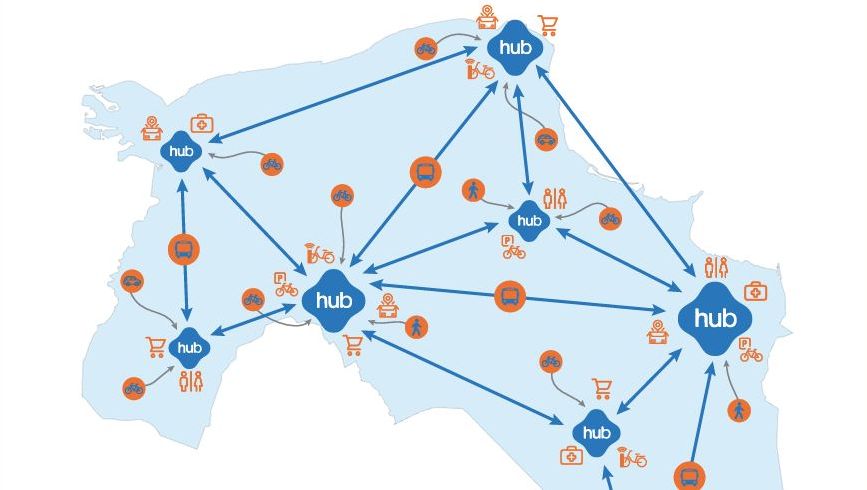
Mobility hubs are becoming increasingly important for accessibility in neighbourhoods and villages across the Province of Groningen. New research into these hubs, where people can switch between modes of transport such as bicycle and bus or bus and train, shows that residents prefer hubs that combine a variety of mobility services with everyday amenities. According to residents of the Province of Groningen, mobility hubs can therefore strengthen liveability while encouraging sustainable travel.
The study provides insight into which mobility services, facilities and locations for mobility hubs are considered important by residents of the Province of Groningen. The study was conducted by the Faculty of Spatial Sciences of the University of Groningen in collaboration with the Province of Groningen. The findings are based on a participatory map-based survey among residents of randomly selected neighbourhoods across the province. A total of 755 unique respondents identified 1,010 preferred locations for mobility hubs and indicated which mobility services and facilities they would like to see at these locations.
Facilities and Local Context
Research shows that residents look beyond transport connections alone. In addition to public transport, cycling facilities, car access and shared mobility services, respondents value facilities that support everyday activities. Parcel pickup points, bicycle parking, toilets, grocery stores and ATMs were among the most frequently mentioned amenities.
Priorities differ depending on the local context. In rural areas, residents place greater emphasis on public transport, car parking and facilities that support local liveability. In semi-urban areas, the combination of cycling, car access, public transport and shared mobility is considered most important, with hubs primarily functioning as efficient transfer points. In urban areas, shared mobility, public transport and practical convenience-oriented facilities are the main priorities.
Preferred locations
Preferred hub locations reveal two clear spatial patterns. On the one hand, residents select existing transport nodes where public transport, cycling and car infrastructure already converge. On the other hand, they favour locations close to existing amenities and community functions, such as village centres and places where daily activities already take place.
Looking ahead
The findings suggest that residents view mobility hubs as more than just transfer points. They see them as opportunities to strengthen liveability and support sustainable travel, provided that hub design and service provision are tailored to the context. This insight supports policies that use mobility investments not only to improve transport connections, but also to enhance access to amenities, create opportunities for social interaction, and make sustainable travel easier and more attractive.
Report
The full report is available at: https://www.rug.nl/research/ursi/ac4a-mobility-hub-report-03-09-26.pdf
Dutch version: https://www.rug.nl/research/ursi/ac4a-mobiliteitshub-rapport-03-09-26.pdf
About AccessCity4All
This research was conducted as part of AccessCity4All, a European research project exploring how the 15-minute city concept can be adapted to become practical and inclusive across urban, semi-urban and rural contexts. The Groningen case study focuses on accessibility and mobility in the city of Groningen and the surrounding region. More information and outputs from the project
Contact
More news
-
08 September 2026
Verhuizing supermarkt Koudum gevolgen voor dorpshart
-
07 September 2026
Can building on water help combat the housing shortage?
-
02 June 2026
Public space belongs to everyone