
Nicolai Verheul and Mats ten Cate win EORAS Thesis Awards 2025
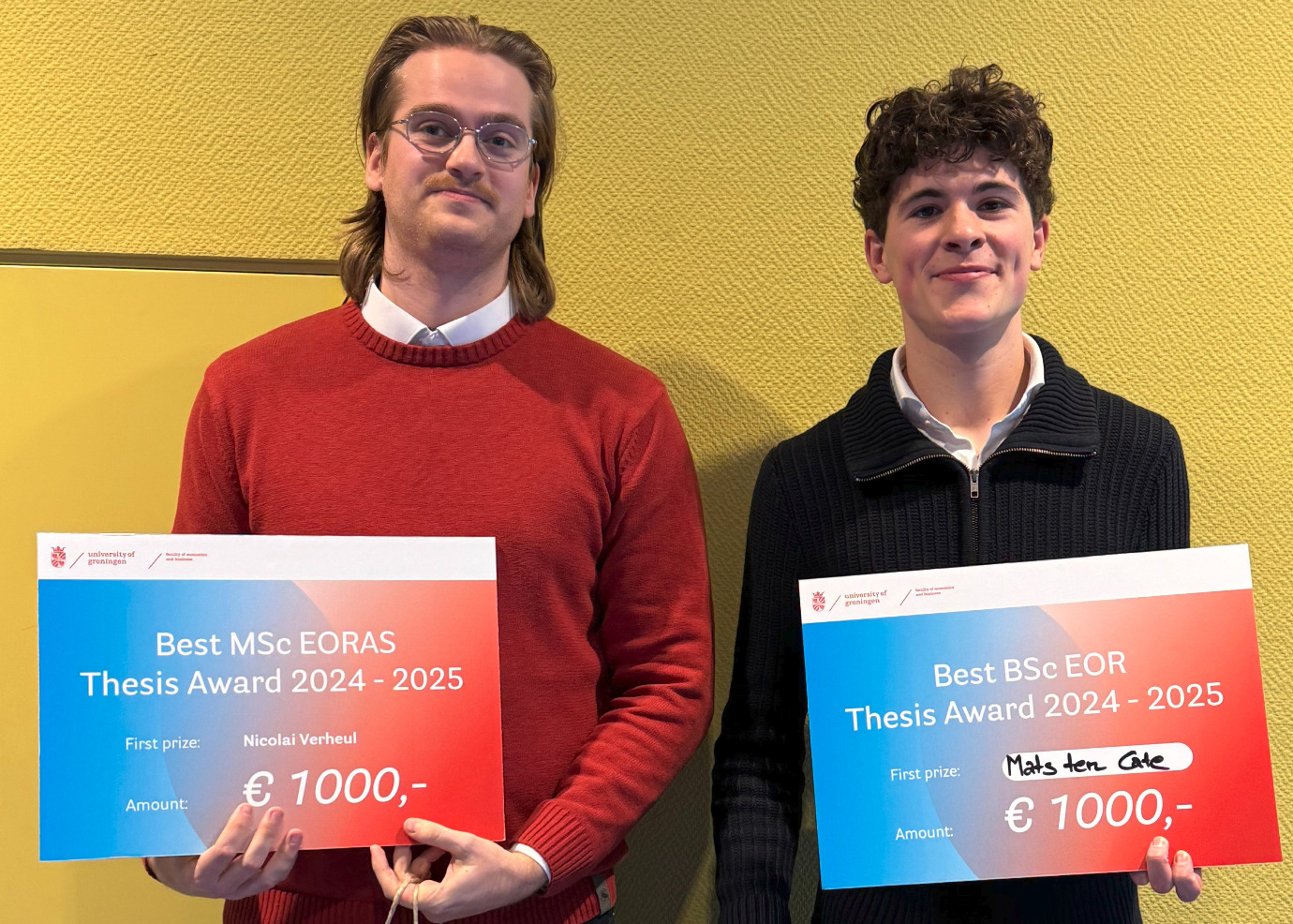
Nicolai Verheul and Mats ten Cate are the winners of the EORAS Thesis Awards 2025, the prize for excellent Bachelor's or Master's theses in the field of Econometrics and Operations Research (and Actuarial Studies). Verheul won the prize for his Master’s thesis on quantifying climate risk in the Dutch electricity market. Ten Cate won the prize for his Bachelor’s thesis on designing cost-effective sustainable aviation fuel supply chains in Europe.
Best Master’s thesis
The Dutch energy transition’s reliance on offshore wind is threatened by grid congestion and investment uncertainty. Climate change-induced wind gusts pose an yet unquantified financial risk. In his Master's thesis, Nicolai Verheul quantifies this risk by developing a statistical model - a Bayesian Markov Switching Autoregressive (MS-ARX) model with a time-varying transition probability (TVTP). This model is used to predict changes in high-frequency wind gust forecasts. Verheuls model uses a unique dataset of hourly Dutch day-ahead prices to identify different price patterns, depending on how often price changes are likely to happen. He finds strong evidence that positive wind gust deviations - for example stormier-than-expected weather - increase the probability of switching to a high-price, high-volatility state. These findings provide investors with a tool to price climate risk more accurately and inform policymakers about the most effective grid investments for preventing weather-induced price volatility. The jury was impressed by the methodological originality, technical depth, and clear policy relevance of the work, which provides new insights into climate risk, grid investment, and electricity market stability. Jury chair Professor Marco Haan: "In his thesis, Nicolai Verheul uses state-of-the-art methods, to quantify how unexpected weather conditions increase the likelihood of extreme price regimes in the Dutch electricity market.''
Best Bachelor’s thesis
Producing jet fuel from CO2 offers a promising pathway to reduce aviation’s carbon footprint, but designing effective supply chains remains a critical challenge. In his Bachelor’s thesis, Mats ten Cate develops a programming optimization model that combines both integer and continuous variables – a mixed-integer linear programming optimization model - to identify the most economically efficient networks of CO₂ point sources, conversion facilities, and airports in northwestern and southeastern Europe for 2030. His results highlight the pivotal role of high-concentration CO2 sources, which are abundant in northwestern Europe but scarce in the southeast, driving jet fuel production costs up to between €1387 and €1434 per tonne. In his analysis, Ten Cate compares three different supply chain structures: centralized facilities, decentralized modular synthesis units, and direct air capture technologies. He shows how regional differences influence cost and feasibility. These findings provide insights into the economic and logistical strategies needed to scale up sustainable aviation fuel production. The jury was impressed by the ambition, technical sophistication, and policy relevance of the work. Jury chair Haan: "Mats ten Cate's thesis combines optimisation, spatial data, expert interviews, and realistic cost structures in a way that is exceptional for a bachelor’s thesis."
EORAS Thesis Awards
The two other nominees for the Bachelor’s Thesis Prize were Emma Katerberg and Gabriel Kruize. Katerberg was nominated for her thesis titled ‘Enhancing Power Distribution System Resilience: Realistic Scenario Generation and Efficient Scenario Reduction Approaches’. Kruize was nominated for his thesis titled ‘Proactive Demand-based Courier Repositioning for the Meal Delivery Routing Problem’. The EORAS Thesis Award - an annual award for excellent Bachelor's or Master's theses in the field of Econometrics and Operations Research (and Actuarial Studies) - is a tribute to late professor Maarten van der Vlerk, who was the director of the Bachelor Econometrics and Operations Research (EOR) and the Master Econometrics, Operations Research and Actuarial Studies (EORAS) for almost 10 years. The winners of the EORAS Thesis Awards receive € 1,000 each.
More news
-
07 September 2026
Why entrepreneurship thrives in specific regions
-
11 August 2026
InnoLaunch: Get your startup ready for takeoff in 8 weeks
-