

How does wording influence concerns about climate change?
A recent study involving researchers from the University of Trier and the Faculty of Economics and Business (FEB) of the University of Groningen demonstrates that even the smallest changes in wording can significantly affect how people respond to surveys about climate change.
While the vast majority of people agree that human-induced climate change is a reality, surveys often produce widely varying results when measuring the level of concern people feel about it. According to the researchers, these differences may not necessarily reflect people's actual attitudes, but rather the way questions are phrased.
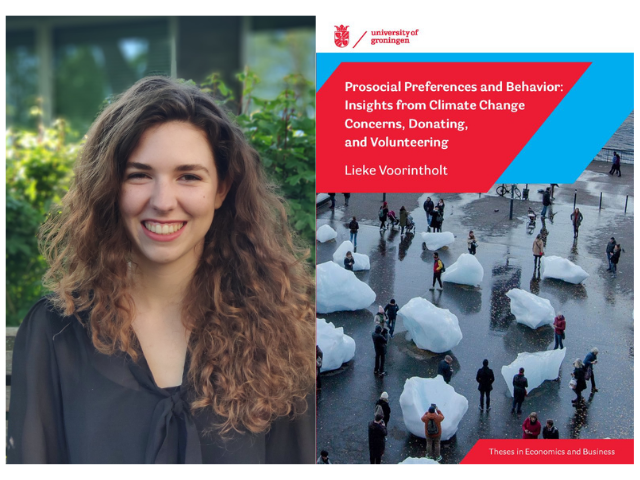
The study was conducted by Dr. Lieke Voorintholt, who recently obtained her PhD at FEB, together with her former PhD supervisors Professor Adriaan Soetevent and Professor Gerard J. van den Berg. The research has been published in the Journal of Economic Psychology.
Small change, big effect
The researchers examined how subtle differences in wording influence responses to climate change surveys. They focused on a statement taken from the Innovation Panel of the British Household Longitudinal Study Understanding Society, where respondents were asked to indicate their level of agreement on a scale from one to five.
The original statement read:
“The effects of climate change are too far in the future to worry me.”
For a test group, a single word was changed:
“The effects of climate change are too far in the future to worry about.”
Although the difference appears minimal, the effect was substantial. Respondents who received the second version reported significantly higher levels of concern about climate change. The proportion of participants expressing the highest level of concern increased from approximately 33% to around 40%.
Implications for survey research
The findings highlight how sensitive survey outcomes can be to seemingly minor wording choices. As a result, previously published survey findings on climate change concerns may need to be interpreted with greater attention to how questions were phrased.
According to Dr. Voorintholt, the results not only help researchers better understand existing survey outcomes, but also provide valuable guidance for designing future surveys. More carefully formulated questions can improve the reliability and comparability of research on public attitudes toward climate change and other societal issues.