

A Decade of Insight: Celebrating 10 Years of the Northern Netherlands Innovation Monitor
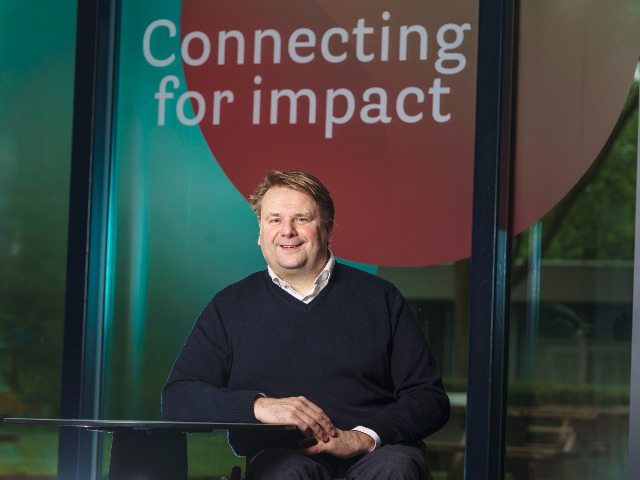
This year, the Northern Netherlands Innovation Monitor will be published for the 10th time. The Northern-Netherlands Innovation Monitor is an initiative to map the innovation dynamics of SMEs (Small and Medium-sized Enterprises) in the northern region and to promote their innovativeness. FEB Research interviewed Professor Thijs Broekhuizen who is the coordinator of the NNI Monitor. He was recently appointed as Professor of Business and Management in Lifelong Learning.
What is the Northern-Netherlands Innovation Monitor?
“The Northern Netherlands Innovation Monitor is originally a joint initiative of the Faculty of Economics & Business of the University of Groningen (UG) and the Northern Netherlands Alliance (SNN). This partnership began in 2016. The primary goal of the Innovation Monitor is to map and analyze the innovation activities, investments, and performance of SMEs in the Northern Netherlands. The Innovation Monitor features a main annual report tracking key indicators over time. This annual report is complemented by thematic mini-reports that address a different focus topic each year.”
How did the NNI Monitor start?
“Former colleague Dries Faems started this project in 2016, filling a void that occurred after the Social and Economic Council of the Netherlands (in Dutch: Sociaal Economische Raad) stopped measuring the innovativeness of the three Northern provinces: Friesland, Groningen, and Drenthe. At that time, there was simply no systematic, longitudinal data on how Northern SMEs actually innovate. Policymakers were making investment decisions based on assumptions, not evidence. That gap motivated us. We wanted to create an annual pulse check — not a one-off study, but a living instrument that tracks how regional innovation capacity develops over time. Together with the Northern Netherlands Alliance (SNN), we decided to measure the SME innovativeness to understand their specific challenges, their innovation activities to enable them to move up the innovation ladder.”
What are your most important findings?
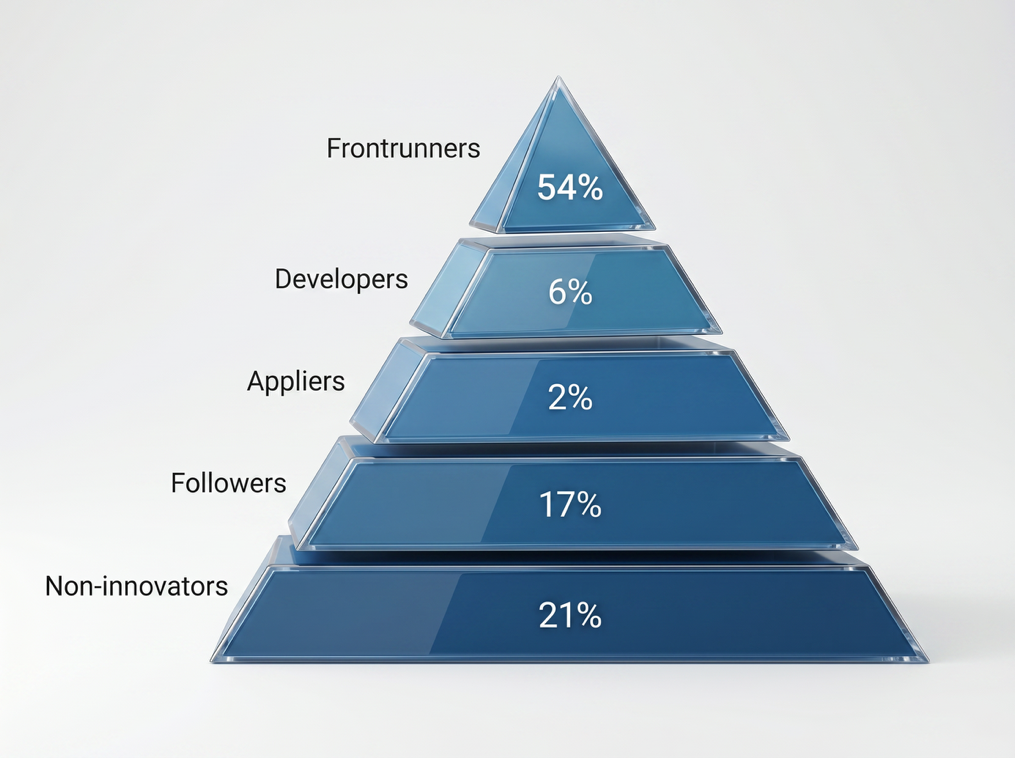
“Innovation in the Northern Netherlands is not a binary story of ‘innovative’ versus ‘not innovative.’ We see a range of firms, ranked in the innovation pyramid, from those that barely engage with innovation (non-innovators and followers), to those that cleverly adopt existing solutions (appliers and developers), to genuine frontrunners that are the forefront of the market. The crucial insight is that differences exist between the performances, challenges, and needs of innovator groups, necessitating an informed, segmented approach. For instance, the groups of "appliers" and “developers” are highly policy-relevant, as they can grow and become frontrunners. They don't need R&D subsidies but rather benefit from easy access to knowledge, networks, and the right collaboration partners. This reframes the entire policy conversation from "How do we create more startups or scaleups?" to "How do we help the broader SME base move up the innovation pyramid?"
Why does this matter?
“It challenges the dominant innovation policy logic, which tends to focus on high-tech frontrunners and startup ecosystems. For a region like the Northern Netherlands, the real economic impact lies in upgrading the innovation capacity of the broad SME base. Our data shows that when companies move even one step up the innovation pyramid — say, from non-innovator to follower— their growth prospects improve significantly. This has direct implications for how provinces and SNN allocate innovation funding. Another important feature is that the systemic analysis enables us to make more informed decisions by providing an overview of the region’s relative strengths. This is important for SNN’s renewed Innovation Strategy for the Northern Netherlands that determines whether and where innovation subsidies will be used to stimulate regional growth.”
What is the societal impact, especially in the northern region?
“The Northern Netherlands is in the middle of several major transitions — energy (from fossil to renewable), digitalization (from analog to digital), circularity (from linear to circular), and health (from cure to positive health). Each of these demands adaptation and innovation from SMEs. The Northern Netherlands Innovation Monitor makes this visible with data. It shows where regional innovation ecosystems work well and where they fall short. That evidence base is essential for inclusive regional development, ensuring that the transitions benefit more than just the usual frontrunners.” The results show that SMEs’ willingness to respond to these challenges has increased: the share of SMEs introducing at least one environmental innovation has risen from 64% in 2016 to more than 80% in 2024.
Did you find any surprising outcome?
“One finding that surprised people relates to the high work and life satisfaction in the North: Northern entrepreneurs score relatively high on life satisfaction, but even higher on work satisfaction. A further analysis reveals that SMEs from Groningen score highest on work (40%) and life satisfaction (36%) as compared to Friesland (36%/22%) and Drenthe (36%/27%). Our findings suggest that entrepreneurship in this region provides a strong sense of purpose and autonomy, even when the broader context — economic uncertainty, tight labor markets, rural infrastructure challenges — is less favorable. It's a signal of resilience that deserves more attention. Another surprise: AI adoption among Northern SMEs was 21% in 2024 and rose sharply to 40% in 2025, yet many SMEs still fail to leverage AI strategically. Companies are experimenting with and using AI for simple solutions (e.g., email, marketing communications), but few have embedded it structurally. That's both a risk and an opportunity.”
Looking ahead, what will you be investigating next?
“Two things: First, we aim to gain a better understanding of the role of regional collaboration networks in innovation, particularly with regard to the use of innovation hubs and networks. Our survey data hints that companies embedded in strong local networks innovate more effectively, but we need to unpack the mechanisms surrounding this, likely with additional data from these hubs. Second, with the rise of AI, a new potential dividing line is emerging between companies that can leverage these technologies and those that cannot. We want to track how that digital divide develops in the Northern Netherlands specifically — because if we don't monitor it now, policy interventions might come too late.”
The Northern Netherlands Innovation Monitor
The Northern Netherlands Innovation Monitor is the result of a strategic partnership between the Faculty of Economics & Business of the University of Groningen (UG) and the Northern Netherlands Alliance (SNN). This collaboration began in 2016. The primary goal of the Innovation Monitor is to map and analyze the innovation activities, investments, and performance of SMEs in the Northern Netherlands on an annual basis.
The Innovation Monitor features a main annual report that presents developments in key indicators. Additionally, specialized sub-studies on specific themes are conducted each year.
The 2025 and previous NNI Monitors are available here. All publications are in Dutch.
Thijs Broekhuizen
Thijs Broekhuizen was appointed as Professor of Business and Management in Lifelong Learning in January 2026. In this new role, he provides academic leadership in Lifelong Learning within FEB and the University of Groningen (UG). The chair encompasses a broad set of responsibilities, including developing a clear educational vision for lifelong learning, programme development, and innovation.His focus lies on building a community: connecting colleagues to the field, fostering shared ownership, and demonstrating what makes executive education genuinely rewarding. His aim is to ensure that lifelong learning is not a peripheral activity, but a core part of what FEB stands for and contributes to society.
Broekhuizen has a long history at FEB, having joined the faculty as a Postdoctoral Researcher in 2006 and worked at FEB in various roles since then. Since January 2020, he has been the scientific director of the University of Groningen Business School (UGBS).