

Civic Wealth Creation Strategies for the Energy Transition
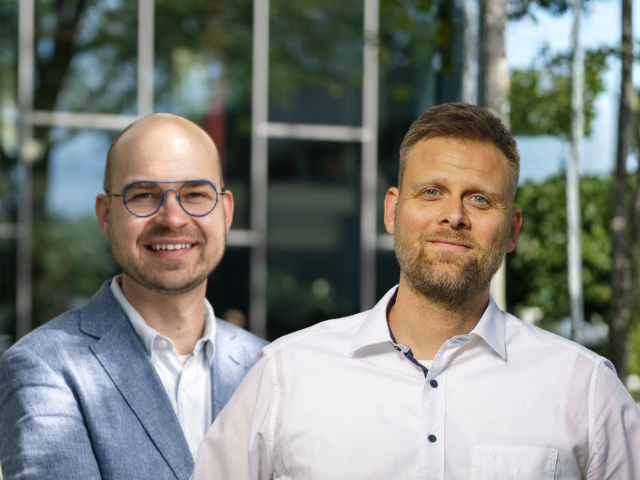
For a successful energy transition, new energy projects need to be scaled-up. This requires the trust of local communities and ensuring they actually benefit from these projects. In their research, associate professors Björn Mitzinneck and Philip Steinberg, together with PhD candidate Emma Field, investigate how energy companies can create not just economic, but also social and communal value for the regions where they operate.
The Northern Netherlands is transitioning away from fossil gas toward green hydrogen, offshore wind, and other renewables. Large energy companies like Shell/NAM, EBN, and Gasunie possess the capital, infrastructure, and technical expertise to drive that transition. But scaling up new energy projects is not purely a technological or financial challenge; it requires earning the trust of local communities and ensuring they actually benefit (civic wealth). Associate professors Philip Steinberg and Björn Mitzinneck- together with their PhD candidate Emma Field - cooperate with the New Energy Coalition to find out how energy companies go about this. Steinberg: “Our research investigates how energy companies can measure, design, and implement strategies that also deliver broader value to the communities around them, not as an afterthought, but as a core part of how they do business.”
Research motivation
The most immediate motivation for Field, Mitzinneck, and Steinberg to delve into this topic is Groningen's experience with gas extraction. For decades, gas was extracted from the Groningen field on a massive scale, generating enormous national revenues. But locally, the consequences were severe: earthquakes, structural damage to thousands of homes, and a deep sense in many communities that the region was treated unfairly. The parliamentary inquiry of 2023 concluded that the interests of Groningers had been structurally neglected. Nij Begun, the government's 30-year recovery program for Groningen and Noord-Drenthe, is now attempting to repair that damage across social, economic, and physical dimensions.
The project on civic wealth creation strategies for the energy transition grows directly from this context. Field: “As the region builds a new energy future around green hydrogen and renewables, a central question is how to ensure the energy transition delivers lasting value to the communities where it occurs. Many larger energy firms and their employees are motivated to contribute to civic wealth - a concept closely related to brede welvaart or broad-based prosperity, a term often used in public discussions - and some are already doing so in relevant (pilot) projects. But on a larger scale, it remains unclear how these firms can systematically contribute to civic wealth and measure their progress and success. That gap, combined with the lived reality of Groningers, is what brought us to this topic.”
Past attempts at local engagement have sometimes been dismissed as symbolic “golden playground” gestures. But the picture is more nuanced, the researchers have found. Some larger energy firms are starting to engage more meaningfully with communities, for instance, by investing in joint communal wind parks.
Their initial work on measurement indicators shows that incumbent companies often lack the internal mechanisms to treat social priorities with the same rigor as financial ones. “Developing better metrics is essential, but it involves a real trade-off: every project is highly particular, and overly rigid indicators risk being too constraining for the local context they are meant to serve. A further complexity is that large incumbents differ fundamentally from regional SMEs and startups. They must account for (inter)national stakeholders and regulatory influences that can sometimes work against regional interests. This multi-fold embeddedness, operating within a municipality, a region, a national, and sometimes even international context, simultaneously creates tensions that smaller firms do not face”, Steinberg explains.
The research team’s literature review also suggests that large energy firms can play different roles: as direct contributors who establish and drive projects themselves, or in a more supportive capacity, providing infrastructure and expertise while enabling smaller firms to lead and take on the entrepreneurial risk. Which role fits best may itself depend on the local context.
High societal stakes
The team’s research addresses a timely and significant problem. Steinberg: “The energy transition in the Northern Netherlands involves major infrastructure, including wind farms and solar parks, hydrogen facilities, grid expansions, and port redevelopment. What all these projects share is that they are sited in specific communities. If those communities experience the transition as something done to them rather than with them, resistance will grow, projects will stall, and the transition itself will slow down. Conversely, if energy firms can share real value, through local jobs, supply chain participation, co-ownership structures, and environmental improvements, the transition can become a vehicle for regional renewal. That is exactly the ambition of Nij Begun's social and economic agendas, and our research aims to provide the evidence base and practical tools to help make it happen on a project basis.”
The research team’s work suggests that companies need to embed social considerations into how they evaluate and steer projects from the outset. The measurement indicators framework the team is developing is intended as a practical tool: a way for firms to assess, on a project-by-project basis, whether they are contributing to a region's social and economic value. “This has implications for corporate strategy, policy design, and the structure of public-private partnerships in the energy transition. Nij Begun's Economische Agenda, for example, seeks a new economic perspective for Groningen and Noord-Drenthe. Our research can help inform what “perspective" means concretely at the level of individual energy projects and firms. The societal stakes are high, and very tangible in the Northern Netherlands. The Nij Begun program exists because an entire region experienced what happens when economic activity generates national wealth, but causes local damage. The parliamentary inquiry's conclusion that Groningers' interests were structurally ignored is not just a historical verdict; it is a warning for the future.”
Co-creation with organizations and collaboration with Macquarie University
In the coming year, the research team will move deeper into the fieldwork phase. Currently, the researchers are conducting interviews with relevant stakeholders in the region. Next, they plan to conduct in-depth case studies with partner firms of the New Energy Coalition and stakeholders across Groningen, including municipalities, provincial government, and civil society organizations. “This is where the research becomes truly co-creative: we are not studying these organizations from a distance but working with them, for instance, in upcoming workshops, to understand what civic wealth creation can look like in practice, on actual projects in the Northern Netherlands”, Mitzinneck explains.
The research team is particularly interested in identifying best-practice models and concrete examples of how firms have structured their engagement with local communities to generate real social, communal, and economic value. ‘Later in the project, through our partnership in Australia, we will compare the Northern Dutch experience with Australian cases. Since Australia is positioning itself as a green hydrogen leader, this will be a very interesting context to explore. That international comparison will help us understand which strategies are context-specific and which are transferable.’ Ultimately, the team wants to deliver a practical toolkit, grounded in the realities of Groningen but useful far beyond it, that helps energy firms become central civic wealth creation partners in the regions where they operate.
This research is conducted by Emma Field, dr. Björn Mitzinneck, dr. Philip Steinberg (University of Groningen, FEB), and in collaboration with dr. Anna Krzeminska and prof. Stefan Trück (Macquarie University), and supported by the New Energy Coalition.