
FAQ - The Do's and Don'ts in Mistral-Vibe
The use of AI must comply with transparency, diligence, non-discrimination, and data protection. Whether AI can be used depends on the purpose of use and the input data.
FAQ Education - FAQ General - FAQ Research
These FAQs serve as a guideline for frequently asked questions and have been prepared in consultation with AJZ. Some nuances have been omitted for readability. If you are unsure whether something is allowed, please contact your P&S coordinator for more information. Note:
Attention: The FAQs have been compiled for the Mistral-Vibe Enterprise licence of the University of Groningen. This licence is only active on the @rug.nl account. Accounts with other email addresses are not covered by the UG's Enterprise license. You can recognize the Enterprise licence by checking whether it is mentioned in the top left corner after logging in. Other External AI tools may only be used for processing public information.
--------------------------------------------------------------------------------------------------
What type of personal data (degree of confidentiality) may I process in Vibe?
|
Confidentiality
|
Public
|
Internal
(Low) |
Confidential (Medium)
|
Secret
(High) |
|
Public infor-
mation |
Organizational information
|
Personal data Organization sensitive information |
Special personal data* Intellectual property (IP)** |
|
|
Mistral - Vibe
|
Yes
|
Yes
|
Be cautious
|
No
|
|
Other External AI tools: ChatGPT, Claude, Perplexity etc,
|
Yes
|
No
|
No
|
No
|
What is meant by ‘degree of confidentiality’?
Public
-
No personal data.
-
If this data is leaked, the University of Groningen (UG) will not suffer reputational damage and/or there will be no significant consequences.
-
No personal data is processed for profiling purposes.
Internal (low)
-
Personal data used only internally within the organization, requiring limited protection, such as basic contact details.
-
If this data is leaked, the RUG may experience short-term reputational damage and/or minor financial harm.
-
Personal data is processed for profiling, but no automated decisions are made based on this data.
Confidential (medium)
-
Data such as addresses and salary information, but not including specially protected categories.
-
If this data is leaked, the UG may face long-term reputational damage and/or significant financial harm.
-
Personal data is processed for profiling, and automated decisions are made based on this data.
Secret (high)
-
Sensitive personal data, such as medical or financial information, and other data classified as special categories of personal data under the GDPR.
-
If this data is leaked, the UG may suffer serious and potentially permanent reputational damage, major financial harm, and/or operational consequences.
-
This category also includes information security data, data breaches, budgets, or other non-public financial information of the UG.
-
Personal data is processed for profiling, and automated decisions with significant personal consequences are made based on this data.
*Special personal data includes information about race/ethnicity, political views, religion/philosophy, union membership, genetic data, biometric data (for unique identification), health data, and/or sexual behaviour/orientation.
**Sensitive information about intellectual property, such as confidential patent applications, unpublished innovations, and scientific articles, especially during the development phase or before formal protection (e.g., patent, trademark registration) is obtained.
How do I handle confidential information within Vibe?
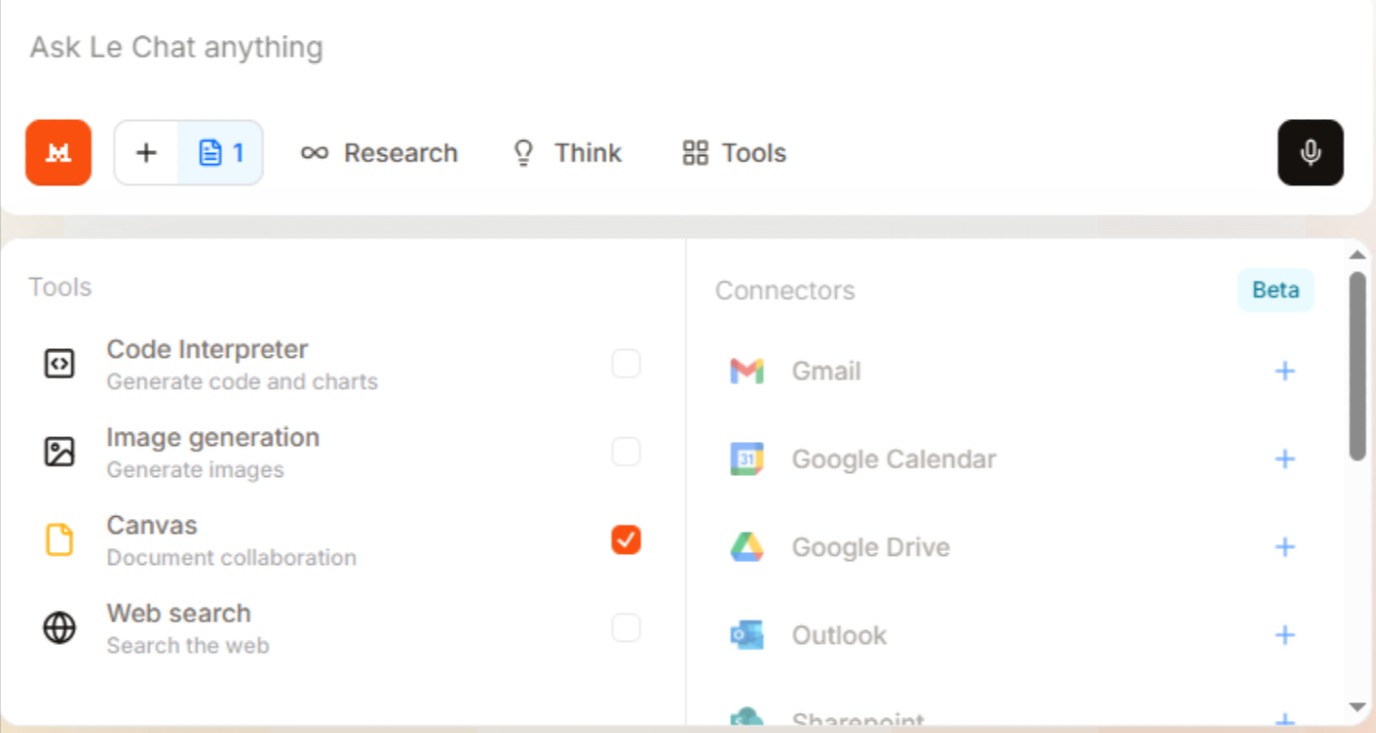
Mistral - Vibe: Be cautious at medium confidentiality level: Mistral can be used, provided that code interpreter, image generation, web search, and Flash Answers are disabled. Click on "Tools" and disable the functions (see example below).
ChatGPT, Claude, Perplexity, etc.: These tools are not supported by the UG and have not all been thoroughly assessed for privacy and security risks. In some cases, these tools have even been rejected due to the risks they pose. External AI tools may only be used for processing public information.
What data is permitted?
What data is permitted?
|
Data Type
|
Examples
|
Allowed?
|
|
No personal data
|
Anonymized or personal data removed.
|
Yes (including all tools)
|
|
Ordinary personal data or confidential business information
|
Names, email addresses, general education information, course codes, board meetings, reorganization plans.
|
Yes, provided the code interpreter, image generation, web search, and Flash Answers are disabled.
|
|
Special categories of personal data
|
Sensitive personal data: race/ethnicity, political opinions, religion/philosophical beliefs, trade union membership, genetic data, biometric data, health data, sexual behaviour/orientation.
|
No
|
|
Sensitive personal data *
|
Student results, assessments, and grades.
|
No
|
|
Intellectual property (IP) **
|
Information regarding inventions.
|
No
|
*Special personal data includes information about race/ethnicity, political views, religion/philosophy, union membership, genetic data, biometric data (for unique identification), health data, and/or sexual behaviour/orientation.
**Sensitive information about intellectual property, such as confidential patent applications, unpublished innovations, and scientific articles, especially during the development phase or before formal protection (e.g., patent, trademark registration) is obtained.
FAQ - Education
Can I use Mistral-Vibe to provide feedback on assignments such as essays and theses from students?
Can I use Mistral-Vibe to provide feedback on assignments such as essays and theses from students?
Yes, as long as no special personal data or intellectual property is processed in the theses, and the AI feedback does not play an automatic and unclear role in decision-making/evaluation and only serves to support the teacher. The teacher remains responsible for assessments, and the use of AI must be communicated to students.
Can I use Mistral-Vibe to develop educational materials?
Can I use Mistral-Vibe to develop educational materials?
Yes, as long as the materials do not contain intellectual property or special categories of personal data.
Can I process personal data of students using Mistral-Vibe?
Can I process personal data of students using Mistral-Vibe?
Yes, as long as the data does not contain special personal data. Ensure that there is no sensitive information such as grades, study results, and evaluations, or special personal data such as information about race/ethnicity, political views, religion/philosophy, union membership, genetic data, biometric data (for unique identification), health data, and/or sexual behaviour/orientation in the notes.
Analyzing study performance is not allowed in Mistral-Vibe, as this processing poses too high risks. For processing personal data of students and employees, Mistral-Vibe is suitable, provided that the use of code interpreter, image generation, web search, and Flash Answers is disabled.
Overview - What personal data is permitted?
Can I analyze student study results with Mistral-Vibe?
Can I analyze student study results with Mistral-Vibe?
No, analyzing student study results is not allowed because this information (in combination with other information about students) may need to be considered as special personal data.
Do I need to explicitly ask my students for permission if I intend to use a Mistral-Vibe agent to provide feedback on their written work?
Do I need to explicitly ask my students for permission if I intend to use a Mistral agent to provide feedback on their written work?
Theses, exams, and other student work are almost always considered personal data, even without a name or student number, due to traceability via context or writing style. Processing can therefore only take place on the basis of a legal ground. Consent is not suitable here; the UG can rely on its educational and examination task (Article 6(1)(e) GDPR). Students must, however, be informed, for example via the syllabus and privacy statement.
The AI Act stipulates that decisions affecting academic progress must never be made solely by AI: there must always be a ‘human in the loop’. AI may support, summarize, and suggest improvements, but it may not assess or decide.
Additionally, copyright remains with the student. Their work may only be used for educational purposes, not for training or external publication.
Recommended communication to students:
“The work you submit (thesis, exam, assignment) may be analysed by lecturers using Mistral to generate feedback. This is done within the processing agreement that UG has concluded with Mistral. Copyright remains fully yours. If you disagree with the feedback, you can contact your lecturer for a possible second review.”
Does the Mistral-Vibe pilot also provide access for students, so that working with an AI assistant can be integrated into education?
Does the Mistral-Vibe pilot also provide access for students, so that working with an AI assistant can be integrated into education?
The AI assistant Vibe Free is now available to all students at the University of Groningen. Vibe is an AI assistant from Europe and distinguishes itself from systems such as Gemini, Claude or ChatGPT by placing extra emphasis on privacy and data protection, in line with European regulations. Vibe was already available to University staff. As the Executive Board considers it important that students too can work in a secure AI environment, it has been decided to extend the pilot to students.
Why Use Vibe Free?
Vibe is a European AI assistant developed by Mistral, which stands out for its particular focus on privacy and data protection. The University of Groningen has a contract with the company, which includes clear agreements on the secure processing of data and personal information. The pilot scheme for students is also covered by this licence. You can use Vibe, for example, to create summaries, improve texts, produce translations, assist with exam preparation (sample questions) or formulate study tips. It can also support you with literature reviews, data processing, and the writing or rewriting of academic texts.
What Should You Pay Attention to When Using Vibe?
The Vibe Free pilot for students has several specific features:
-
Educational programmes may draw up specific guidelines for the use of AI and Vibe. You will receive further information on this from your programme or faculty.
-
Lecturers may ask students to use Mistral-Vibe Free for educational purposes. Lecturers are not permitted to use AI for automated assessment or marking.
-
Vibe Free for students includes almost all the features of the full version, but with daily limits. You can send a maximum of 25 prompts per day and upload 5 to 10 files per session.
-
Vibe Free is not suitable for summative assessments – assessments where the mark formally counts towards the final grade – that are highly time-dependent (such as an exam in the Aletta Jacobs Hall).
-
Vibe Free is, however, suitable for formative assessment – assessment where the mark does not count – such as practice assignments. Vibe Free can also be used for summative assessment where the mark counts and deadlines are less critical (such as an essay that can be written over several weeks), but please bear in mind the daily limits.
-
Students cannot be required to use AI assistants that have not been approved by the University of Groningen without being offered an alternative.
-
AI products are constantly evolving, including Vibe. Consequently, their functionalities are regularly updated. The University of Groningen has no influence over this. The pilot with Mistral is scheduled to run until August 2028, but developments may mean that the partnership with Mistral has to be terminated earlier.
May I upload a PDF of a published scientific article to a Library in Mistral–Vibe?
May I upload a PDF of a published scientific article to a Library in Mistral–Vibe?
This concerns an article (and the journal in which it was published) that does not have an open access licence (such as a CC licence), but to which the University of Groningen does have a subscription.
In principle, all works, such as images, books and articles, are protected by copyright. It is therefore standard practice to seek permission in advance before using any content.
The secure storage of data and Mistral’s non-use of it for model training do not override copyright protection. To answer this question, we distinguish between three types of licence:
-
Open access and Creative Commons:
Yes, provided that the terms of the specific licence are met. See the question “Can you use copyright-protected material with Mistral where the licence terms are governed by Creative Commons (CC) conditions?” for the table and details.
-
Non-open access articles, literature and other content covered by RUG/UB licence(s):
No, unless the publisher’s licence terms explicitly permit this. At present, this is not the case with any publisher.Publishers are generally very protective of their content and usually do not permit its use in AI tools. Uploading an article to which the University of Groningen has a subscription, but which is not covered by an open access licence, is only permitted if the publisher’s licence terms explicitly allow this for the intended use. If the licence does not provide clear permission in this regard, prior consent from the publisher is required. At present, no publisher has granted permission for this type of use.
-
Non-open access articles, literature and other content under personal licence(s):
Unknown – As a user, you must request permission from the publisher or other copyright holder yourself.Publishers are generally very protective of their content and often do not permit its use in AI tools, unless explicitly stated in the licence. Practical implication: If you wish to use copyright-protected material in an AI tool for teaching or research, the text and data mining (TDM) exceptions do not always provide a free pass. You should therefore always check the specific licence terms of the material and whether the rights holder permits such use.
FAQ - General use
How can I create an account or log in?
How can I create an account or log in?
You can create an account with Mistral-Vibe by:
-
Choose for SIGN UP
-
Log in with your UG email address. Use your @rug.nl or @student.rug.nl email address
-
Click ‘Continue’,
-
Select ‘Continue with University of Groningen – SSO’
-
Use your P-number and corresponding password, and enter the one-time MFA code.
It is essential not to use Google, Apple, or Microsoft for logging in. Only with this procedure will a UG account be covered by the legal agreement between the UG and Mistral
Can I process transcripts using Mistral-Vibe?
Can I process transcripts using Mistral-Vibe?"
Processing transcripts in Mistral-Vibe is allowed, provided the following conditions are met:
-
The transcripts do not contain special personal data.
-
The tools 'code interpreter', 'image generation', and 'web search' are disabled.
-
The 'Flash Answers' function is disabled.
Transcripts that contain only ordinary personal data, such as names, general education information, and course codes, may be processed. However, if the transcripts contain sensitive information such as study results or special personal data such as information about race/ethnicity, political views, religion/philosophy, union membership, genetic data, biometric data (for unique identification), health data, and/or sexual behaviour/orientation, it is not allowed.
Can I have audio files transcribed by Mistral-Vibe?
Can I have audio files transcribed by Mistral-Vibe?”
Mistral-Vibe offers a built-in transcription feature for ‘short’ audio clips. However, for transcribing audio files, we recommend using Whisper on our own IT infrastructure. This solution is suitable for data classified at the highest level.
Can I convert meeting notes into minutes using Mistral-Vibe?
Can I convert meeting notes into minutes using Mistral-Vibe?
Yes, that is allowed, as long as the notes do not contain any special categories of personal data. You may process ordinary personal data, such as names and general discussion points. Ensure that no sensitive information—such as grades, academic results, assessments, or special categories of personal data (e.g., information about race/ethnicity, political opinions, religion/philosophical beliefs, trade union membership, genetic data, biometric data for unique identification, health data, and/or sexual behaviour/orientation)—is included in the notes.
For meetings involving organization-sensitive information, Mistral-Vibe is suitable, provided that the use of the code interpreter, image generation, web search, and Flash Answers is disabled (see the example under Mistral-Vibe: Caution at medium confidentiality level).
Can I summarize or textually or substantively improve university policy documents using Mistral-Vibe?
Can I summarize or textually or substantively improve university policy documents using Mistral-Vibe?
Yes, you can.
Can I use Mistral-Vibe to prepare presentations?
Can I use Mistral-Vibe to prepare presentations?
Yes, as long as no special personal data or intellectual property is processed in the presentations.
Can I use Mistral-Vibe to write emails on behalf of the university?
Can I use Mistral-Vibe to write emails on behalf of the university?
Yes, as long as the content of the emails does not contain special personal data or intellectual property.
Can I use Mistral-Vibe to plan and organize meetings?
Can I use Mistral-Vibe to plan and organize meetings?
Yes, as long as no special personal data of participants is processed.
Can I use Mistral-Vibe on my tablet or mobile phone?
Can I use Mistral-Vibe on my tablet or mobile phone?
The mobile app currently does not work for enterprise users (such as the UG) because the Mistral app does not support the Single Sign-On (SSO) login method, which is required to comply with UG’s privacy and security guidelines. Mistral is developing this functionality and expects to roll it out soon.
Does the pilot also provide access to Mistral-Vibe’s models via an API?
Does the pilot also provide access to Mistral’s models via an API?
The current Mistral-Vibe pilot at the UG does not yet offer direct access to Mistral’s models via an API. This functionality depends on further coordination between CIT, the faculties, and other involved services.
Efforts are actively underway to realize this possibility in the future. However, due to the complexity and numerous dependencies, it is currently impossible to provide a concrete timeline for when, how, and for whom this functionality will become available.
Can I have the recording of the University Council (or Faculty Council) meeting (public meeting) transcribed using Vibe?
Can I have the recording of the University Council (or Faculty Council) meeting (public meeting) transcribed using Vibe?
Mistral-Vibe offers a built-in transcription feature for ‘short’ audio clips. However, for transcribing audio files, we recommend using Whisper on our own IT infrastructure. This solution is suitable for data classified at the highest level.
May I upload a photo or video to Vibe?
May I upload a photo or video to Vibe? I would like a description of a photo featuring clearly identifiable people. I took this photo myself and did not ask these people for permission.
Photos and videos of people are not automatically considered special categories of personal data under the GDPR, unless they are used to differentiate based on race, health, religion, etc. In such cases, processing the image is not permitted.
Technically and legally, uploading photos and videos to Vibe is possible, but ethical and privacy considerations call for restraint. Using images of people for commercial and promotional purposes (e.g., marketing, recruitment, and fundraising) is not allowed without their prior consent.
Go through the following steps to determine whether you should upload the photo or video to Vibe:
-
What do you want to achieve? Can this also be done with an anonymized image or without identifiable individuals?
-
Weigh whether the purpose justifies the privacy intrusion. How would the photographed individuals react if their image were processed in an AI system without their consent?
-
Always ask for prior consent when using visual material for marketing, recruitment, fundraising, or other promotional purposes.
In summary, it is not prohibited to upload photos or videos with clearly identifiable people to Vibe, but it is also not recommended. First, consider whether there are less privacy-intrusive alternatives and take the interests of the depicted individuals into account in your decision.
FAQ - Research
Can I check research papers for plagiarism with Mistral-Vibe?
Can I check research papers for plagiarism with Mistral-Vibe?
No, checking for plagiarism is outside the scope of Mistral-Vibe, and specialized tools are available for this.
See EDU-support for more information on Assignment with plagiarism detection.
Can I check research papers for AI use with Mistral-Vibe?
Can I check research papers for AI use with Mistral-Vibe?
No, checking for AI use is outside the scope of Mistral-Vibe. Due to, among other things, the high risk of false positives and false negatives, scores from AI detection tools do not count as evidence of student fraud, according to the UG AI policy for education.
See EDU-support for more information on "Dealing with fraud and risks.
May I upload a PDF of a published scientific article to a Library in Mistral–Vibe?
May I upload a PDF of a published scientific article to a Library in Mistral–Vibe?
This concerns an article (and the journal in which it was published) that does not have an open access licence (such as a CC licence), but to which the University of Groningen does have a subscription.
In principle, all works, such as images, books and articles, are protected by copyright. It is therefore standard practice to seek permission in advance before using any content.
The secure storage of data and Mistral’s non-use of it for model training do not override copyright protection. To answer this question, we distinguish between three types of licence:
-
Open access and Creative Commons:
Yes, provided that the terms of the specific licence are met. See the question “Can you use copyright-protected material with Mistral where the licence terms are governed by Creative Commons (CC) conditions?” for the table and details.
-
Non-open access articles, literature and other content covered by RUG/UB licence(s):
No, unless the publisher’s licence terms explicitly permit this. At present, this is not the case with any publisher.Publishers are generally very protective of their content and usually do not permit its use in AI tools. Uploading an article to which the University of Groningen has a subscription, but which is not covered by an open access licence, is only permitted if the publisher’s licence terms explicitly allow this for the intended use. If the licence does not provide clear permission in this regard, prior consent from the publisher is required. At present, no publisher has granted permission for this type of use.
-
Non-open access articles, literature and other content under personal licence(s):
Unknown – As a user, you must request permission from the publisher or other copyright holder yourself.Publishers are generally very protective of their content and often do not permit its use in AI tools, unless explicitly stated in the licence. Practical implication: If you wish to use copyright-protected material in an AI tool for teaching or research, the text and data mining (TDM) exceptions do not always provide a free pass. You should therefore always check the specific licence terms of the material and whether the rights holder permits such use.
Can you use copyright-protected material in Mistral where the licence terms are governed by Creative Commons (CC) conditions?
Can you use copyright-protected material in Mistral where the licence terms are governed by Creative Commons (CC) conditions?
Articles in the public domain (sometimes marked with CC0) or under a Creative Commons licence (e.g. CC-BY) may be uploaded, provided that the specific terms of the licence are met. Please refer to the table below for the exact conditions that must be met.
Important notes:
-
Obligation to delete: Articles and generated chats must be deleted after use to prevent unnecessary dissemination.
-
Personal responsibility: The user is personally responsible for complying with the licence terms.
-
Uncertainty regarding AI: The current Creative Commons licences are not yet specifically tailored to AI applications. It is possible that changes may be made to these in the future.
Explanatory notes:
|
Licence type |
Description |
Allowed in Mistral Vibe? |
|
CC-BY |
Attribution is required; otherwise, the content may be used freely, including for commercial purposes. |
Yes, as long as you cite the source. |
|
CC-BY-SA |
Attribution is required + derivative works must be distributed under the same licence. |
Yes, as long as you cite the source and share the output under the same licence. |
|
CC-BY-NC |
Attribution required, for non-commercial use only |
Yes, however, only for non-commercial use (for example, standard undergraduate and postgraduate lectures, and research without commercial interests). The material must not be used for activities that generate profit, either directly or indirectly (for example, postgraduate education, teaching at business schools, paid courses, commercial training programmes or research with commercial partners). |
|
CC-BY-ND |
Attribution required; partial reproductions are not permitted. |
You may adapt the material for your own use (e.g. summarise, translate or analyse it), but you may not share the adapted version or use it in research or teaching. You may share the original material, provided you do not alter it, and you may use the original material provided you credit the creator. |
|
CC0 (Public Domain) |
No copyright restrictions. |
Yes, feel free to use it. |
|
All Rights Reserved |
Traditional copyright; no explicit permission for reuse. |
No, unless the rights holder has given their explicit consent. See the answer to the question “May I upload a PDF of a published scientific article to a Library in Mistral–Vibe?” |
May I upload a data file (CSV or Excel) in Vibe and request an analysis of the document?
May I upload a data file (CSV or Excel) in Vibe and request an analysis (text analysis, sentiment analysis, categorization etc.) of the document?
The file contains thousands of rows of responses to an online survey, including, for example, open-ended responses from respondents and includes their email addresses.
The processing of personal data in Vibe is permitted only if it is consistent with the original purpose for which the data was collected (purpose limitation, Art. 5(1)(b) of the GDPR). This assumes that the data was initially collected lawfully, in compliance with GDPR obligations such as purpose limitation, the duty to provide information, and other relevant provisions.
Requirements for use in Vibe:
-
Purpose limitation: The purpose of using the data in Vibe must not deviate from the purpose for which the data was initially collected. If the purpose differs, a new assessment is required, including the determination of a legal basis and, if applicable, a Data Protection Impact Assessment (DPIA). For advice on this matter, please contact the Privacy & Security (P&S) coordinator of your department or faculty. It is not ruled out that use for a different purpose may be possible, but this requires careful consideration.
-
Data minimization: Use only the data necessary for the intended purpose. When importing datasets containing email addresses, names, or other directly identifiable personal data, the data must be processed in an anonymized or pseudonymized form, if possible.
-
Restriction of use: The results of the analysis may only be used for the original purpose for which the data was collected.
For general guidelines and explanations regarding the use of datasets, please refer to the UG’s privacy page. Please note: not all cases can be addressed or explained here; in complex situations or cases of doubt, please contact the P&S Coordinator.