
FAQ - Wat mag er wel en niet in Mistral-Vibe?
Gebruik van AI moet voldoen aan transparantie, zorgvuldigheid, non-discriminatie en gegevensbescherming. Of AI wel of niet gebruikt kan worden, hangt af van het gebruiksdoel en van de ingevoerde gegevens.
FAQ Onderwijs - FAQ Algemeen gebruik - FAQ Onderzoek
Deze FAQ's zijn bedoeld als richtlijn op een aantal veelgestelde vragen en is in samenspraak met AJZ opgesteld. Voor de leesbaarheid zijn sommige nuances weggelaten. Twijfel je of iets is toegestaan? Neem dan gerust contact op met je P&S-coördinator voor meer informatie.
Let op: De FAQ zijn opgesteld voor de Mistral-Vibe Enterprise licentie van de RUG. Deze licentie is enkel actief op het @rug.nl account. Accounts met andere -mailadressen vallen niet onder de Enterprise licentie van de RUG. Je herkent de Enterprice licentie door - na het inloggen - te checken of dit linksboven is vermeld. Andere Externe AI-tools mogen uitsluitend worden gebruikt voor de verwerking van openbare informatie.
--------------------------------------------------------------------------------------------------
Welke type gevens (mate van vertrouwelijkheid) mag ik verwerken in Vibe?
|
Vertrouwelijk-
heid |
Openbaar
(publiek)
|
Intern
(laag)
|
Vertrouwelijk
(medium) |
Geheim
(hoog)
|
|
Openbare informatie
|
Organisatie informatie
|
Persoons-
gegevens Organisatie sensitieve informatie |
Bijzondere persoons-
gegevens* Intellectueel eigendom (IP)** |
|
|
Mistral - Vibe
|
Ja
|
Ja
|
Opletten
|
Nee
|
|
Andere Externe AI-tools: ChatGPT, Claude, Perplexity etc.
|
Ja
|
Nee
|
Nee
|
Nee
|
Wat wordt bedoeld met 'mate van vertrouwelijkheid'?
Openbaar (Publiek)
-
Geen persoonsgegevens,
-
Bij het uitlekken van deze gegevens leidt de RUG geen reputatieschade en/of zijn er geen significante gevolgen.
-
Er worden geen persoonsgegevens verwerkt voor profiling.
Intern
-
Persoonsgegevens die alleen intern binnen de organisatie gebruikt worden, maar waar beperkte bescherming voor nodig is, zoals basiscontactgegevens.
-
Bij het uitlekken van deze gegevens leidt de RUG op de korte termijn reputatieschade en/of kleine financiële schade.
-
Er worden persoonsgegevens verwerkt voor profiling, maar geen geautomatiseerde beslissingen genomen.
Vertrouwelijk
-
Gegevens zoals adressen, salarisinformatie, maar geen bijzonder beschermde categorie.
-
Bij het uitlekken van deze gegevens leidt de RUG op de lange termijn reputatieschade en/of grote financiële schade.
-
Er worden persoonsgegevens verwerkt voor profiling en op basis van die gegevens worden geautomatiseerde beslissingen genomen.
Geheim
-
Gevoelige persoonsgegevens, zoals medische of financiële gegevens en andere gegevens die onder de AVG onder bijzondere persoonsgegevens vallen.
-
Bij het uitlekken van deze gegevens leidt de RUG ernstige en mogelijk blijvende reputatieschade, grote financiele schade en/of operationele gevolgen.
-
Gegevens op het gebied van informatiebeveiliging, datalekken, budgetten of andere (niet-openbare) financiële gegevens van de RUG.
-
Er worden persoonsgegevens verwerkt voor profiling en op basis van die gegevens worden geautomatiseerde beslissingen genomen met grote persoonlijke gevolgen.
*Gevoelige informatie zoals cijfers, studieresultaten en beoordelingen of bijzondere persoonsgegevens zoals informatie over ras/etniciteit, politieke opvattingen, religie/levensovertuiging, vakbondslidmaatschap, genetische gegevens, biometrische gegevens (voor unieke identificatie), gezondheidsgegevens en/of seksueel gedrag/geaardheid in de notities staan.
**Gevoelige informatie over intellectueel eigendom, zoals vertrouwelijke octrooiaanvragen, ongepubliceerde innovaties en wetenschappelijke artikelen, met name tijdens de ontwikkelingsfase of voordat formele bescherming (bijv. octrooi, merkregistratie) is verkregen.
Hoe ga ik om met vertrouwelijke informatie binnen Vibe?
Mistral - Vibe: Opletten bij gemiddeld vertrouwelijkheidsniveau: Mistral kan gebruikt worden, mits code interpreter, image generation, web search en Flash Answers zijn uitgeschakeld. Klik op “Tools” en schakel de functies uit (zie voorbeeld hieronder).
ChatGPT, Claude, Perplexity et cetera: Deze tools worden niet ondersteund door de RUG en zijn niet allemaal (grondig) beoordeeld op privacy- en beveiligingsrisico's. In sommige gevallen zijn deze tools zelfs afgewezen vanwege de risico's die zij met zich meebrengen. Externe AI-tools mogen uitsluitend worden gebruikt voor de verwerking van openbare informatie.
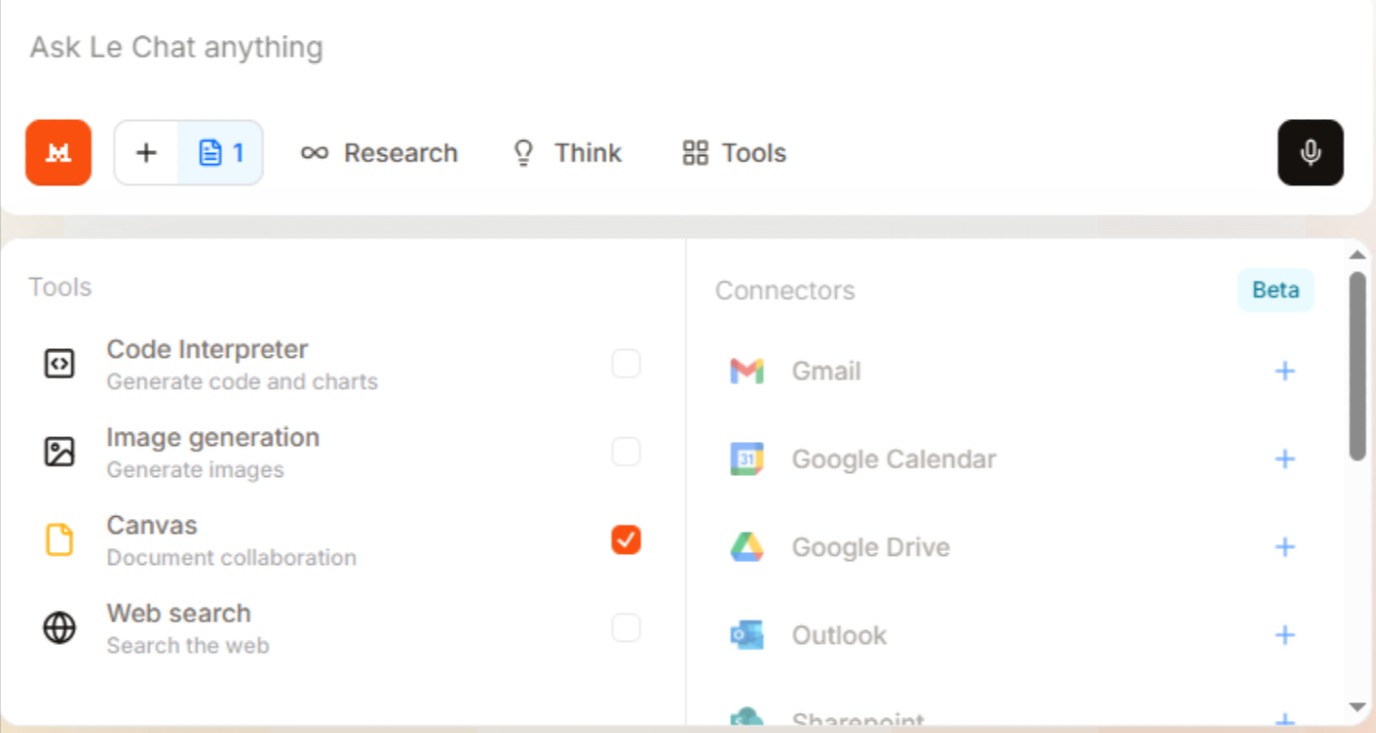
Welke gegevens zijn toegestaan?
Welke gegevens zijn toegestaan?
|
Gegevenstype
|
Voorbeelden
|
Toegestaan
|
|
Geen persoonsgegevens
|
Geanonimiseerd of persoonsgegevens zijn verwijderd.
|
Ja (incl. alle tools)
|
|
Gewone persoonsgegevens of vertrouwelijke bedrijfsinformatie
|
Namen, algemene opleidingsinformatie, cursuscodes, bestuursvergadering, reorganisatieplannen.
|
Ja, mits code interpreter, image generation, web search en Flash Answers zijn uitgeschakeld.
|
|
Bijzondere persoonsgegevens
|
Informatie over ras / etniciteit, politieke opvattingen, religie / levensovertuigingen, vakbondslidmaatschap, genetische gegevens, biometrische gegevens, gezondheidsgegevens, seksueel gedrag/geaardheid.
|
Nee
|
|
Gevoelige persoonsgegevens *
|
Studieresultaten, beoordelingen en cijfers van studenten
|
Nee
|
|
Intellectueel eigendom (IP) **
|
Informatie over uitvindingen
|
Nee
|
*Gevoelige informatie zoals cijfers, studieresultaten en beoordelingen of bijzondere persoonsgegevens zoals informatie over ras/etniciteit, politieke opvattingen, religie/levensovertuiging, vakbondslidmaatschap, genetische gegevens, biometrische gegevens (voor unieke identificatie), gezondheidsgegevens en/of seksueel gedrag/geaardheid in de notities staan.
**Gevoelige informatie over intellectueel eigendom, zoals vertrouwelijke octrooiaanvragen, ongepubliceerde innovaties en wetenschappelijke artikelen, met name tijdens de ontwikkelingsfase of voordat formele bescherming (bijv. octrooi, merkregistratie) is verkregen.
FAQ - Onderwijs
Mag ik Mistral-Vibe gebruiken om feedback te geven op opdrachten zoals essays en scripties van studenten?
Mag ik Mistral-Vibe gebruiken om feedback te geven op opdrachten zoals essays en scripties van studenten?
Ja, zolang er geen bijzondere persoonsgegevens of intellectueel eigendom in de scripties worden verwerkt en de feedback van AI geen automatische en onduidelijke rol speelt in besluitvorming/beoordeling en enkel ter ondersteuning van de docent dient. De docent blijft altijd verantwoordelijk voor beoordelingen en het gebruik van AI moet worden benoemd aan studenten.
Mag ik Mistral-Vibe gebruiken om onderwijsmateriaal te ontwikkelen?
Mag ik Mistral-Vibe gebruiken om onderwijsmateriaal te ontwikkelen?
Ja, zolang het materiaal geen intellectuele eigendom of bijzondere persoonsgegevens bevat.
Mag ik persoonlijke gegevens van studenten verwerken met behulp van Mistral-Vibe?
Mag ik persoonlijke gegevens van studenten verwerken met behulp van Mistral-Vibe?
Ja, dat mag, zolang de gegevens geen bijzondere persoonsgegevens bevatten. Zorg ervoor dat er geen gevoelige informatie zoals cijfers, studieresultaten en beoordelingen of bijzondere persoonsgegevens zoals informatie over ras/etniciteit, politieke opvattingen, religie/levensovertuiging, vakbondslidmaatschap, genetische gegevens, biometrische gegevens (voor unieke identificatie), gezondheidsgegevens en/of seksueel gedrag/geaardheid in de notities staan.
Het analyseren van studieprestaties is niet toegestaan in Mistral-Vibe, omdat deze verwerking te hoge risico’s geeft. Voor verwerking van persoonlijke gegevens van studenten en medewerkers is Mistral-Vibe geschikt, mits het gebruik van code interpreter, image generation, web search en Flash Answers is uitgeschakeld (zie voorbeeld bij Mistral - Vibe: Opletten bij gemiddeld vertrouwelijkheidsniveau).
Mag ik studieresultaten van studenten analyseren met Mistral-Vibe?
Mag ik studieresultaten van studenten analyseren met Mistral-Vibe?
Nee, het analyseren van studieresultaten van studenten is niet toegestaan omdat deze informatie (in combinatie met overige informatie over studenten) mogelijk als bijzondere persoonsgegevens moet worden beschouwd.
Moet ik mijn studenten expliciet om toestemming vragen als ik hun schriftelijk werk van feedback ga voorzien met hulp van een Mistral agent?
Moet ik mijn studenten expliciet om toestemming vragen als ik hun schriftelijk werk van feedback ga voorzien met hulp van een Mistral agent?
Scripties, tentamens en ander studentenwerk zijn vrijwel altijd persoonsgegevens, ook zonder naam of studentnummer, vanwege de herleidbaarheid via context/schrijfstijl. Verwerking kan dus alleen op basis van een wettelijke grondslag. Toestemming is hier ongeschikt; de RUG kan zich beroepen op haar onderwijs- en examineringstaak (artikel 6 lid 1 sub e AVG). Studenten moeten wel geïnformeerd worden, bijvoorbeeld via syllabus en privacyverklaring.
De AI Act bepaalt dat beslissingen die invloed hebben op studievoortgang nooit uitsluitend door AI genomen mogen worden: er moet altijd een 'human in the loop' zijn. AI mag dus ondersteunen, samenvatten en verbeteringen voorstellen, maar niet beoordelen of beslissen.
Daarnaast blijft het auteursrecht bij de student. Hun werk mag enkel binnen onderwijsdoeleinden worden gebruikt, niet voor training of externe publicatie.
Aanbevolen communicatie richting studenten
“Het door jou ingeleverde werk (scriptie, tentamen, opdracht) kan door docenten met behulp van Mistral worden geanalyseerd om feedback te genereren. Dit gebeurt binnen de verwerkersovereenkomst die de RUG met Mistral heeft afgesloten. Het auteursrecht blijft volledig bij jou. Ben je het niet eens met de feedback, dan kun je bij de docent terecht voor eventueel een tweede review.”
Biedt de pilot Mistral ook toegang voor studenten, zodat het werken met een AI assistent in het onderwijs geïntegreerd kan worden?
Biedt de pilot ook toegang voor studenten, zodat het werken met een AI assistent in het onderwijs geïntegreerd kan worden?
De AI-assistent Vibe Free is nu voor alle studenten van de RUG beschikbaar. Vibe is een AI-assistent uit Europa en onderscheidt zich van systemen als Gemini, Claude of ChatGPT door extra aandacht voor privacy en databescherming, in lijn met Europese regelgeving. Vibe was al beschikbaar voor RUG-medewerkers. Omdat het CvB het belangrijk vindt dat ook studenten in een veilige AI-omgeving kunnen werken, is besloten de pilot uit te breiden naar studenten.
Waarom Vibe Free gebruiken?
Vibe is een Europese AI-assistent van het bedrijf Mistral die onderscheidt door extra aandacht voor privacy en databescherming. De RUG heeft een contract met het bedrijf en hierin zijn goede afspraken gemaakt over de veilige verwerking van data en persoonsgegevens. Ook de pilot voor de studenten valt onder deze licentie. Je kunt Vibe bijvoorbeeld gebruiken voor het maken van samenvattingen, het verbeteren van teksten, maken van vertalingen, het helpen met toetsvoorbereiding (voorbeeldvragen) of het formuleren van studietips. Daarnaast kan het je ook ondersteunen bij literatuuronderzoek, dataverwerking, en het (her)schrijven van academische teksten.
Waar moet je op letten bij het gebruik van Vibe?
De pilot met Vibe Free voor studenten kent een aantal specifieke kenmerken:
-
Opleidingen kunnen specifieke richtlijnen opstellen voor de inzet van AI en Vibe. Hierover ontvang je via de opleiding/faculteit aanvullende informatie.
-
Docenten mogen aan studenten vragen om Mistral-Vibe Free te gebruiken in het onderwijs. Gebruik van AI door docenten voor geautomatiseerde beoordeling/becijfering is niet toegestaan.
-
Vibe Free voor studenten bevat bijna alle functionaliteiten uit de volledige versie, alleen met dagelijkse limieten. Je kunt maximaal 25 prompts per dag versturen en 5 tot 10 bestanden per sessie uploaden.
-
Vibe Free is niet geschikt voor summatieve toetsen - toetsing waarbij het cijfer formeel meetelt - die heel tijdsafhankelijk zijn (zoals een tentamen in de Aletta Jacobshal).
-
Vibe Free is wel geschikt voor formatieve toetsing - toetsing waarbij het cijfer niet mee telt - zoals oefenopdrachten. Vibe Free kan ook ingezet worden voor summatieve toetsing waarbij het cijfer meetelt en deadlines minder bepalend zijn (zoals een essay dat over meerdere weken geschreven kan worden), maar houd hierbij rekening met de dagelijkse limieten.
-
Het gebruik van andere AI-assistenten die niet zijn goedgekeurd door de RUG kan niet verplicht worden gesteld aan studenten zonder een alternatief te bieden.
-
AI-producten zijn volop in ontwikkeling, zo ook Vibe. De functionaliteiten worden dan ook regelmatig veranderd. Hierop heeft de RUG geen invloed. De pilot met Mistral loopt in principe t/m augustus 2028, maar ontwikkelingen kunnen ertoe leiden dat de samenwerking met Mistral eerder moet worden stopgezet.
Mag ik een PDF van een gepubliceerd wetenschappelijk artikel uploaden in een Library in Mistral-Vibe?
Mag ik een PDF van een gepubliceerd wetenschappelijk artikel uploaden in een Library in Mistral Vibe?
Betreft een artikel (en het journal waarin het is gepubliceerd) dat geen open access licentie heeft (zoals een CC licentie), maar waarvoor de RUG dan wel een abonnement heeft.
In principe zijn alle werken, zoals afbeeldingen, boeken en artikelen, beschermd door auteursrecht. Het is daarom standaard om vooraf toestemming te vragen voordat je content gebruikt.
De veilige opslag en het niet gebruiken van gegevens voor modeltraining door Mistral heffen de auteursrechtelijke bescherming niet op. Voor het beantwoorden van deze vraag maken we onderscheid tussen drie licentietypes:
-
Open access en Creative Commons:
Ja, mits voldaan wordt aan de voorwaarden van de specifieke licentie. Zie vraag “Mag je met auteursrechtelijk beschermd materiaal werken met Mistral waar licentievoorwaarden gelden onder de creative commons (CC) voorwaarden” voor de tabel en details.
-
Niet-open access artikelen, literatuur en andere content via RUG/UB-licentie(s):
Nee, tenzij de licentievoorwaarden van de uitgever dit expliciet toestaan. Op dit moment is dit bij geen enkele uitgever het geval.
Uitgevers zijn over het algemeen zeer beschermend ten aanzien van hun content en staan het gebruik in AI-tools meestal niet toe. Het uploaden van een artikel waarvoor de RUG een abonnement heeft, maar dat niet onder een open access-licentie valt, is alleen toegestaan als de licentievoorwaarden van de uitgever dit expliciet toestaan voor het beoogde gebruik. Indien de licentie hierover geen duidelijke toestemming geeft, is voorafgaande toestemming van de uitgever vereist. Op dit moment heeft geen enkele uitgever toestemming gegeven voor dit soort gebruik.
-
Niet-open access artikelen, literatuur en andere content via persoonlijke licentie(s):
Onbekend – Als gebruiker dien je zelf toestemming aan de uitgever of andere auteursrechthebbende te vragen.
Uitgevers zijn over het algemeen zeer beschermend ten aanzien van hun content en staan het gebruik in AI-tools vaak niet toe, tenzij expliciet vermeld in de licentie.
Praktische implicatie: Als je auteursrechtelijk beschermd materiaal wilt gebruiken in een AI-tool voor onderwijs of onderzoek, bieden de tekst- en datamining (TDM) uitzonderingen niet altijd een vrijbrief. Controleer daarom altijd de specifieke licentievoorwaarden van het materiaal en of de rechthebbende dit gebruik toestaat.
FAQ - Algemeen
Hoe kan ik een account aanmaken of inloggen?
Hoe kan ik een account aanmaken of inloggen?
Je kunt een account aanmaken bij Mistral-Vibe door:
-
Kies voor SIGN UP
-
Je logt hier in je RUG e-mailadres. Gebruik een @rug.nl of @student.rug.nl e-mailadres
-
Klik op 'Doorgaan' of 'Continue'
-
Klik vervolgens op 'Continue with University of Groningen - SSO'.
-
Gebruik vervolgens je P-nummer of S-nummer met bijbehorende wachtwoord en code in.
Het is belangrijk dat je bij het inloggen geen gebruik maakt van Google, Apple, Microsoft of prive e-mailadressen. Alleen door bovenstaande procedure te volgen, valt een account onder de juridische overeenkomst tussen de RUG en Mistral.
Mag ik transcripten verwerken met behulp van Mistral-Vibe?
Mag ik transcripten verwerken met behulp van Mistral-Vibe?"
Het verwerken van transcripten in Mistral-Vibe is toegestaan, mits aan de volgende voorwaarden wordt voldaan:
-
De transcripten bevatten geen bijzondere persoonsgegevens.
-
De tools 'code interpreter', 'image generation' en 'web search' staan uitgeschakeld.
-
De functie 'Flash Answers' is uitgeschakeld.
Transcripten die uitsluitend gewone persoonsgegevens bevatten, zoals namen, algemene opleidingsinformatie en cursuscodes, mogen worden verwerkt. Echter, indien de transcripten gevoelige informatie zoals studieresultaten of bijzondere persoonsgegevens zoals informatie over ras/etniciteit, politieke opvattingen, religie/levensovertuiging, vakbondslidmaatschap, genetische gegevens, biometrische gegevens (voor unieke identificatie), gezondheidsgegevens en/of seksueel gedrag/geaardheid bevatten, is het niet toegestaan.
Mag ik audiobestanden laten transcriberen door Mistral-Vibe?
Mag ik audiobestanden laten transcriberen door Mistral-Vibe?
Mistral-Vibe biedt een ingebouwde transcriptie functie voor “korte” audio fragmenten. Echter voor het transcriberen van audiobestanden raden we aan om gebruik te maken van Whisper op onze eigen IT-infrastructuur. Deze oplossing is geschikt voor data met de hoogste classificatie.
Mag ik notities van een vergadering met behulp van Mistral-Vibe omzetten naar notulen?
Mag ik notities van een vergadering met behulp van Mistral-Vibe omzetten naar notulen?
Ja, dat mag, zolang de notities geen bijzondere persoonsgegevens bevatten. Je mag gewone persoonsgegevens, zoals namen en algemene gesprekspunten, verwerken. Zorg ervoor dat er geen gevoelige informatie zoals cijfers, studieresultaten en beoordelingen of bijzondere persoonsgegevens zoals informatie over ras/etniciteit, politieke opvattingen, religie/levensovertuiging, vakbondslidmaatschap, genetische gegevens, biometrische gegevens (voor unieke identificatie), gezondheidsgegevens en/of seksueel gedrag/geaardheid in de notities staan.
Voor vergaderingen met organisatiesensitieve informatie is Mistral-Vibe geschikt, mits het gebruik van code interpreter, image generation, web search en Flash Answers is uitgeschakeld (zie voorbeeld bij Mistral-Vibe: Opletten bij gemiddeld vertrouwelijkheidsniveau:).
Mag ik beleidsdocumenten van de universiteit samenvatten of tekstueel of inhoudelijk verbeteren met behulp van Mistral-Vibe?
Mag ik beleidsdocumenten van de universiteit samenvatten of tekstueel of inhoudelijk verbeteren met behulp van Mistral-Vibe?”
Ja, dat mag je.
Mag ik Mistral-Vibe gebruiken om presentaties voor te bereiden?
Mag ik Mistral-Vibe gebruiken om presentaties voor te bereiden?
Ja, zolang er geen bijzondere persoonsgegevens of intellectuele eigendom in de presentaties worden verwerkt.
Mag ik Mistral-Vibe gebruiken om e-mails te schrijven namens de universiteit?
Mag ik Mistral-Vibe gebruiken om e-mails te schrijven namens de universiteit?
Ja, zolang de inhoud van de e-mails geen bijzondere persoonsgegevens of intellectuele eigendom bevat.
Mag ik Mistral-Vibe gebruiken om vergaderingen te plannen en te organiseren?
Mag ik Mistral-Vibe gebruiken om vergaderingen te plannen en te organiseren?
Ja, zolang er geen bijzondere persoonsgegevens van deelnemers worden verwerkt.
Is Mistral-Vibe beschikbaar voor de tablet of mobiele telefoon?
Is Mistral-Vibe beschikbaar voor de tablet of mobiele telefoon?
De mobiele app werkt op dit moment niet voor enterprise gebruikers (zoals de RUG), omdat de Mistral app de Single Sign On (SSO) inlog methode niet ondersteunt en dit wel nodig is om te voldoen aan de Privacy en Security richtlijnen van de RUG. Mistral is deze functionaliteit aan het ontwikkelen en verwacht deze binnenkort uit te rollen.
Biedt de pilot ook toegang tot de modellen van Mistral-Vibe via een API?
Biedt de pilot ook toegang tot de modellen van Mistral via een API?
De huidige Mistral-Vibe pilot binnen de RUG biedt nog geen directe toegang tot de Mistral-modellen via een API. Dit is een functionaliteit die afhankelijk is van verdere afstemming tussen het CIT, de faculteiten en andere betrokken diensten.
Er wordt actief aan gewerkt om deze mogelijkheid in de toekomst te realiseren, maar door de complexiteit en de vele afhankelijkheden is het op dit moment niet mogelijk om een concrete planning te geven voor wanneer, hoe en voor wie deze functionaliteit beschikbaar zal worden.
Mag ik de opname van de URaad (of faculteitsraad)vergadering (openbare vergadering) laten transcriberen met Vibe?
Mag ik de opname van de URaad (of faculteitsraad)vergadering (openbare vergadering) laten transcriberen met Vibe?
Mistral-Vibe biedt een ingebouwde transcriptie functie voor “korte” audio fragmenten. Echter voor het transcriberen van audiobestanden raden we aan om gebruik te maken van Whisper op onze eigen infrastructuur. Deze oplossing is geschikt voor data met de hoogste classificatie.
Mag ik een foto of video uploaden in Vibe?
Mag ik een foto of video uploaden in Vibe? Ik wil graag een beschrijving van een foto waar mensen op staan die duidelijk herkenbaar zijn. Ik heb deze foto zelf gemaakt en heb deze mensen geen toestemming gevraagd.
Foto’s en video’s van mensen zijn niet per definitie bijzondere persoonsgegevens onder de AVG, tenzij ze worden gebruikt om onderscheid te maken op basis van ras, gezondheid, geloof, etc. Dan is verwerking van de afbeelding niet toegestaan.
Technisch en juridisch is het uploaden van foto's en video's in Vibe mogelijk, maar ethisch en privacy-technisch is terughoudendheid geboden. Het gebruik van afbeeldingen van mensen voor commerciële en wervende doelen (bijv. marketing, recruitment en fondsenwerving) is niet mogelijk zonder hun vooraf gegeven toestemming.
Doorloop de volgende stappen door om na te gaan of je de foto of video moet willen uploaden in Vibe:
-
Wat wil je bereiken? Kan dit ook met een geanonimiseerde afbeelding of zonder herkenbare personen?
-
Weeg af of het doel de privacy-inbreuk rechtvaardigt. Hoe zouden de gefotografeerden zelf reageren als hun afbeelding zonder toestemming in een AI-systeem wordt verwerkt?
-
Vraag vooraf toestemming bij gebruik van beeldmateriaal voor marketing, recruitment, fondsenwerving en andere wervende doelen.
Al met al is het dus niet verboden om foto's of video's met mensen die duidelijk herkenbaar zijn in Vibe te uploaden, maar het wordt niet aangeraden. Ga eerst na of er minder privacy-invasieve alternatieven zijn en neem de belangen van de afgebeelde personen mee in je beslissing.
FAQ - Onderzoek
Mag ik onderzoekspapers laten controleren op plagiaat met Mistral-Vibe?
Mag ik onderzoekspapers laten controleren op plagiaat met Mistral-Vibe?"
Antwoord: Nee, het controleren op plagiaat valt buiten het toepassingsgebied van Mistral-Vibe en er zijn gespecialiseerde tools voor beschikbaar.
Zie de EDU-support voor meer informatie over Assignment with plagiarism detection.
Mag ik onderzoekspapers laten controleren op gebruik van AI met Mistral-Vibe?
Mag ik onderzoekspapers laten controleren op gebruik van AI met Mistral-Vibe?
Nee, het controleren op gebruik van AI valt buiten het toepassingsgebied van Mistral-Vibe. Vanwege o.a. het grote risico op false positives en false negatives gelden scores van AI-detectietools niet als bewijs voor fraude van studenten, volgens het RUG AI-beleid voor onderwijs.
Zie EDU-support voor meer informatie over “Dealing with fraud and risks”
Mag ik een PDF van een gepubliceerd wetenschappelijk artikel uploaden in een Library in Mistral-Vibe?
Mag ik een PDF van een gepubliceerd wetenschappelijk artikel uploaden in een Library in Mistral Vibe?
Betreft een artikel (en het journal waarin het is gepubliceerd) dat geen open access licentie heeft (zoals een CC licentie), maar waarvoor de RUG dan wel een abonnement heeft.
In principe zijn alle werken, zoals afbeeldingen, boeken en artikelen, beschermd door auteursrecht. Het is daarom standaard om vooraf toestemming te vragen voordat je content gebruikt.
De veilige opslag en het niet gebruiken van gegevens voor modeltraining door Mistral heffen de auteursrechtelijke bescherming niet op. Voor het beantwoorden van deze vraag maken we onderscheid tussen drie licentietypes:
-
Open access en Creative Commons:
Ja, mits voldaan wordt aan de voorwaarden van de specifieke licentie. Zie vraag “Mag je met auteursrechtelijk beschermd materiaal werken met Mistral waar licentievoorwaarden gelden onder de creative commons (CC) voorwaarden” voor de tabel en details.
-
Niet-open access artikelen, literatuur en andere content via RUG/UB-licentie(s):
Nee, tenzij de licentievoorwaarden van de uitgever dit expliciet toestaan. Op dit moment is dit bij geen enkele uitgever het geval.
Uitgevers zijn over het algemeen zeer beschermend ten aanzien van hun content en staan het gebruik in AI-tools meestal niet toe. Het uploaden van een artikel waarvoor de RUG een abonnement heeft, maar dat niet onder een open access-licentie valt, is alleen toegestaan als de licentievoorwaarden van de uitgever dit expliciet toestaan voor het beoogde gebruik. Indien de licentie hierover geen duidelijke toestemming geeft, is voorafgaande toestemming van de uitgever vereist. Op dit moment heeft geen enkele uitgever toestemming gegeven voor dit soort gebruik.
-
Niet-open access artikelen, literatuur en andere content via persoonlijke licentie(s):
Onbekend – Als gebruiker dien je zelf toestemming aan de uitgever of andere auteursrechthebbende te vragen.
Uitgevers zijn over het algemeen zeer beschermend ten aanzien van hun content en staan het gebruik in AI-tools vaak niet toe, tenzij expliciet vermeld in de licentie.
Praktische implicatie: Als je auteursrechtelijk beschermd materiaal wilt gebruiken in een AI-tool voor onderwijs of onderzoek, bieden de tekst- en datamining (TDM) uitzonderingen niet altijd een vrijbrief. Controleer daarom altijd de specifieke licentievoorwaarden van het materiaal en of de rechthebbende dit gebruik toestaat.
Mag je met auteursrechtelijk beschermd materiaal werken met Mistral Vibe waar licentievoorwaarden gelden onder de creative commons (CC) voorwaarden?
Mag je met auteursrechtelijk beschermd materiaal werken met Mistral waar licentievoorwaarden gelden onder de creative commons (CC) voorwaarden?
Artikelen uit het Publieke Domein (soms aangegeven met CC0) of met een Creative Commons-licentie (bijvoorbeeld CC-BY) mogen worden geüpload, mits voldaan wordt aan de specifieke voorwaarden van de licentie. Raadpleeg de onderstaande tabel voor de exacte voorwaarden waaraan moet worden voldaan.
Belangrijke opmerkingen:
-
Verwijderingsplicht: Artikelen en gegenereerde chats moeten na gebruik worden verwijderd om onnodige verspreiding te voorkomen.
-
Eigen verantwoordelijkheid: De gebruiker is zelf verantwoordelijk voor het naleven van de licentievoorwaarden.
-
Onzekerheid over AI: De huidige Creative Commons-licenties zijn nog niet specifiek afgestemd op AI-toepassingen. Het is mogelijk dat hierin in de toekomst aanpassingen komen.
Toelichting:
|
Licentietype |
Beschrijving |
Toegestaan in Mistral Vibe? |
|
CC-BY |
Naamsvermelding vereist, verder vrij te gebruiken, ook commercieel. |
Ja, mits je de bron vermeldt. |
|
CC-BY-SA |
Naamsvermelding vereist + afgeleide werken moeten onder dezelfde licentie worden verspreid. |
Ja, mits je de bron vermeldt en de output onder dezelfde licentie deelt. |
|
CC-BY-NC |
Naamsvermelding vereist, alleen voor niet-commercieel gebruik. |
Ja, maar alleen voor niet-commercieel gebruik (bijvoorbeeld reguliere bachelor- en master colleges, onderzoek zonder commerciële belangen). Het materiaal mag niet worden gebruikt voor activiteiten die direct of indirect winst genereren (bijvoorbeeld, post-academisch onderwijs, onderwijs aan business schools, betaalde cursussen, commerciële trainingen of onderzoek met commerciële partners). |
|
CC-BY-ND |
Naamsvermelding vereist, delen van bewerkingen niet toegestaan. |
Je mag het materiaal voor eigen gebruik bewerken (bijv. samenvatten, vertalen, analyseren), maar je mag de bewerking niet delen of gebruiken in onderzoek of onderwijs. |
|
CC0 (Public Domain) |
Geen auteursrechtelijke beperkingen. |
Ja, vrij te gebruiken. |
|
All Rights Reserved |
Traditioneel auteursrecht, geen expliciete toestemming voor hergebruik. |
Nee, tenzij de rechthebbende expliciet toestemming heeft gegeven. Zie antwoord op vraag “Mag ik een PDF van een gepubliceerd wetenschappelijk artikel uploaden in een Library in Mistral-Vibe?” |
Mag ik een databestand (CSV of Excel) uploaden en Mistral-Vibe vragen om een analyse uit te voeren?
Mag ik een databestand (CSV of Excel) uploaden en Vibe vragen om een analyse (text analysis, sentiment analysis, categoriseren etc) uit te voeren?
Het bestand bevat duizenden regels aan antwoorden op een online enquête met bijvoorbeeld open antwoorden van respondenten en in de data staan ook e-mailadressen van de respondenten.
Het verwerken van persoonsgegevens in Vibe is alleen toegestaan indien dit aansluit bij het oorspronkelijke doel waarop de data is verzameld (doelbinding, Art. 5(1)(b) AVG). Hierin wordt verondersteld dat de data initieel rechtmatig is verzameld, met inachtneming van de AVG-verplichtingen zoals doelbinding, informatieplicht en andere relevante bepalingen.
Vereisten voor gebruik in Vibe:
-
Doelbinding: Het doel van het gebruik van de data in Vibe mag niet afwijken van het doel waarvoor de data initieel zijn verzameld. Indien er sprake is van een afwijkend doel, is een nieuwe beoordeling vereist, inclusief het vaststellen van een rechtsgrond en, indien van toepassing, een Data Protection Impact Assessment (DPIA). Voor advies hierover kun je contact opnemen met de Privacy & Security (P&S) coördinator van de dienst of faculteit. Het is niet uitgesloten dat het gebruik voor een ander doel mogelijk is, maar dit vereist een zorgvuldige afweging.
-
Dataminimalisatie: Gebruik uitsluitend de noodzakelijke data voor het beoogde doel. Bij het invoeren van datasets met e-mailadressen, namen of andere direct herleidbare persoonsgegevens dient de data, indien mogelijk, geanonimiseerd of gepseudonimiseerd te worden verwerkt.
-
Gebruiksbeperking: De resultaten van de analyse mogen uitsluitend worden gebruikt voor het oorspronkelijke doel waarvoor de data is verzameld.
Voor algemene richtlijnen en toelichting op het gebruik van datasets wordt verwezen naar de privacy pagina van de RUG. Let op: niet alle casussen kunnen hier worden behandeld of toegelicht, bij complexe situaties of twijfelgevallen neem dan contact op met de P&S Coördinator.