

Market Time, Forest Time: Language, Deforestation, and Shifting Multispecies Assemblages in the Peruvian Amazon
What does it mean to experience environmental change in everyday life? In this blog, Nick Amlen, Assistant Professor of Language and Culture at Campus Fryslân, explores the connections between coffee farming, social relationships, cultural practices, and languages of Indigenous Matsigenka people in the Peruvian Amazon.
The Lower Yavero Valley
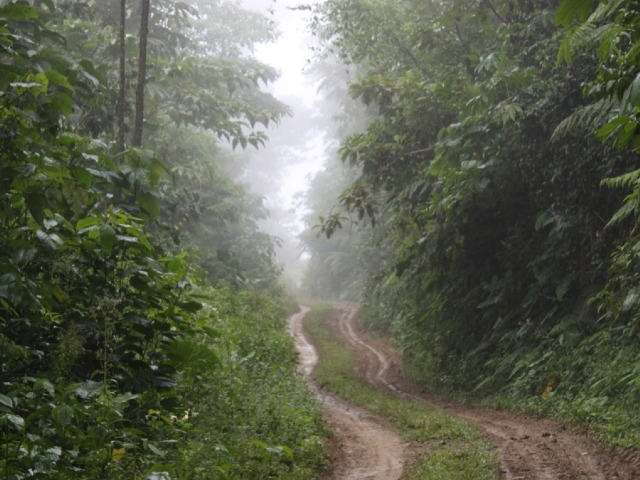
A few decades ago, the lower Yavero Valley of the Southern Peruvian Amazon was densely forested and inhabited mostly by Indigenous Matsigenka people. These people lived mostly from hunting, fishing, foraging, and gardening. But since then, roads have been built through the most remote corners of the region (as shown in the photograph). These roads have made it possible for tens of thousands of farmers from the rural Andean highlands to migrate here in search of land for the cultivation of coffee and other tropical cash crops. Today, the landscape is a patchwork of old growth forest, agricultural plantations, and pastureland.
For nearly 20 years, I have been working collaboratively with both Matsigenka people and agricultural migrants in this region to understand how the rapid expansion of the coffee industry into the rainforest has affected people’s day-to-day social, cultural, and linguistic lives. In particular, I want to know: what is it like to live in an environment undergoing profound ecological change? How can a close-up anthropological perspective on people’s lives inform how we understand the destruction of the world’s largest remaining forest?
Living as a Coffee Farmer
One insight of this project is that learning to be a coffee farmer is, at its core, a matter of learning to relate with other species in novel ways. Many Matsigenka families in this region have long relied on deep and nuanced knowledge about the forest to sustain themselves: the only way to survive was to know what animals, insects, and fruits were likely to become available in which micro-ecological niches and during which weeks of the year. However, as deforestation has fragmented the ecosystem, and as people have turned to commercial farming, multi-species engagements have taken a very different form. Succeeding as a coffee farmer requires removing weeds, using chemicals to prevent fungus, planting shade crops like banana and avocado, and fertilizing the soil so that coffee plants can thrive. In this sense, the experience of transitioning to commercial agriculture has consisted largely of reorienting one’s attention to the landscape and its living beings.
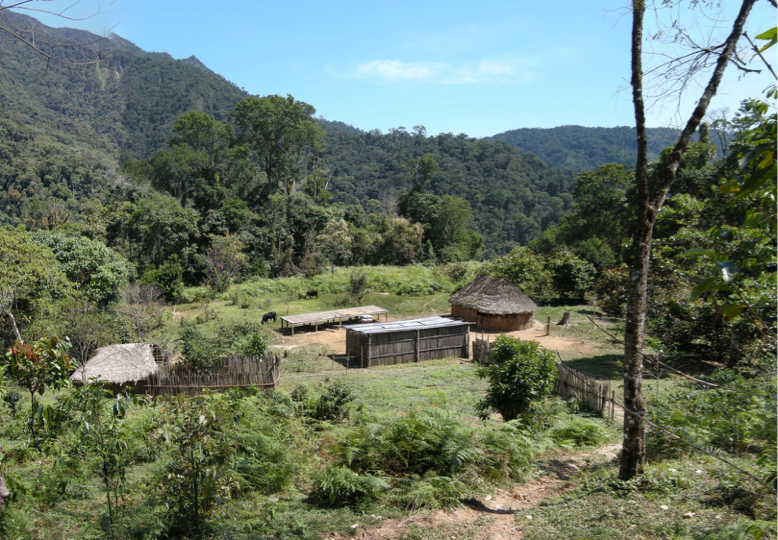
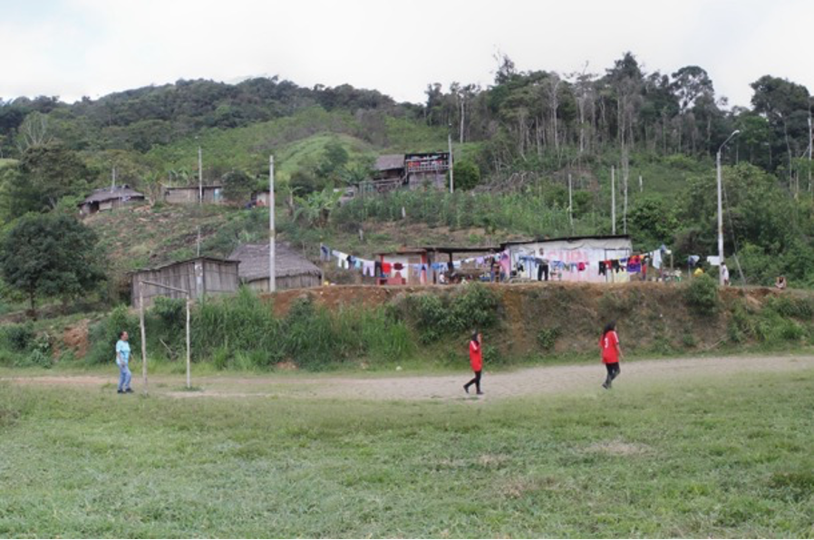
The shift to commercial farming is not only a matter of transforming one’s inter-species relationships, however: it also corresponds to a reconfiguration of human social and institutional life. In Matsigenka society, hunting, gathering, and small-scale gardening have generally been conducted among families and households. However, becoming a coffee farmer means forming relationships with the coffee merchants who drive through the Amazonian frontier to buy their product; with state agronomists who offer technical consultation about soil chemistry and harvesting techniques; and with neighboring farmers, with whom they must coordinate labor during busy times of the year. The new economic order thus involves types of cooperation and negotiation that hunting, gathering, and gardening do not. For this reason, Matsigenka people in some communities have left behind their widely dispersed forest homes to live in nucleated villages where they can coordinate with their neighbors more easily (some forest homes and village homes are shown in the photographs below). In this sense, the transformation in inter-species relationships has come along with an equally profound reorientation in the ways that humans live and interact with each other.
Language in Daily Life
As a linguistic anthropologist, one of the things that interests me the most about this social and institutional transformation is that it is also necessarily a transformation in linguistic and communicative practices. As previous generations of Matsigenka people tended to limit their interactions to their families and to the Matsigenka language, the coffee economy brings today’s community members into all manner of new interactions. One must speak the language of soil chemistry with the state agronomists, in Spanish; one must drive a hard bargain in Spanish or Quechua (a neighboring Indigenous language) with traveling coffee merchants; and one must use Spanish public oratory to rally cooperative labor and defend one’s land claims against encroaching neighbors. Joining the coffee economy is thus a wholesale transformation in day-to-day experience: it is one of changing inter-species engagements, new social and institutional commitments, and the adoption of linguistic practices about herbicide application, fertilizer prices, and legal disputes. While academic disciplines such as ecology, economics, and linguistics tend to view these issues separately, in the messy world of day-to-day interaction they are inseparable.
Market Time and Forest Time
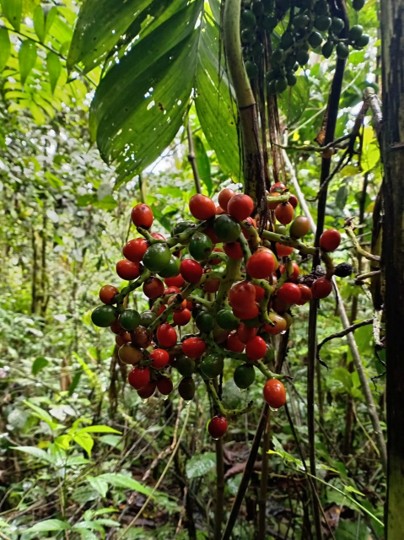
One thing that my Matsigenka research collaborators and I explore in this project is that the transformation described above is not evenly experienced throughout the year. The Amazon rainforest is defined by a (relatively) dry season, in which most of the activities of commercial agriculture take place, and a rainy season, in which Matsigenka people leave behind their fields and return to hunting, gathering, and gardening. We call these periods “market time” and “forest time” (respectively). In some communities, people spend market time in their homes in the community center, speaking Spanish, using money, and interacting with people in the community and beyond. During forest time, people hike for several hours to their forest homes, where they speak Matsigenka, interact mostly with their families, and eat from the landscape (see, for example, the delicious porenki fruits in the photograph below, which ripen during forest time).
In this corner of the Amazon rainforest, this is what it feels like to live in the midst of a dramatic ecological transformation. It means interacting with different kinds of species, engaging in different kinds of social commitments, and speaking different languages in different communicative contexts. It also means moving back and forth between different ways of living throughout the course of the year.
The commercial agricultural economy and its daily practices move a bit further into the Amazon every year. Market time is displacing forest time, and it is likely that many aspects of forest time will be lost in the coming years and decades. This is a matter of conflicted sentiment among many Matsigenka people who value their cultural traditions while also seeking a comfortable life in the global economy. It is not clear what will happen next: will the ancestral linguistic and ecological knowledge associated with forest time simply be lost, or will it be preserved in some other form? How will Matsigenka people understand, respond to, or resist that loss?
Why Interdisciplinarity Matters
There are many ways to understand this transformation: as an ecological crisis, as a challenge of rural economic development, as a topic of international policy and law, and as a day-to-day experience among people at the capitalist periphery. It is, of course, all of those things. One of the remarkable opportunities of working at Campus Fryslân is that, unlike in a more disciplinary institutional setting, experts from each of those fields are present in our community. Thus, we are able to invite our students to engage with such problems from many angles, and to see globally urgent problems in their full complexity.
About the author
Nick Emlen is an Assistant Professor in Language & Culture at Campus Fryslân. His expertise lies in Indigenous languages, migration, coffee, cocaine, specifically applied to the South American context.