
Watch the solar eclipse on 12 August at one of the UG’s observation sites
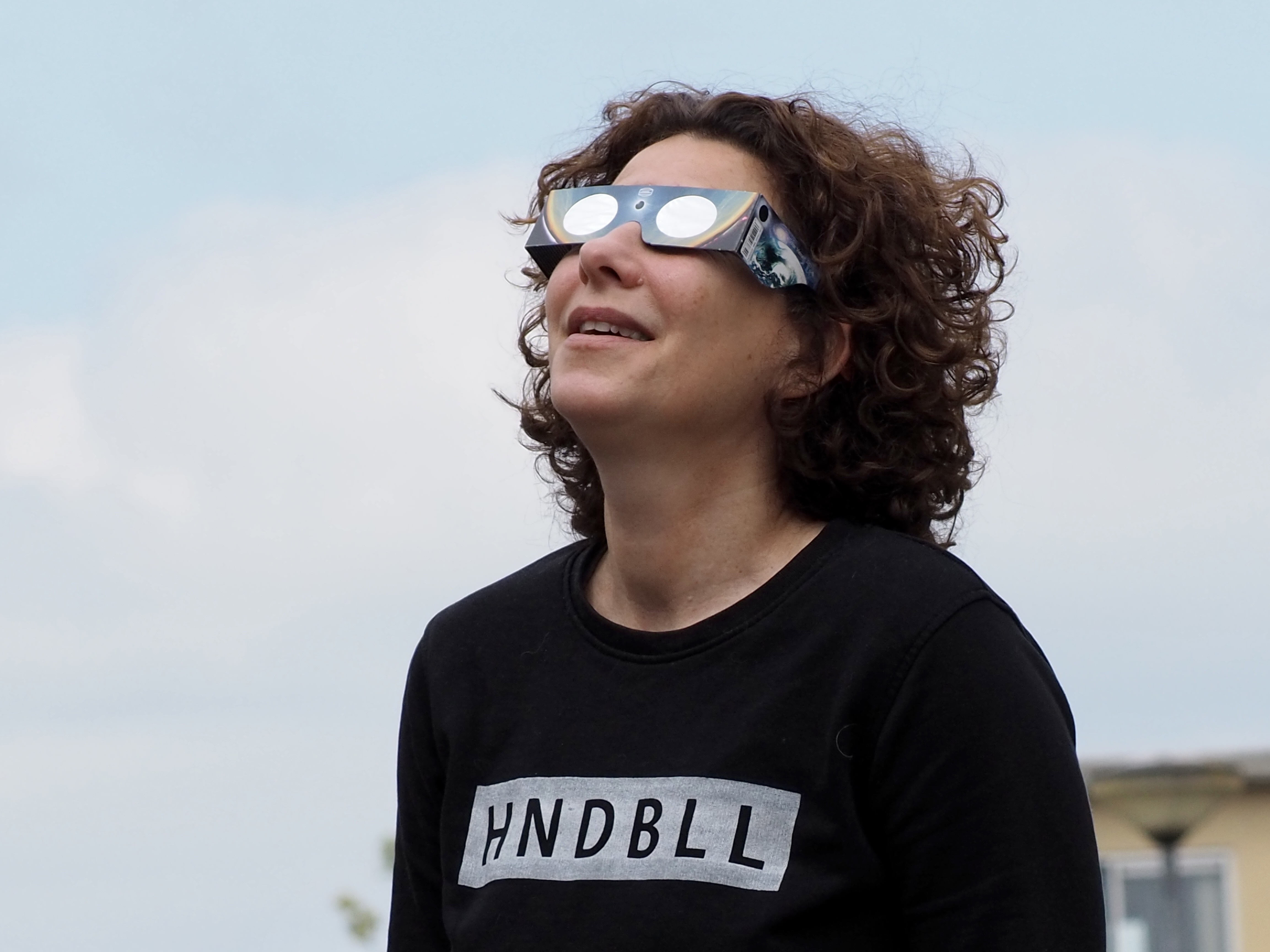
Europe is gearing up for a magnificent natural phenomenon: on 12 August, there will be a total solar eclipse in northern Spain. Here in the Netherlands, it will be a partial eclipse. No less than 90 per cent of the Sun will be obscured. The University of Groningen (UG) has set up observation points at various locations in the north, equipped with instruments and special eclipse glasses so that people can view the solar eclipse safely.
For experts, this solar eclipse is comparable to that of 11 August 1999. The next eclipse of this magnitude in the Netherlands is a long way off: 3 September 2081. In short, make the most of this opportunity!
View of the horizon
The eclipse begins at 7.17 p.m. The maximum phase of the eclipse is at 8.11 p.m. At that moment, the sun will be low above the horizon. To see this magnificent phenomenon, a clear view of the horizon is essential. This is the case at the observation points. The eclipse will end around sunset, and then we’ll have to wait 55 years for an eclipse of similar magnitude.
Observation points
On Vlieland, the Badhuys beach pavilion is the viewing spot; on Terschelling, the event will take place at the library in Midsland. On Ameland, restaurant Sjoerd on the beach near Nes is the hotspot. And on the mainland, the viewing spots are the harbour at Lauwersoog, the Zielhoes in Noordpolderzijl, the AG Ems terminal and the roof of Forum Groningen. All locations will be staffed from 6.00 p.m. Everyone is very welcome to drop by.
Experiment: the impact of a solar eclipse on nature
The eclipse is also being observed from a different perspective. It is a well-known phenomenon that nature falls silent during an eclipse. Forty members of the public in the northern Netherlands have received a device from the UG that automatically counts birds based on sound. In this way, UG researchers hope to gain insight into the ‘silence’ of nature.
More news
-
-
03 September 2026
Ming Cao reappointed as scientific director of the Jantina Tammes School
-
01 September 2026
Evrim Ursavas appointed scientific director Wubbo Ockels School